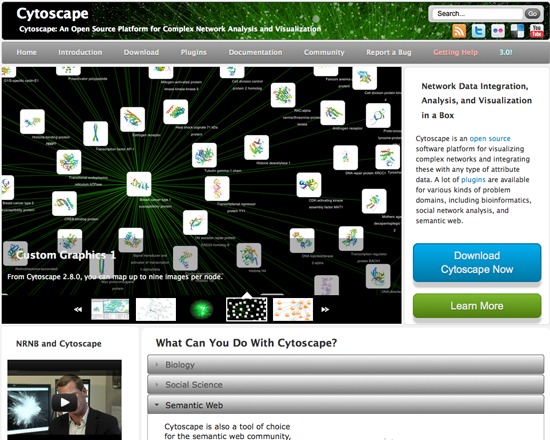
Cytoscape
- Last Updated: 10/5/2018 12:00:00 AM
- Site: http://cytoscape.org/
Cytoscape is an open source software platform for visualizing data networks and pathways. Though designed for bioinformatic systems, it has been generalized to complex network analysis and has applications extending to the semantic web. Its core distribution has basic features for data integration and visualization, with additional features available via Java-based plugins.
Documentation
Creator(s): Cytoscape Consortium
Creator's Site: http://www.cytoscape.org/
Creator's Email:
Repository:
Attributes
- Type of analysis: Visualization Analysis
- Type of license: Free Open Source
- Web Usable: Software you Download and Install
- Ease of Use: Moderate
- TaDiRAH Goals: Analysis
- TaDiRAH Methods: Other (analysis) Visualization
List this tool appear on
Tools for Network Analysis
This list collects commonly used network analysis tool by digital humanities scholars.
Rating
Suggested Tools
Comments
Cytoscape is a platform for network visualization and analysis. The latest version, Cytoscape 3.0.1, is the result of a long-running collaborative project involving numerous developers and funding agencies across the globe. The team of core developers resides mainly at the University of California and is funded by the US National Institute of General Medical Sciences and the National Resource for Network Biology.
The program was first designed for bioinformatic systems, and many of the people involved in the project have background in biology. The key goals of the program are visualization of molecular interaction networks and biological pathways as well as integration of these networks with annotations, gene expression profiles and other state data. Cytoscape has been used to analyze data from a variety of fields beyond biomedical research, such as network analysis, the semantic web or the social sciences.Cytoscape is a Java application and runs on the Linux, Windows, and Mac OS X platforms. UNIX platforms such as Solaris and FreeBSD can run Cytoscape with Java version 5 or later. The program is available under the GNU Lesser General Public License.
Cytoscape has numerous features, distributed for free through the Cytoscape App Store. Its latest version includes a flexible toolbar for quick access to common actions, new Data Table controls to interface with the data, integrated support for graphical annotations in networks, support for independent sets of networks within a single session, advanced network and table import controls, improved architecture and an API for a more stable experience. Cytoscape can be downloaded as an automatic installation package for Windows, Mac OS X, and Linux, or as a compressed archive. The source code is also available for download. It’s important to notice that Cytoscape requires registration to download the program or the code.
Cytoscape's strengths include its ability to support several languages for the data files including Eastern Asian languages using two-byte characters, English and many others. It also has a function that allows users to encode any attribute of their data (such as name, type, degree, weight or expression data) as a visual property (such as color, size, transparency, or font type). These encoded attributes together form a Visual Style that can be used to customize the visual appearance of the network. As a program with many rich functions it looks challenging, but thanks to a very clear and detailed online manual it ran quite smoothly afterwards. The manual on Cytoscape’s website is really helpful in case you are either a newbie or guru in the network visualization. The manual gives detailed description of all the functions and capabilities of the program. It answered almost all the questions I had in the process of installation and running the program.
To summarize the review of Cytoscape I’d like to mention some more features that make the program really valuable for in depth visualization analysis. First of all it’s flexibility of working with visualization. Visualizations are dynamic allowing users to interact with them. Additionally it’s the ability to support import/export standard file formats. Also you can export networks as publishiable-quality images in PDF, PS, SVG, PNG, JPEG, and BMP files.
Cytoscape also appears in Project Bamboo's DiRT, a registry of digital tools suitable for academic research. DiRT contains a wide range of tools and software searchable by task, such as annotation, content management, collaborative research, or authoring. It is an excellent resource for Digital Humanists seeking the right tool for the task at hand.
View Cytoscape in DiRT:
http://dirt.projectbamboo.org/resources/cytoscape
View the full site:
http://dirt.projectbamboo.org/
Cytoscape is mentioned in these research abstracts https://dh2017.adho.org/abstracts/282/282.pdf, https://dh2018.adho.org/en/intellectual-history-and-computing-modeling-and-simulating-the-world-of-the-korean-yangban/