Mallet
- Last Updated: 11/6/2013 12:00:00 AM
- Site: http://mallet.cs.umass.edu/
Mallet is a Java based library and command line framework that provides statistical and machine learning tools for use with natural language processing.
Documentation
Creator(s): Andrew McCallum
Creator's Site: http://people.cs.umass.edu/~mccallum/
Creator's Email: mccallum@cs.umass.edu
Repository:
Attributes
- Type of analysis: Natural Language Processing Analysis Content Analysis
- Type of license: Open Source
- Background Processing: Doesn't Run in Background
- Web Usable: Software you Download and Install
- Ease of Use: Very Difficult
- Warning: Complex and Difficult
- Historic Tool (developed before 2005): Development sustained to present
- TaDiRAH Goals: Analysis
- TaDiRAH Methods: Content Analysis Other (analysis) Statistical Analysis
List this tool appear on
Rating
Suggested Tools
Comments
Overview and Setup
Mallet is a free open source command line tool and Java library that specializes in machine learning algorithms and their applications to text. Mallet is in essence two programs. It comes with a command line executable that has access to its most frequently used features, and also a Java library that can be built into any other Java program. The package is distributed in tar.gz form and needs to be built from source code. Anyone already familiar with building Java programs should have no trouble getting Mallet up and running. However, anyone new to Java programming should familiarize themselves with the Java Compiler, Apache Ant, and the command line before proceeding. General installation instructions can be found on the Mallet webpage.
Features
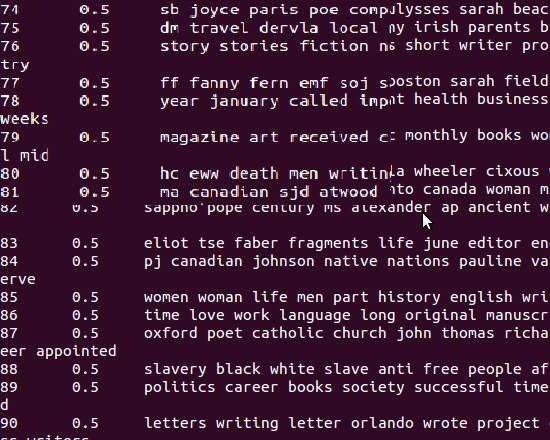
Mallet is designed to read plain text files only, but has the capability to import from either a folder of text documents or a single document with new lines delimiting each entry. Each document can be assigned a name as well as a class. Once imported, Mallet uses machine learning algorithms to build models based on the imported data. Two of the biggest features of Mallet are Topic Modeling and Classification. The classifier guesses the class of new textual documents based on a corpus of already classified documents that it has trained on. The topic modeler infers topics in a corpus, and the prevalence of each topic within each individual document. Mallet outputs in the form of raw data. It may be necessary to involve a separate statistical program or conversion software to get the data into a form that is easy to analyze. All mentioned features are available through the command line.
Conclusion
Mallet is both a powerful tool and a powerful tool framework. Apart from the features mentioned above Mallet also contains a large collection of smaller tools available through the Java API which cannot all be documented here. Mallet is useful at both a moderate and advanced level. Newer users only wishing to access the major features of Mallet can do so through the command line, while advanced users familiar with Java programming can incorporate any portion of Mallet into a much larger program. Mallet's lack of a GUI can be daunting for the less experienced user; however, the learning experience is more than worth the rewards. For those interested in this tool, a very good introductory tutorial can be found here ‘http://programminghistorian.org/lessons/topic-modeling-and-mallet’.
Overview and Setup
Mallet is a free open source command line tool and Java library that specializes in machine learning algorithms and their applications to text. Mallet is in essence two programs. It comes with a command line executable that has access to its most frequently used features, and also a Java library that can be built into any other Java program. The package is distributed in tar.gz form and needs to be built from source code. Anyone already familiar with building Java programs should have no trouble getting Mallet up and running. However, anyone new to Java programming should familiarize themselves with the Java Compiler, Apache Ant, and the command line before proceeding. General installation instructions can be found on the Mallet webpage.
Features
Mallet is designed to read plain text files only, but has the capability to import from either a folder of text documents or a single document with new lines delimiting each entry. Each document can be assigned a name as well as a class. Once imported, Mallet uses machine learning algorithms to build models based on the imported data. Two of the biggest features of Mallet are Topic Modeling and Classification. The classifier guesses the class of new textual documents based on a corpus of already classified documents that it has trained on. The topic modeler infers topics in a corpus, and the prevalence of each topic within each individual document. Mallet outputs in the form of raw data. It may be necessary to involve a separate statistical program or conversion software to get the data into a form that is easy to analyze. All mentioned features are available through the command line.
Conclusion
Mallet is both a powerful tool and a powerful tool framework. Apart from the features mentioned above Mallet also contains a large collection of smaller tools available through the Java API which cannot all be documented here. Mallet is useful at both a moderate and advanced level. Newer users only wishing to access the major features of Mallet can do so through the command line, while advanced users familiar with Java programming can incorporate any portion of Mallet into a much larger program. Mallet's lack of a GUI can be daunting for the less experienced user; however, the learning experience is more than worth the rewards. For those interested in this tool, a very good introductory tutorial can be found here ‘http://programminghistorian.org/lessons/topic-modeling-and-mallet’.
Mallet also appears in Project Bamboo's DiRT, a registry of digital tools suitable for academic research. DiRT contains a wide range of tools and software searchable by task, such as annotation, content management, collaborative research, or authoring. It is an excellent resource for Digital Humanists seeking the right tool for the task at hand.
View Mallet in DiRT:
http://dirt.projectbamboo.org/resources/mallet
View the full site:
http://dirt.projectbamboo.org/
Mallet was used in these research abstracts https://dh2018.adho.org/en/interrogating-the-roots-of-american-settler-colonialism-experiments-in-network-analysis-and-text-mining/
https://dh2018.adho.org/en/a-graphical-user-interface-for-lda-topic-modeling/