GINGER II
GINGER II is a word-sense disambiguator for English, offering a new approach to the algorithm developed for GINGER I. It directly extracts semantic disambiguation rules from dictionary example phrases, and semantically tags, syntactically parses and disambiguates those examples. This legacy tool has no affiliated web site and is no longer available.
Documentation
Attributes
- Type of analysis: Natural Language Processing Analysis Content Analysis
- Type of license: Free
- Web Usable: Other
- Ease of Use: Moderate
- Historic Tool (developed before 2005): No longer in active development
- TaDiRAH Goals: Analysis
- TaDiRAH Methods: Content Analysis Other (analysis) Statistical Analysis
List this tool appear on
Rating
Suggested Tools
Comments
More information about GINGER II and its development and functionality may be found here:
Dini, Luca, Vittorio di Tomaso and Frederique Segond. \"GINGER II: An Example-Driven Word Sense Disambiguator.\" Computers and the Humanities 34.1-2 (2000): 121-126. Web.
Program Overview
GINGER II was a word sense disambiguation tool for English language texts developed by Luca Dini, Vittorio di Tomaso and Frédérique Segond, and released in 2000 as the successor to their GINGER I, released in 1998 (Dini, di Tomaso and Segond 121).
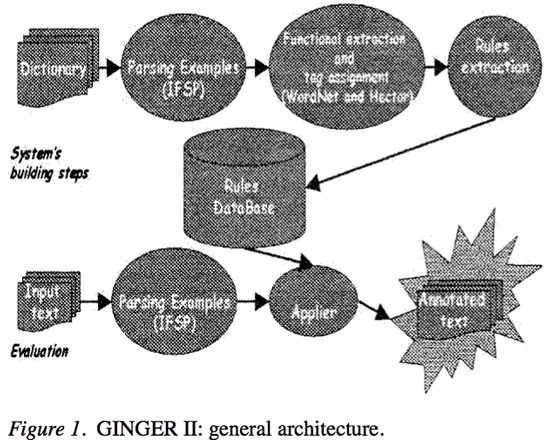
GINGER II drew from machine-readable dictionaries to generate a semantically-tagged corpus (121). It used the HECTOR Oxford Dictionary of English, the Xerox Incremental Finite State Parser for English and WordNet 1.5 (English) to learn semantic disambiguation tools (Dini, di Tomaso and Segond 122). It used the syntactic relations between subject and verb, verb-object and modifier and subject-object, and associated each word of a functional pair with the appropriate semantic information (122). GINGER II then built a database of semantic disambiguation rules from the relations between words in the corpus' sentences (Dini, di Tomaso and Segond 121).
Unlike its predecessor GINGER I, GINGER II utilized a nonstatistical approach that \"directly extracts semantic disambiguation rules from dictionary example phreases using all funcitonal relations found there,\" which does not require statistical validation (121). It also improved on GINGER I:
− it relies on dictionary sense numbering to semantically tag dictionary examples
− it uses syntactic parsing of dictionary examples to extract semantic disambiguation rules
− it uses two sets of semantic information to produce semantic disambiguation rules: the dictionary numbering provided from HECTOR and the 45 top level categories of WordNet. (121)
Though GINGER II was designed for English texts, its designers concluded that its methodology is applicable to any language where web-based dictionaries are extant but large pre-tagged corpora are not (Dini, di Tomaso and Segond 125).
Source
Dini, Luca, Vittorio di Tomaso and Frederique Segond. \"GINGER II: An Example-Driven Word Sense Disambiguator.\" Computers and the Humanities 34.1-2 (2000): 121-126. Web.