Collate: Interactive Collation of Large Textual Traditions
- Last Updated: 11/23/2018 12:00:00 AM
- Site: http://www.hd.uib.no/humdata/2-91/robin.htm
Collate was a program designed for scholars concerned with the difficulties of medieval vernacular traditions. It aimed to help scholars with the preparation of critical editions, and could collate up to a hundred texts. Collate was also capable of handling marked up text. It was available for Macintosh only, and could be purchased directly from its creator.
Documentation
Creator(s): Peter M.W. Robinson
Creator's Site: http://www.petermwrobinson.me.uk/
Creator's Email:
Repository:
Attributes
- Type of analysis: Capture Gathering
- Type of license: Commercial
- Background Processing: Doesn't Run in Background
- Web Usable: Other
- Ease of Use: Easy
- Historic Tool (developed before 2005): No longer in active development
- TaDiRAH Goals: Capture
- TaDiRAH Methods: Gathering
List this tool appear on
Rating
Suggested Tools
Comments
Collate: Interactive Collation of Large Textual Traditions is a historically important tool. Additional information may be found in the following:
Johnson, Eric. \"Technical Review: Collate: Interactive Collation of Large Textual Traditions.\" Computers and the Humanities 27.5-6 (1993): 401-420. Web.
\"Version 1.0 of Collate: A New Program for the Collation of Large Textual Traditions.\" Vicky A. Walsh, ed. ACH Newsletter 13.2 (1991): 6. Print.
Program Overview
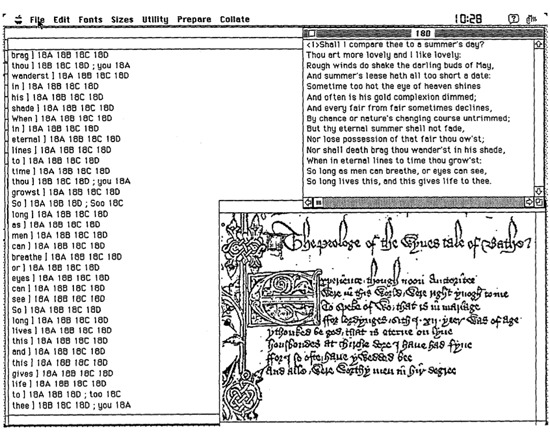
Collate was a program released in the early 1990s for identifying similarities and differences between files on Macintosh computers (Johnson 401).
Eric Johnson reviewed it for Computers and the Humanities in 1994, and tested it using variations of Shakespeare's eighteenth sonnet (401). Collate accepted and could process up to 100 text files, and each had to be edited to add the block markers, tags and codes needed to tell the program how to treat key parts of the file (401).
Collate was originally developed for use on medieval texts, and consequently offered numerous tools for examining complex texts such as a regularizer for variant spellings (401). It also included fuzzy matching to assist researchers in determining what qualifies as a variant, could handle notation for marginal glosses and descriptions of ornamental capitals, and an output option for inserting formatting codes readable by TeX processors (Johnson 402).
Johnson had a few criticisms of Collate. He found that the need to prepare text files with notations and tags increases the learning curve and margin for user errors (Johnson 402). In addition, Collate was not particularly fast at processing texts - Johnson estimated that it would take a full two days to collate the complete works of Shakespeare (Johnson 403).
However, Johnson found Collate to overall be \"a robust and adaptable program for collating all kinds of texts...[i]ts output is exhaustive, and it can be formatted in sophisticate ways ready for publication\" (403).
Source
Johnson, Eric. \"Technical Review: Collate: Interactive Collation of Large Textual Traditions.\" Computers and the Humanities 27.5-6 (1993): 401-420. Web.