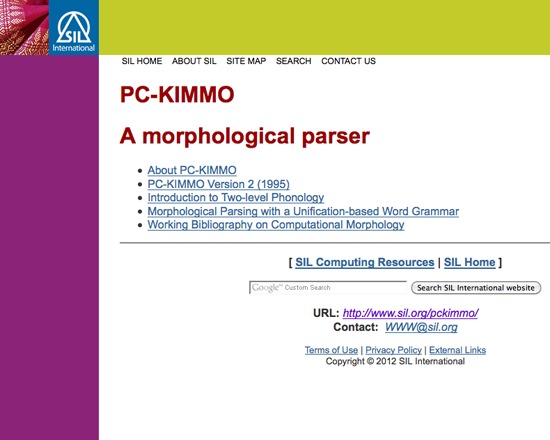
PC-KIMMO
- Last Updated: 11/20/2014 12:00:00 AM
- Site: http://www-01.sil.org/pckimmo/
PC-KIMMO is a tool for morphological parsing available since 1985. It is designed to generate and/or parse words, for use by computational linguists, descriptive linguists and others interested in natural language processing. Though this tool is no longer being actively developed, it is still available for download, as is its documentation.
Documentation
Attributes
- Type of analysis: Natural Language Processing Analysis Content Analysis
- Type of license: Free
- Web Usable: Software you Download and Install
- Ease of Use: Moderate
- Historic Tool (developed before 2005): Development sustained to present
- TaDiRAH Goals: Analysis
- TaDiRAH Methods: Content Analysis
List this tool appear on
Rating
Suggested Tools
Comments
PC-Kimmo is a microprocessor implementation of the original KIMMO morphological parser. More information on its development and functionality may be found in the following:
Antworth, Evan L. \"Glossing Text with the PC-KIMMO Morphological Parser.\" Computers and the Humanities 26.5-6 (1992): 389-398. Web.
Hinkelman, Elizabeth and Mark Olsen. \"Technical Reviews: PC-Kimmo: A Computational Linguistic Tool for Humanities Applications.\" Computers and the Humanities 26.2 (1992): 157-168. Web.
Program Overview
PC-KIMMO is a morphological parser developed for microcomputers (Antworth 389). Its development began in 1985 at the Summer Institute for Linguistics in Texas (\"About PC-KIMMO\").
PC-KIMMO was coded in Microsoft C by David Smith and Stephen McConnell, and was directed by Gary Simons (\"About PC-KIMMO\"). The program was developed for IBM/PC, Macintosh and UNIX (Hinkelman and Olsen 157), and also ran on PC-compatible computers with MS-DOS (Antworth 391). It could generate word forms from roots, reduce word forms to roots, and identify the tense, mood, gender and number of words (Hinkelman and Olsen 157). PC-KIMMO was language-independent and has been used for languages ranging from English to Finnish to Japanese (157).
According to Evan L. Antworth, \"PC-KIMMO is based on [Kimmo] Koskenniemi's two-level model of morphology. In the two-level model, a word is represented as a direct, character-for-character correspondence between its underlying or lexical form (UF) and its surface form (SF) (Antworth 391).\" KIMMO was a parser where \"the morphological description is stated independently of the parser program code and comprises two components, a lexical (and morphotactic) component and a phonological component\" in Finnish computer scientist Kimmo Koskenniemi's morphological parsing system (Antworth 390). Koskenniemi developed his parser to be applicable across languages and the result \"[could] be used to build parsers for any natural language\" (390). Lauri Karttunen did so in 1983, and Karttunen's KIMMO became the best-known implementation (390).
In addition to parsing texts, PC-KIMMO could produce interlinear text translations or annotations. It could also be used to build applications, such as the text processing program KTEXT (Antworth 393). The KTEXT application parsed text stored on a disk file then wrote the results to a new disk file, and had the advantage of accepting PC-KIMMO rules and lexicon files directly without requiring modification (393).
PC-KIMMO was designed particularly for humanities computing tasks:
In order to meet the demands of humanities computing, we need a general morphological parser that meets three criteria: (1) it must be consistent with generally accepted linguistic theory, (2) it can be used with any natural language, and (3) it can easily be used as part of a larger computational system. PC-KIMMO, though perhaps not the ultimate solution to our parsing needs, meets these criteria and has the advantage that it is readily available to scholars who use personal computers. (Antworth 397)
It was well-received by the Humanities Computing academic community. Reviewers Elizabeth Hinkelman and Mark Olsen, writing for journal Computers and the Humanities, found that PC-KIMMO offered
a very simple form of linguistic analysis that can be made very comprehensive with some effort. Like most CL efforts, it has a weak user interface and a data acquisition bottleneck. The code is competently executed and extensively documented. It shows great promise, and we consider it as one of the first solid indications that CL technology is ready for humanities applications. (Hinkelman and Olsen 162)
NOTE: While development of PC-KIMMO ceased in the mid-1990s (\"About PC-KIMMO\"), SIL Computing Resources maintains it as a free download, including all applicable documentation.
Sources
\"About PC-KIMMO: A Two-Level Processor for Morphological Analysis.\" SIL International (homepage). 27 Mar. 1996. Web. 30 Sept. 2013.
Antworth, Evan L. \"Glossing Text with the PC-KIMMO Morphological Parser.\" Computers and the Humanities 26.5-6 (1992): 389-398. Web.
Hinkelman, Elizabeth and Mark Olsen. \"Technical Reviews: PC-Kimmo: A Computational Linguistic Tool for Humanities Applications.\" Computers and the Humanities 26.2 (1992): 157-168. Web.
The site has been moved to: https://software.sil.org/pc-kimmo/