FINNMORF
FINNMORF was a tool for generating full lexical paradigms for Finnish words. It modelled Finnish morphological competence, to facilitate identification of the most likely forms of a word within its context. Although the program could not select the correct form from context, the complexity of Finnish required sophisticated modelling to correctly determine the possible root form of a given word. As such, FINNMORF represented a significant contribution to computational linguistics.
Attributes
- Type of analysis: Search Discovering
- Background Processing: Not Applicable
- Web Usable: Other
- Ease of Use: Easy
- Historic Tool (developed before 2005): Influential No longer in active development Discontinued (no longer available)
- TaDiRAH Methods: Discovering
List this tool appear on
Rating
Suggested Tools
Comments
More information on the development and applications of FINNMORF may be found here:
Holman, Eugene. \"FINNMORF: A Computerized Reference Tool for Students of Finnish Morphology.\" Computers and the Humanities 22.3 (1988):165-172. Web.
Program Overview
FINNMORF was a computational linguistics reference tool developed in the 1980s by Eugene Holman (Holman 165).
Holman wrote FINNMORF in BASIC to generate full paradigms for \"virtually any Finnish lexical item which can be declined or conjugated\" (165). It ran directly from the operating system on an IBM PC or compatible under MS-DOS (Holman 166).
Holman designed FINNMORF to take advantage of the capacity for personal computers to \"become a source of specific information about the language being studied\" (Holman 165). Holman chose BASIC, which was not commonly used in computational linguistics at the time, to complement this aim (Holman 171). BASIC's appeal lay in its string handling capabilities and the fact it permitted developers to create ad hoc variables as needed (171). Most importantly, Holman found that BASIC was so common and easy to learn compared to languages like LISP or SNOBOL4 that, \"insofar as a future language teacher or student is going to have any programming experience at all, it is most likely to be with some dialect of BASIC\" (171) -- an important consideration for a language modeling tool.
It was designed to assist language learning and instruction, and for that reason, \"[a]ppropriately programmed, it can provide a powerful alternative to dictionaries, thesauruses, morphological hand-books, and many other traditional ancillaries to foreign-language instruction in CALL\" (165) It modeled Finnish morphological forms, taking into account factors unique to the Finnish language:
Three considerations require a reference tool of this type: (1) the paradigm of a Finnish nominal or verb can have several hundred different forms, (2) the Finnish lexicographical tradition is oriented towards Finns learning foreign languages rather than towards foreigners learning Finnish (for this reason neither bilingual nor monolingual Finnish dictionaries normally list principal parts or provide information concerning the morphological behavior of specific entries), and (3) Finnish morphology is characterized by several morphophonemic alternations such as grade alternation, vowel harmony, and assibilation, which can cause the surface forms of a specific lexical stem to diverge from one another sharply. Consequently, students of Finnish as a foreign language acutely need a convenient and quick means of viewing the paradigms of an unfamiliar lexical item and determining its inflectional characteristics. (Holman 165-166)
FINNMORPH contained two modules for handling data, FINNVERB, which conjugated verbs, and FINNSUB, which declined nominals, plus a third for returning the user to the operating system (Holman 166). FINNVERB was self-contained, while FINNSUB required eleven separate data files to run (166). Its modules could be run separately or together, and its output could be printed or saved to disk (166). The interface consisted of a menu of options tied to numerical keys (166).
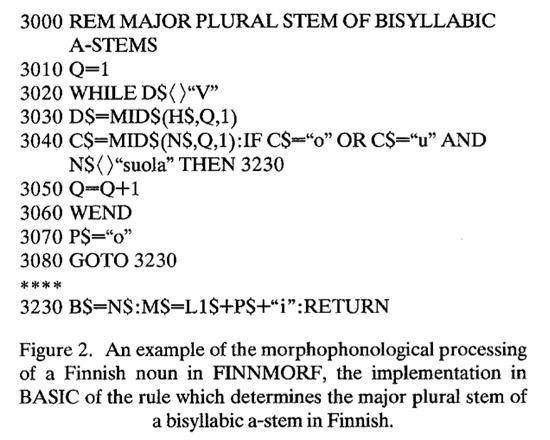
Wherever the text contained compound words, FINNMORF required users to insert a slash (/) between the component words as without it, the program could not locate the morpheme boundary (Holman 167). FINNMORF broke down words for processing via string-handling processes, and then generated stems and paradigms for the item:
After a lexical item is input, the program module in question matches it as a whole against various lists of ambiguous or anomalous lexical items to determine whether more information is needed before the paradigms can be constructed, and then breaks it down into substrings of various sizes to determine whether it is synchronically foreign, and how it behaves with respect to such morpho-phonemic processes as vowel harmony, consonant gradation, and vowel mutations. When these basic characteristics have been determined the program subjects the string to a battery of tests to determine which morphological alternations and which declensional patterns apply to it; strings corresponding to the appropriate stem allomorphs are produced when appropriate. When the entire battery of tests is complete, strings corresponding to the major and minor stems will have been produced, and from these the paradigms are formed by simply adding the endings to the appropriate stem. (167)
In Holman's estimation, FINNMORF \"exemplifies the potential of [the BASIC] programming language for computational linguistics\" (Holman 165).
Source
Holman, Eugene. \"FINNMORF: A Computerized Reference Tool for Students of Finnish Morphology.\" Computers and the Humanities 22.3 (1988):165-172. Web.
https://rd.springer.com/article/10.1007%2FBF00118889
there is a paper about this tool.