KLIC (Key Letter in Context)
KLIC (Key Letter in Context) was a program for graphological anaylsis particularly useful to scholars analyzing the language of medieval texts, created by Grace B. Logan of the Waterloo Arts Computing Office. It assisted in determining where different spelllings represent different pronunciations, and when they are variant spellings of the same word.
Attributes
- Type of analysis: Analysis Content Analysis
- Background Processing: Not Applicable
- Web Usable: Other
- Ease of Use: Easy
- Historic Tool (developed before 2005): Influential No longer in active development
- TaDiRAH Goals: Analysis
- TaDiRAH Methods: Content Analysis Other (analysis)
List this tool appear on
Rating
Suggested Tools
Comments
More information on the design and applications of KLIC may be found here:
Logan, Harry M. \"KLIC: A Computer Aid to Graphological Analysis.\" Computers and the Humanities 12.1-2 (1978): 93-96. Web.
Program Overview
KLIC was a program for text analysis developed in the 1970s by Grace B. Logan of the University of Waterloo Arts Computing Office (Logan 94).
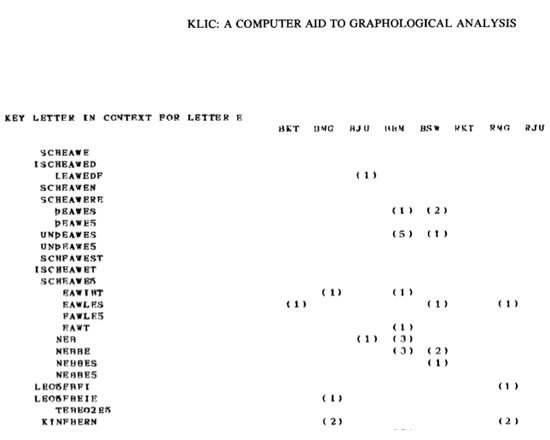
Much like Key Word in Context (KWIC) programs produced word concordances, KLIC produced \"an alphabetized list of key letters printed under each other in a \"gutter\" with the graphological context of the word it occurs in printed on either side of it\" with individual words \"tagged to indicate its frequency of occurrence in each text and manuscript\" (94).
KLIC was developed to address the problem of analyzing medieval texts, particularly the relationship between pronunciation and spelling found in such texts (Logan 93). For example, \"in the Modem English the sons raise meat and the sun's rays meet, the two sentences have exactly the same pronunciation but are differentiated in writing\" (italics in original) because
in medieval texts writing was more strongly motivated to represent speech than to represent grammatical forms. In a medieval text the two sentences cited above might be spelled the same since they are pronounced the same. Nevertheless, no text represents a phonological transcription, and there are further inconsistencies in that the same word may be represented by different spellings. The problem, then, is to determine when these different spellings represent different pronunciations and when they represent different words with the same pronunciation. (93)
Grace B. Logan developed KLIC to analyze lists of headwords or unique words generated by Philip H. Smith's concordance package (Logan 94). Harry M. Logan found that
The headword includes a \"translated\" form for proper collation and alphabetizing, the text form and its frequency of occurrence, to which KLIC adds a tag identifying manuscript and text. The \"translated\" form is necessary to indicate equivalences of letters and positioning in the alphabet, especially when non-alphabetic characters and diacritics are used. Thus, not only can capital letters be equated with their small letter equivalents, but such letters as þ and ð can be listed after t in the alphabet and either treated separately or together, depending on the choice of the concordancer. (94)
KLIC sorted all words containing the desired letter by the letters appearing to the right of that letter, which made it possible to determine which letters or combinations of letters tend to follow the key letter within the source text (94). The list of sorted words were arranged in the leftmost column of a table, with the frequency of each word provided in the columns to the right (Logan 96). Each text in the corpus analyzed was assigned its own column, enabling direct comparison of word frequencies between texts (96).
The KLIC results required cross-referencing with a concordance for word context information, but Harry M. Logan found that even the KLIC results alone were useful for identifying dialect characteristics and differences across texts when applied to Middle English texts (96).
Source
Logan, Harry M. \"KLIC: A Computer Aid to Graphological Analysis.\" Computers and the Humanities 12.1-2 (1978): 93-96. Web.