Attributes
- Type of analysis: Natural Language Processing Analysis Content Analysis Enrichment
- Background Processing: Not Applicable
- Web Usable: Other
- Ease of Use: Moderate
- Historic Tool (developed before 2005): No longer in active development
- TaDiRAH Goals: Enrichment Analysis
- TaDiRAH Methods: Content Analysis Editing Other (analysis)
List this tool appear on
Rating
Suggested Tools
Comments
More information on the development and applications of LEXICO may be found here:
Venezky, Richard L, Nathan Relles and Lynne Price. \"LEXICO: A System for Lexicographic Processing.\" Computers and the Humanities 11.3 (1977): 127-137. Web.
Program Overview
LEXICO was \"an interactive system which assists lexicographers in storing, editing, and concording texts; lemmatizing word lists; and generating slips\" developed in the 1970s by Richard L. Venezky of the University of Delaware and Nathan Relles and Lynne Price of the University of Wisconsin-Madison (Venezky, Relles and Price 127).
The LEXICO system began development in the early 1970s (Venezky, Relles and Price 137). It was originally designed as research tool for exploring different computerized approaches for lexical processing, but as of 1977 had become a user system (Venezky, Relles and Price 127). It was installed at the Madison Academic Computing Center at the University of Wisconsin, and had been applied to projects such as a stylistic analysis of Modern French literature and text processing for the Dictionary of Old English (127). Its slips, analogous to file cards, were particularly useful for compiling dictionary entries as they encoded words with their lemma, context and information about their source (127). As a user-oriented system, LEXICO was intended to be accessible to users regardless of skill level, and to provide the appropriate level of assistance as needed (127).
LEXICO was developed to run on mainframe and networked computers (Venezky, Relles and Price 136). Venezky, Relles and Price indicated, however, that if they were to start the project over again, they would include microcomputers for certain tasks (Venezky, Relles and Price 137). At the time of initial development, they found FORTRAN to be the only high-level programming language suitable for implementing it (Venezky, Relles and Price 136). As of 1977, LEXICO
requires a minimum of 100k of core storage, a remote terminal, and minimal random access, secondary storage...[t]he system consists of 20 separately executable subsystems (programs), composed of 285 distinct functional modules (subroutines). The entire system contains about 28,000 lines of code, 95% of which are FORTRAN, the remainder assembly language; this is equivalent to about 100,000 machine instructions. (136)
The system was developed to meet six goals: A) The system should be unified with consistent methods of accomplishing tasks and responses to user requests; B) Users should not need to understand the computer's operating system, file formats and so forth to successfully complete their tasks; C) Users should be able to flexibly and easily to specify tasks in a manner that minimizes the potential for user error; D) The system should have default values that reduce the need for user declarations; E) The system should be easy to maintain with minimal additional programming; F) Design decision should take into account user cost and minimize its expense (Venezky, Relles and Price 127-128).
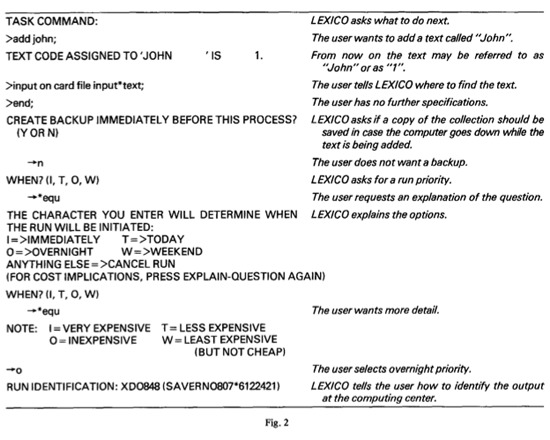
As a system, LEXICO enabled users to process a text or collections of texts (Venezky, Relles and Price 128). A collection included a directory identifying and describing the text, some elements of which could be defined as defaults applying to all texts in the user's collection (128). Users specified tasks with LEXICO's command language, with keywords corresponding to the type of task and method of execution, in addition to a declared endpoint (128). They could also enter commands corresponding to user aids, such as explaining an error or question, viewing an example or viewing the system menu, which showed all commands permissible for the given task (Venezky, Relles and Price 128-129).
To process a given collection, LEXICO required users to define a sequence of processes, which may include
1. creation of a collection and, optionally, definition of collection default values; 2. entry of one or more texts into the collection, optionally producing a listing of each text; 3. correction of errors in texts (editing); 4. concording texts; 5. formation of a headword classification (lemmatization) process for the collection by definition of spelling conversions and base form -- text form associations; 6. headword classification of the words that occur in texts, producing, for each text, a listing of the headword (base form) associated with each text form; 7. deletion of texts from the collection; and 8. deletion of the collection from the system (after all processing is complete). (Venezky, Relles and Price 128)
Users interacted with the system from a remote terminal, from which some tasks could be completed on demand, while others were so processing intensive that they were performed externally at a computing center, requiring the user to add their job to a queue and retrieve printouts some time later (128).
Venezky, Relles and Price compared LEXICO to its contemporaries. They noted that, while LEXICO shares concordance generation functionality with JEUDEMO, it could not match JEUDEMO's stylistic analysis capabilities, such as word-pattern searching (Venezky, Relles and Price 137). At the same time, JEUDEMO could not match LEXICO's collection management, spelling conversion or lemmatization (137). They also note that LEXICO had specialized lexicographic functions missing in EYEBALL, SCAN and RATS, but that they were better suited for phrase handling and grammatical parsing due to their origins in literary computing (137).
Venezky's team was still gathering data on how well their design criteria had been met at the time of writing, though they had logged several hundred hours of user interactions (137). That said, they found that \"[t]he system permits a unique symbiosis of user and computer. Lemmatization...is too time-consuming to be achieved by human effort alone and too ill-defined to allow complete algorithmic specification\" (137).
Source
Venezky, Richard L, Nathan Relles and Lynne Price. \"LEXICO: A System for Lexicographic Processing.\" Computers and the Humanities 11.3 (1977): 127-137. Web.