SELECT (Sum and Evaluate the Largest Exponentiated Correlation Terms)
SELECT (Sum and Evaluate the Largest Exponentiated Correlation Terms) was a computer program for identifying associationally rich words for content analysis emerging from the WORDS research program developed in the 1970s. Although historically important, SELECT is no longer available and does not have an web presence.
Attributes
- Type of analysis: Natural Language Processing Analysis Content Analysis
- Background Processing: Not Applicable
- Web Usable: Other
- Ease of Use: Moderate
- Historic Tool (developed before 2005): Influential No longer in active development
- TaDiRAH Goals: Analysis
- TaDiRAH Methods: Content Analysis
List this tool appear on
Rating
Suggested Tools
Comments
More information about the development and application of SELECT, and its affiliation with WORDS, is available here:
Iker, Howard P. \"SELECT: A Computer Program to Identify Associationally Rich Words for Content Analysis. I. Statistical Results.\" Computers and the Humanities. 8.5-6 (1974): 313-319. Web.
Iker, Howard P. \"SELECT: A Computer Program to Identify Associationally Rich Words for Content Analysis. II. Substantive Results.\" Computers and the Humanities. 9.1 (1975): 3-12. Web.
Program Overview
SELECT was a tool for multivariate reduction (MVR), a method of factor or cluster analysis of text, developed by Howard P. Iker in the 1970s (Iker, \"Statistical Results\" 131).
SELECT emerged from the development of Iker's WORDS system, which could not include an effective MVR function due to its intensive computational demands (313). WORD also didn't include synonymization as it was too difficult to implement, required too much processing time, and imposed a need for the very a priori categorization systems WORDS was intended to avoid (Iker, \"Statistical Results\" 313).
The multivariate reduction technique that became SELECT was originally intended for WORDS, but Iker and his colleagues found that \"the technique has implications for any attempt to determine word groupings that uses word contiguities for primary data\" (Iker, \"Substantive Results\" 3). It addressed a gap in WORDS' processing by selecting the words within a text with the highest correlation sums for inclusion in an Inter-Correlational Matrix (ICM) and MVR analysis (Iker, \"Statistical Results\" 315). The name SELECT derived from its method, which \"is to Sum and Evaluate the Largest Exponentiated Correlation Terms from the ICM\" (315).
SELECT used statistics to determine word correlations within a text, relying on linguistic redundancy to accomplish its MVR analysis (3):
In brief, a computer program, SELECT, is applied to all word types remaining after removal of function words and lemmatization. SELECT works (1) by computing the absolute correlation between a pair of words, (2) setting the correlation to zero if it is statistically nonsignificant, (3) exponentiating the correlation in order to emphasize high coefficients, (4) adding this value to sum cells corresponding to the two words correlated, and (5) continuing this procedure until all possible pairwise word combinations have been examined. On completion, the 215 highest \"correlating\" words (the largest number of variables currently used in the WORDS System) are selected for MVR analysis. This method is under study as an alternative to choosing for analysis the 215 highest frequency words - regardless of their associational structure. (Iker, \"Substantive Results\" 3)
The design of SELECT was intended to improve the results possible with the MVR techniques used in WORDS, particularly its value to extracting themes from a text (3). With respect to linguistic redundancy, Iker judged that \"[i]f the same basic content materials can be identified by different words, then a procedure can be devised to maximize the identification, discrimination, richness, etc., of these themes by choosing \"better\" words without having to worry about losing those themes which would have been identified were the words different\" (3).
In Iker's opinion, SELECT was successful within the context of WORDS for two reasons:
(1) it allows a totally objective, associationally sensible, and reasonably efficient method for selecting the best word subset for analysis; (2) the words it does select afford a much better set of content themes for description of the data base under analysis. These themes are \"better\" because they are richer, more interpretable, and more easily discriminated from each other, and they constitute better descriptions of the data. (Iker, \"Substantive Results\" 319)
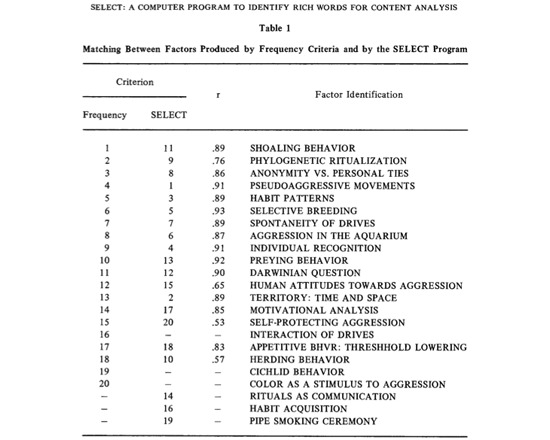
When he overviewed SELECT's results, Iker found that they \"parallel those produced by frequency-based word selection,\" but were easier to interpret and distinguish than thematic results generated from frequency data (Iker, \"Statistical Results\" 12).
Sources
Iker, Howard P. \"SELECT: A Computer Program to Identify Associationally Rich Words for Content Analysis. I. Statistical Results.\" Computers and the Humanities. 8.5-6 (1974): 313-319. Web.
Iker, Howard P. \"SELECT: A Computer Program to Identify Associationally Rich Words for Content Analysis. II. Substantive Results.\" Computers and the Humanities. 9.1 (1975): 3-12. Web.