Documentation
Attributes
- Type of analysis: Analysis
- Type of license: Commercial
- Background Processing: Doesn't Run in Background
- Ease of Use: Moderate
- Historic Tool (developed before 2005): Influential No longer in active development
- TaDiRAH Goals: Analysis
- TaDiRAH Methods: Other (analysis) Statistical Analysis
List this tool appear on
Rating
Suggested Tools
Comments
More information on TEXTPACK V and its use is available in the following:
Alexa, Melina and Cornelia Zuell. \"Commonalities, differences and limitations of text analysis Software: The results of a review.\" Zuma - Arbeitsbericht (Jun. 1999). Web.
Olsen, Mark. \"Software Review: TEXTPACK V: Text Analysis Utilities for the Personal Computer.\" Computers and the Humanities 23.2 (1989):155-160. Web.
Program Overview
TEXTPACK V was a text analysis package for PCs released in the 1980s by Peter Mohler and Cornelia Zuell of ZUMA (Zentrum fuer Umfragen, Methoden un Analysen (Olsen 155). This version was a port with improvements of the original FORTRAN program, which was released for mainframe computers in the 1970s and developed by Jurgen Hoehe, Hans-Dieter Klingemann and Klaus Radermacher (155).
Mark Olsen, who reviewed TEXTPACK V for the journal Computers and the Humanities in 1989, described it as
a collection of interdependent utilities designed to perform simple elements of text analysis, such as concordances, word frequency counts, word tagging, and text reformatting. The utilities are batch-oriented, reflecting the early development of TEXTPACK on mainframe computers. (155)
As a package, its programs were useful \"for the qualitative description of literary texts, analysis of content, and data management. The majority of the program assists users in exploring and editing textual source material\" (McCarty et al. 114).
It was included in the Tools for Humanists, 1989 guide to available software and hardware for humanistic research. At the time of its publication, that guide found that \"TextPack is it [sic] the only package reliably distributed for mainframes and personal computers that automatically codes a text\" (McCarty et al. 115).
TEXTPACK V required users to pre-process texts by applying two hierarchical levels of descriptive tags, with a third level supplied by the system (115). This tagging supplied identifiers that labeled information such as paragraphs and sentences, conforming to one of three prescribed formats (Olsen 155). The SENTENCE program used the pre-processed text to convert it into a form compatible with the rest of TEXTPACK (155).
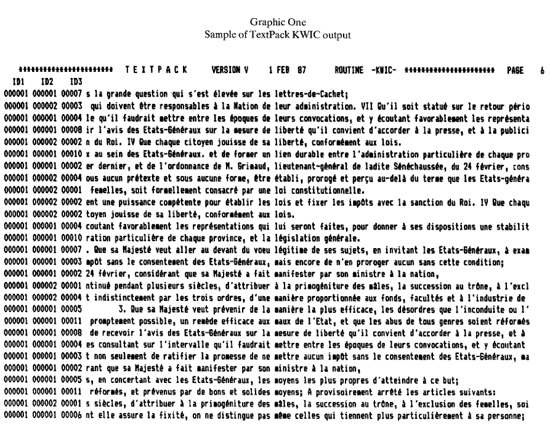
There were ten additional programs in TEXTPACK V, supplying functions such as correcting and editing system files (SENMERGE), tokenization (LISTSPLT), frequency counts (FREQ), keyword-in-context listings (KWIC), and generating a content analysis dictionary (TAGCODER) (McCarty et al 115-116). It also included a function for converting output to ASCII for use by analytical systems (REFORM).
The TEXTPACK V programs were distributed on four diskettes, requiring 1.3MB storage, and were easily installed without compatibility problems (Olsen 155). It ran on PCs and compatibles in an MS-DOS environment (Olsen 160).
Mark Olsen was highly critical of TEXTPACK V. Some of his issues with it stemmed from its origins as a mainframe package, as to his eye, the ported version \"ha[s] not...lost the flavor of a much earlier and more primitive era of humanities computing\" (Olsen 155). The programs retained markers of mainframe computing, for example that \"[a]ll the programs are controlled with options set using 'Program Control Cards,' and include such quaint parameters as specifying whether the INPUT is from DISK or CARD\" (155). These characteristics negatively impacted Olsen's user experience, as in his view,
simply compiling mainframe programs to run in a PC environment is counter-productive, since the main advantage of the PC is its interactive immediacy. Batch-oriented programs may be better left on mainframes with their superior processing speed and expensive high-speed peripheral devices, such as line-printers. (155)
He found a number of TEXTPACK V's programs frustrating, particularly SENTENCE:
SENTENCE does very little in addition to what the user is required to provide in pre-processing. While the program can separate punctuation marks from words and transform numeric strings to words (i.e. \"50\" becomes \"fifty\"), SENTENCE hardly seems worth the effort, particularly in a microcomputer environment, as the user is required to perform a large number of pre-processing steps to prepare the data for SENTENCE. (Olsen 156)
Olsen also found the KWIC program \"difficult to use, requires several preliminary steps, and fails to work properly,\" based on a test using a sample from a French text (156). From the original text of 707 words, comprising 5,016 bytes, the KWIC took \"seven minutes to generate a full concordance, not including the pre-processing time required by SENTENCE and LISTSPLT\" (156).
Olsen's final assessment was damning:
There is little to recommend TEXTPACK V to the researcher in the humanities. It is difficult to use and not particularly effective. Its individual modules, such as the KWIC program, are not comparable to many other packages and public domain programs. Given the structural limitations of the system, it is hard to see any advantage that can be gained from learning how to use it. This is only compounded when the weak documentation and obscure program operation are taken into account. (Olsen 159-160)
In light of its numerous problems, Olsen concluded \"TEXTPACK V needs to be redesigned from the ground up, a process which should attempt to incorporate elements of full text retrieval and more sophisticated text processing than is supported by the current implementation\" (Olsen 160).
Sources
McCarty, Willard et al. Tools for Humanists, 1989. Toronto: Centre for Computing in the Humanities at the University of Toronto, Jun. 6-9, 1989.
Olsen, Mark. \"Software Review: TEXTPACK V: Text Analysis Utilities for the Personal Computer.\" Computers and the Humanities 23.2 (1989):155-160. Web.