Attributes
- Type of analysis: Natural Language Processing Analysis Content Analysis
- Type of license: Commercial
- Background Processing: Doesn't Run in Background
- Ease of Use: Moderate
- Historic Tool (developed before 2005): Influential No longer in active development
- TaDiRAH Goals: Analysis
- TaDiRAH Methods: Content Analysis
List this tool appear on
Rating
Suggested Tools
Comments
More information on Parser 1.0 and its use is available in the following article:
Francis, Alexander L. \"Technical Review: Parser 1.0: An Elementary Parsing Program for the DOS Environment.\" Computers and the Humanities 27.5-6 (1993): 406-409. Web.
Program Overview
Parser 1.0 was a text analysis program for IBM PC or compatibles running a minimum of DOS 2.1 (Francis 406). It was developed by Prospero Software, based in London, England (Francis 409).
According to Alexander L. Francis, who reviewed Parser 1.0 for the journal Computers and the Humanities in 1993,
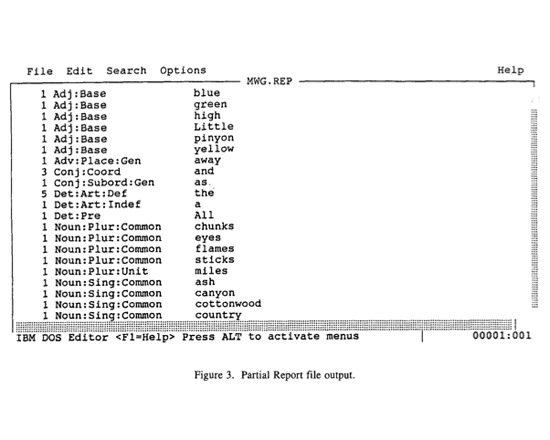
Parser 1.0 is designed to take in an arbitrarily large ASCII text file and generate a \"verticalized\" output file containing the words in the text in a variety of different orders, each word paired with one of the 104 \"part-of-speech\" tags that have been taken into account by the program's authors. (Francis 406)
Francis found the installation straightforward for experienced DOS users, and the step-by-step instructions provided for less experienced users simple to follow (406). He was also pleased with the program's design and supporting documentation:
The excellent instructions make Parser extremely easy to use in its most basic mode. The 63 page documentation booklet is well written and informative, though I would have preferred a little more information about the precise method of analysis used by Parser. (406)
The program's parsing function was fast, done in seconds for files of 500 words or less, though Francis noted that he did not test Parser with larger files (406). Its output was in the form of an ASCII file that could be processed further with Parser's REPORT.EXE package (406). The raw output was \"alphabetically ordered by tag within each sentence, and alphabetically by word within each category of tag\" (Francis 408). Parser also included a batch processing capacity for automating the parsing and output file generation for a sequence of files (Francis 406).
Francis had just one complaint about the program, pertaining to its part-of-speech tagging: that it seemed to rely on heavily on the built-in lexicon, and therefore could not provide alternate tags for the user to choose the most appropriate from (Francis 407).
Overall, he judged Parser to be useful and effective for word frequency analysis and general parsing, though he recommended testing the program with a subset of one's corpus before taking its results at face value (Francis 408).
Source
Francis, Alexander L. \"Technical Review: Parser 1.0: An Elementary Parsing Program for the DOS Environment.\" Computers and the Humanities 27.5-6 (1993): 406-409. Web.