Documentation
Attributes
- Type of analysis: Natural Language Processing Analysis Content Analysis
- Background Processing: Doesn't Run in Background
- Ease of Use: Moderate
- Historic Tool (developed before 2005): Influential No longer in active development
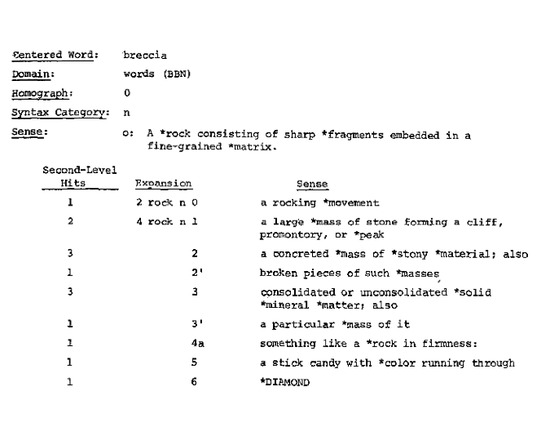
- TaDiRAH Goals: Analysis
- TaDiRAH Methods: Content Analysis Other (analysis)
List this tool appear on
Rating
Suggested Tools
Comments
More information on SOLAR is available in the following article:
Diller, Timothy and John Olney. \"SOLAR (A Semantically-Oriented Lexical Archive): Current Status and Plans.\" Computers and the Humanities 8.4-5 (1974): 301-311. Web.
Program Overview
SOLAR (Semantically Oriented Lexical ARchive) was a lexical resource developed by the System Development Corporation (SCR) in Santa Monica, California in the 1970s (Diller and Olney 301). It was primarily distributed via the ARPA Network, with copies available by request for those without access to the network (Diller and Olney 310).
According to Timothy Diller and John Olney of SCR, SOLAR \"is designed to permit a researcher to access a broad range of semantic data, all keyed to individual English words\" (Diller and Olney 301). SCR built in that breadth with the aim of making SOLAR relevant across fields, such as theoretical linguistics, philosophy of language, second language instruction and automated language processing (301). According to Diller and Olney in their article \"SOLAR (A Semantically Oriented Lexical ARchive): Current Status and Plans,\" published in 1974 prior to SOLAR's release,
The SOLAR project is beginning to function both as a lexical information center and as a source of new lexical data. As an information center, it provides insightful descriptions of selected English words extracted from the technical literature of several fields and formatted for machine processing. As a source of new lexical data, it offers collocational features, semantic fields, definitional expansions within a designated set of words, and keyword-in-context materials derived by processing machine-readable transcripts of Webster's Seventh New Collegiate Dictionary (W7), Roget's International Thesaurus and other text corpora. (Diller and Olney 301-302).
Rather than being a lexicon itself, it offered a series of information-rich source files for constructing a lexicon (Diller and Olney 302). It was made up of seven files:
File 1: Semantic Analysis
File 2: Explanatory Notes for the Descriptive Constants Used in the Semantic Analyses
File 3: Conceptual Analysis of Notions Involved by the Descriptive Constants
File 4: Collocational Features Correlated with Particular Word Senses
File 5: Semantic Fields
File 6: Definitional Expansions
File 7: Contexts of Occurrence (Diller and Olney 302-303)
It also included two supplementary files, a Word Index and a Bibliography (Diller and Olney 309). Within this collection of files, SOLAR integrated data derived from relevant papers, presented in according to the wishes of the authors wherever possible (309).
Diller and Olney summarized SOLAR as a resource
designed to provide convenient access to semantic and conceptual analyses proposed by linguists, anthropologists, psychologists, philosophers and computer scientists, as well as to semi-processed, formatted data extracted from dictionaries, thesauri, and textual corpora. (Diller and Olney 310).
Source
Diller, Timothy and John Olney. \"SOLAR (A Semantically-Oriented Lexical Archive): Current Status and Plans.\" Computers and the Humanities 8.4-5 (1974): 301-311. Web.