Attributes
- Type of analysis: Search Analysis Capture Content Analysis Gathering Discovering
- Ease of Use: Moderate
- Usage: Experimental
- Historic Tool (developed before 2005): Influential No longer in active development
- TaDiRAH Goals: Capture Analysis
- TaDiRAH Methods: Content Analysis Discovering Gathering
List this tool appear on
Rating
Suggested Tools
Comments
More information on OPCOL, its development and its use is available in the following article:
Cannon Jr., Robert L. \"OPCOL: an Optimal Text Collation Algorithm.\" Computers and the Humanities 10.1 (1976): 33-40. Web.
Program Overview
OPCOL was an experimental algorithm \"which optimizes efficiency with respect to the number of word comparisons\" during an automated text collation developed by Robert L. Cannon, Jr. of the University of South Carolina (Cannon 33).
OPCOL's optimization applied recent research into the 'longest common subsequence' (lcs) problem (Oakman 130). The lcs problem refers to \"finding the longest common sequence between two texts of length M and N [which] has shown that both the maximum and minimum number of comparisons is M times N\" (130).
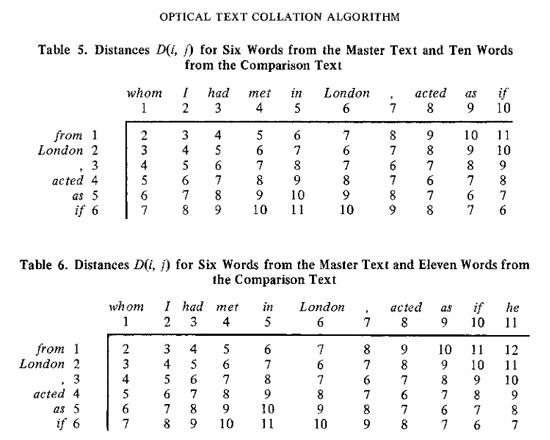
The OPCOL algorithm conducted \"pairwise matching between two texts until a point is reached at which the texts do not match\" and built a table of distances between words from the master and comparison texts as it searched for the next match (Cannon 37). Then, once the algorithm found a new match, \"an additional word from the master (comparison) text will next be added. The algorithm will continue to add words from the master (comparison) text as long as their addition continues to reduce the distance between the two texts\" (Cannon 38).
Robert Oakman, whom Cannon thanked for \"many helpful discussions and for a critical reading of a draft of this paper\" in his article \"OPCOL: An Optimal Text Collation Algorithm\" (Cannon 33), discussed OPCOL in his book Computer Methods for Literary Research. Oakman, describing Cannon's findings and their implementation in OPCOL, clarified that
the \"distance\" increases between texts increases as long as they lack identity and begins to decrease when a word in common is finally encountered. The computer continues to check distances every time it adds and looks at another word in either text. When the distance stops decreasing again, the maximum common distance has been found, the variants can be printed, and normal checking resumes. (Oakman 130-131)
Reflecting on Cannon and his work on OPCOL, Oakman praised his contribution to literary research:
Cannon's approach is intended to minimize comparisons and the amount of compute storage required for large collations; the mathematical elegance of his approach argues for the further application of theoretical results in computer science complicated, real problems like literary collation. Rarely to theoretical breakthroughs in computer research ever reach the needs of literary scholars; Cannon deserves commendation for his commitment to concrete applications of theoretical principals. His algorithm, only tested experimentally, also deserves test with a significant literary textual problem and modification to present the variants in a form easily analyzable by the scholar. (Oakman 131)
Sources
Cannon Jr., Robert L. \"OPCOL: an Optimal Text Collation Algorithm.\" Computers and the Humanities 10.1 (1976): 33-40. Web.
Oakman, Robert L. Computer Methods for Literary Research. Athens: University of Georgia Press, 1984.
https://www.jstor.org/stable/30204218
here is the more information about OPCOL