PRORA
PRORA was a historically important set of six interrelated programs for creating computerized concordances, first released in the 1960s. It output on punched cards, could be used for any language represented by the Latin alphabet, and also had functions for generating word lists and annotating texts. Glickman and Staalman desgined PRORA to reduce the requirement for researchers to learn computers to use them in their literary studies.
Documentation
Attributes
- Type of analysis: Analysis
- Background Processing: Not Applicable
- Web Usable: Other
- Ease of Use: Moderate
- Historic Tool (developed before 2005): Influential No longer in active development
- TaDiRAH Goals: Analysis
- TaDiRAH Methods: Other (analysis)
List this tool appear on
Rating
Suggested Tools
Comments
The developers on the PRORA series of programs:
Glickman, Robert Jay. \"An Integrated Series of Computer Programs for Literary Research.\" MLA, Conference 16, 27 Dec. 1965.
Glickman, Robert Jay and Gerrit Joseph Staalman. Manual for the Printing of Literary Texts and Concordances by Computer: Preliminary Edition. Toronto: University of Toronto Press, 1966.
Additional perspectives on PRORA and its applications:
Lieberman, David. \"Reviews.\" Computers and the Humanities 1.1 (1966): 12. Web.
Burton, Dolores M. \"Automated Concordances and Word Indexes: The Process, The Programs, and the Products.\" Computers and the Humanities 15.3 (1981): 139-154. Web.
Program Overview
PRORA was an early set of interconnected programs developed by Robert J. Glickman and Gerrit J. Staalman of the University of Toronto for creating concordances and word indexes with the assistance of a computer (Burton 139).
It was written in FORTRAN IV, SPS and MAP (Burton 146) and required an IBM 026 Keypunch with a FORTRAN keyboard, chosen as the devices most commonly available in North American universities (Glickman 5). Its name derived from an abbreviation of Programs for Research on Romance Authors, but despite its original focus on texts in Romance languages, Glickman and Staalman stressed that PRORA was also applicable to texts in any language written in the Latin alphabet, such as Dutch, Czech or Finnish (1). For texts with characters not available on the FORTRAN keyboard, PRORA implemented special codes to accommodate them (Glickman 5). This included characters with diacritic marks, such as in Spanish and Italian texts (Glickman 7).
PRORA emerged from the tension between the benefits and drawbacks of concording texts by computer (Glickman 1). Despite the clear speed advantages of computer versus manual concordance, the need for users to have special training in computer programming and techniques was a deterrent to humanities scholars, while the need to pre-edit their data for best results meant less time available for analyzing the output (1). Furthermore, the characters available on computers were limited, as computers of the time were designed with scientific rather than literary applications in mind (Glickman 2). Glickman and Staalman believed that \"intervention by the scholar should be limited to decision-making in the scholar's own field of competency\" (Glickman and Staalman 1), and as such, PRORA was designed to meet eight aims:
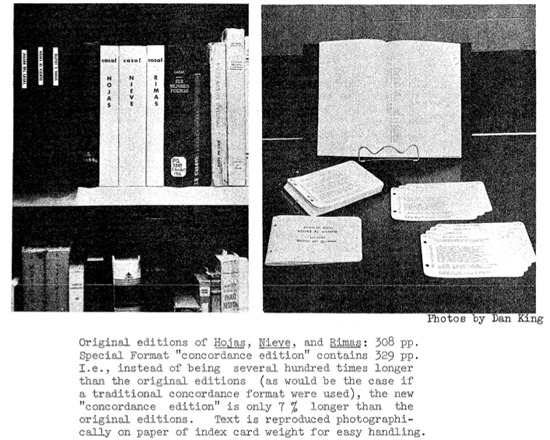
Glickman and Staalman released their \"Manual for the Printing of Literary Texts and Concordances by Computer\" in 1966, describing PRORA's functions and use (Glickman and Staalman 1). At this time, PRORA consisted of three programs (Glickman and Staalman 2). PRORA I converted a tape stored on IBM punch cards to a record on tape, PRORA II used that tape record to print out the text in a 'standard' format, and PRORA III printed the record in a 'special' format optimized for concordance (2).
PRORA III's special format included page numbers and coding information, namely index number, book, part and line number (Glickman and Staalman 9). It printed on cards that had to be placed in a specialized binder for browsing (Glickman and Staalman 13). To examine instances of a particular word, users had to consult the word index for the text, which required PRORA V to print, and manually pull out all the cards where the word appeared (Glickman and Staalman 15).
PRORA IV-VI were projected, not available, at the time of the manual's publication (Lieberman 12). PRORA VI would \"to construct and update a master tape-file of all words appearing in a given text or group of texts\" (Glickman and Staalman 15). It would also include functions for adding lemma to each word, translations of a word in context, variants from other editions of the text, and for directly inserting analytical data (Glickman and Staalman 15-16). PRORA VI would also generate a Vertical List, compare words from the PRORA I tape to the Master Reference File, and print words according to the order of their appearance alongside their lemma and function (Glickman 17). PRORA V would be a means of retrieving and arranging information from PRORA IV's master tape, extending beyond generating word indexes into dictionaries and frequency lists (Glickman and Staalman 16). The index function used a version of PRORA's Vertical List that had been edited to include only those words of interest (Glickman 18). Finally, PRORA VI would generate a complete or partial concordance from the master tape (Glickman and Staalman 16).
PRORA was favourably received by its audience. In 1966, David Lieberman reviewed the manual for Computers in the Humanities, with the final assessment that \"[t]his manual should be of great interest not only to a literary scholar interested in using the program described therein, but to anyone actively working with computer aids to literary text analysis\" (Lieberman 12). He particularly drew attention to the care with which Glickman and Staalman described the limitations of the system in relation to the available hardware, and why they implemented the solutions they did (12). The only drawback Lieberman noted was the lack of information on program runtimes (12).
It was also still in discussion fifteen years later, appearing in Dolores M. Burton's 1981 article \"Automated Concordances and Word Indexes: The Process, The Programs, and the Products.\" Burton found PRORA notable for \"its clarity and its humanistic orientation\" (Burton 146).
In light of Lieberman and Burton's assessments, PRORA was successful at smoothing the path of scholars wishing to create computer-assisted concordances, and as a fulfilment of Glickman and Staalman's aim of providing
a series of computer programs designed primarily for scholars who work in the fields of literature and linguistics; who have little or no knowledge of how computers operate, but who would utilize computer technology if it were possible to do so without sacrificing their own research time in order to learn the details of computer science. (Glickman and Staalman 1).
Sources
Burton, Dolores M. \"Automated Concordances and Word Indexes: The Process, The Programs, and the Products.\" Computers and the Humanities 15.3 (1981): 139-154. Web.
Glickman, Robert Jay. \"An Integrated Series of Computer Programs for Literary Research.\" MLA, Conference 16, 27 Dec. 1965.
Glickman, Robert Jay and Gerrit Joseph Staalman. Manual for the Printing of Literary Texts and Concordances by Computer: Preliminary Edition. Toronto: University of Toronto Press (1966).
Lieberman, David. \"Reviews.\" Computers and the Humanities 1.1 (1966): 12. Web.