Pliny
- Last Updated: 10/5/2018 12:00:00 AM
- Site: http://pliny.cch.kcl.ac.uk/
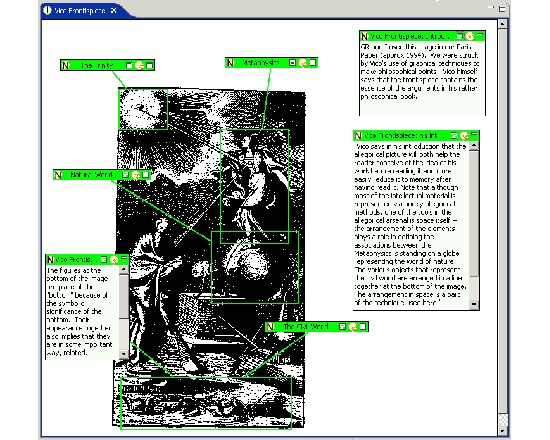
Pliny was a tool for working with annotations when conducting personal scholarly research, and can be used with both digital and print materials. It also had data manangement and organizational features, and was designed to facilitate reading, reacting to that reading and forming an interpretation. Pliny stored all data on the user's computer rather than remotely on the web.
Documentation
Attributes
- Type of analysis: Analysis Annotating Capture Content Analysis Enrichment Gathering Interpretation
- Type of license: Free Open Source
- Background Processing: Doesn't Run in Background
- Web Usable: Software you Download and Install
- Ease of Use: Moderate
- Warning: No longer supported
- Historic Tool (developed before 2005): No longer in active development
- TaDiRAH Goals: Capture Enrichment Analysis Interpretation
- TaDiRAH Methods: Annotating Content Analysis Contextualizing Editing Gathering
List this tool appear on
Data modeling and management
This list is about the basic need of many researchers to organise, manage, publish and eventually archive information collected in the course of their research. Simple tools dealing with one type of information are rarely adequate because of the rich connections within Humanities data.
A number of open-source, web-based tools now available allow you to model, collect, manage and publish data characterised by heterogeneous entities which are linked together through relationships. These can include documents, images, events, people, places, organisations, structures, portable objects, and many other entities which form rich networks of relationships.
While any sort of complex data modelling and data management/publishing can be achieved - laboriously and at huge expense - by programming in conventional relational (and other) database tools, newer web-based approaches can provide nearly ready-made open-source solutions to a wide range of basic research data management needs. However many researchers are unaware of what is available. This list aims to highlight suitable tools for consideration.
Rating
Suggested Tools
Comments
As of 2017, Pliny is no longer being developed. However, the site is still up and functioning, which can be found above.
Pliny was used in this research abstract available in XML format https://raw.githubusercontent.com/lehkost/ToolXtractor/master/data/xml/2015/BRADLEY_John_How_about_Tools_for_the_whole_range_of_sch.xml