MONK (Metadata Offer New Knowledge)
- Last Updated: 10/19/2018 12:00:00 AM
- Site: http://quest.library.illinois.edu/monk/project/downloads/
MONK (Metadata Offer New Knowledge) is a digital environment for humanities scholars. It is desgined to assist with the discovery and analysis of patterns within texts, incorporating full text content from corpora such as ECCO, EEBO and Early American Fiction directly into the tool. The MONK Workbench is the primary environment, permitting users to create worksets, perform analytics and save their results. In addition, the MONK workbench can be used in conjunction with the Flameco faceted browser and Zotero.
Documentation
Creator(s): MONK Project
Creator's Site: http://www.monkproject.org/
Creator's Email: monkproject@lis.illinois.edu
Repository:
Attributes
- Type of analysis: Search Visualization Natural Language Processing Analysis Capture Content Analysis Gathering Discovering
- Type of license: Free Open Source
- Background Processing: Not Applicable
- Web Usable: Run in Browser
- Ease of Use: Moderate
- TaDiRAH Goals: Capture Analysis
- TaDiRAH Methods: Content Analysis Discovering Gathering Other (analysis) Statistical Analysis Visualization
List this tool appear on
Rating
Suggested Tools
Comments
Overview and Setup
Monk is an open source digital environment based around the Seasr analytics engine. Users can log into the Monk servers, access the Monk database, and pass select passages through a variety of Seasr flows. Monk is a web-based project and is accessible through any web browser via their website. Funding for the project ended in 2009 resulting in the programing behind sunset at the same time. No current work is being done on the project.
Features
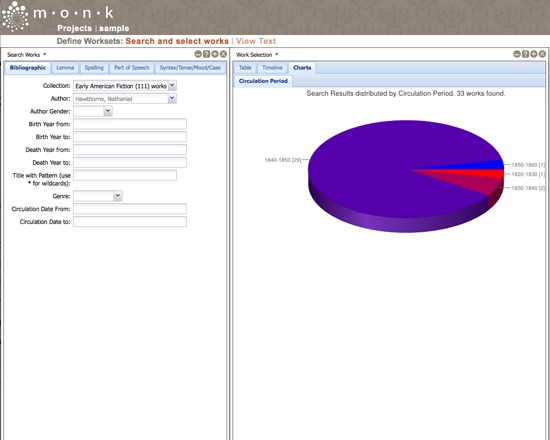
The Monk project was primarily interested in creating a functional working environment. Likewise, Monk offers the user a streamlined process through which they can select text from the Monk corpus, select a tool or flow to operate on the chosen text, then save the results to their own personal profile for later viewing. Unfortunately, Monk does not give the user the option to upload their own text as the project experimented with building the texts into the platform itself. The user can choose between several different toolsets to apply to the chosen text as well as the ability to edit and save preferred toolsets. Unfortunately, many of these features are little more than a proof-of-concept and other more up to date tools easily outperform them. As well, many of the implemented features have not been updated to work with the latest versions of certain browsers, and the server no longer supports an important set of analysis tools.
Conclusion
For researchers interested in learning more about the development of tools themselves, Monk is a valuable asset as it represents and important experiment in interface and environment. Monk has inspired several other tools who have taken up and further explored the ideas that Monk created. Researchers interested in Monk should explore it as a working prototype, a living example of the thoughts and ideas that went into its creation. However, it probably won’t find much use for the actual analysis of texts.
More information on MONK is available in the following articles:
Harriett E. Greene. \"Under the Workbench: An analysis of the use and preservation of MONK text mining research software.\" Literary and Linguistic Computing 28.1 (2013). Web.
Unsworth, John and Martin Mueller. \"The MONK Project Final Report.\" The MONK Project. 2 Sept. 2009. Web.
Xiang, Xin and John Unsworth. \"Connecting Text Mining and Natural Language Processing in a Humanistic Context.\" Proceedings of Digital Humanities 2006. la Sorbonne, Paris, France, July 5-9, 2006: 234-236. Web.
MONK also appears in Project Bamboo's DiRT, a registry of digital tools suitable for academic research. DiRT contains a wide range of tools and software searchable by task, such as annotation, content management, collaborative research, or authoring. It is an excellent resource for Digital Humanists seeking the right tool for the task at hand.
View MONK in DiRT:
http://dirt.projectbamboo.org/resources/monk-project
View the full site:
http://dirt.projectbamboo.org/