Introductory Social Media Analysis
This list contains a number of tools that focus on exploring and analyzing social media through different approaches. If focuses on several networks, though twitter is the most common focus. This is a good introduction to a wide variety of tools that vary both in difficulty and type of analysis.
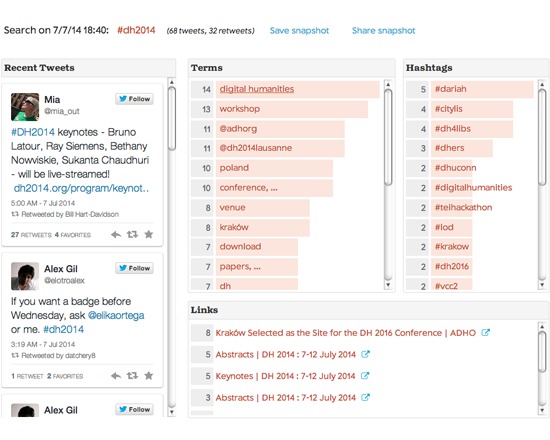
<p>twXplorer is a free, web-based tool for querying Twitter and exploring the search results based on common words, hashtags and commonly shared links. Each search brings up the 500 most recent tweets for that search term, and the tool permits users to save 'snapshots' for later analysis. twXplorer requires users to log in with their Twitter account.</p>
<p>Netvizz is a free, web-based tool for extracting datasets from Facebook. As the tool utilizes Facebook Apps, users must have a Facebook account to access it.</p>
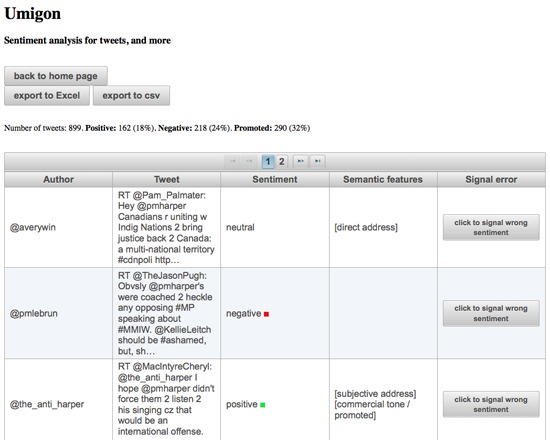
<p>Umigon is a tool used for the sentiment analysis of texts. It is one of the tools of the <a href="http://tapor.ca/tools/1668">Nocode app</a> which is a suite of text analysis tools. Results can be exported in Excel or CSV format for further analysis.</p> <p>It was formerly a stand alone web-based and open-source tool for the sentiment analysis of tweets. From a person's Twitter handle, Umigon retrieved that account's tweets and processed them for sentiment while accounting for factual statements (ex: "I hate war" will be classified has negative, and "war in Syria" will be classified as neutral). Tweets could also be pasted manually in the entry box provided. Beyond sentiment analysis, Umigon could identify characteristics such as whether the tweet contains a question, whether it contains possible promotional/commercial subject matter, or temporal indicators based on tense.</p> <p>The developer of this application can be reached on <a href="http://twitter.com/seinecle">Twitter.</a></p>
<br>As of April 2022, Umigon has been archived after a long period without new developments.
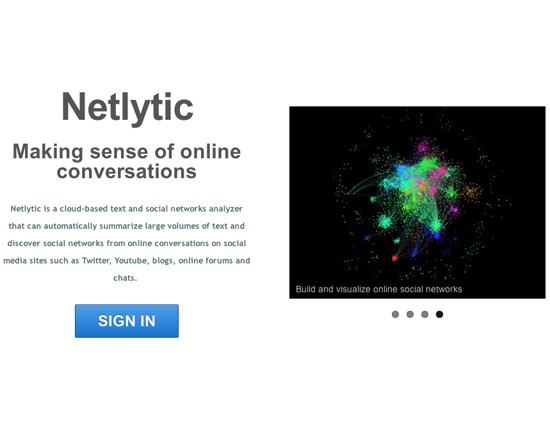
<p>Netlytic is a free, web-based tool for analyzing and visualizing text and social network data. It enables users to capture data from sources such as social media, blogs or online forums; identify themes and actors; and generate both chain and personal name networks for further analysis and visualization. Users can import datasets from RSS, cloud storage (Google Drive or Dropbox), Twitter, YouTube, Instagram and a plain text file. Results can be exported in formats accessible to other network analysis tools, such as CSV.</p>
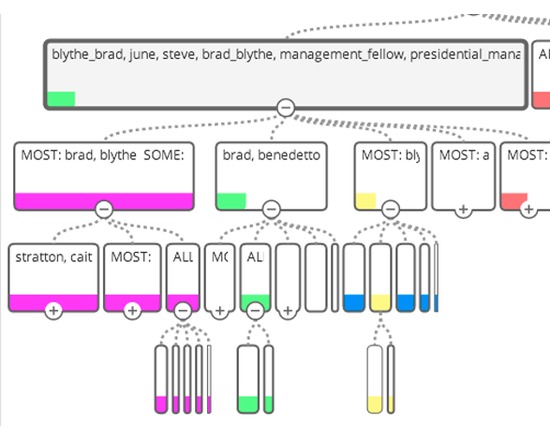
<p><span>Overview is a free, web-based tool for document mining. Developed by and for journalists, Overview is also broadly applicable to other corpus-based research applications. Aside from providing </span><a href="http://overview.ap.org/about/overview.ap.org/blog/2013/12/advanced-search-quoted-phrases-boolean-operators-fuzzy-matching-and-more/">advanced search features</a><span><span> such as regular expressions and fuzzy matching, </span></span><span>Overview automatically </span><a href="http://overview.ap.org/blog/2013/04/how-overview-can-organize-thousands-of-documents-for-a-reporter/">sorts documents according to topic</a><span> and provides a fast visualization and reading interface. You can apply tags to search results, individual documents, or entire topics to track what you've found, then export the entire document set with its tags to perform further processing or create visualization. It’s been used for qualitative research, social media conversation analysis, legal document review, digital humanities, and more. </span></p> <div><span> </span></div> <div>
<span>Overview can be run via the web interface (max 200 000 documents) or downloaded and installed. </span><span>The system can import documents in PDF or CSV format and currently supports analysis in 9 languages. The code is open source and there is a plugin API to extend Overview's analysis and visualization capability.</span>
</div>
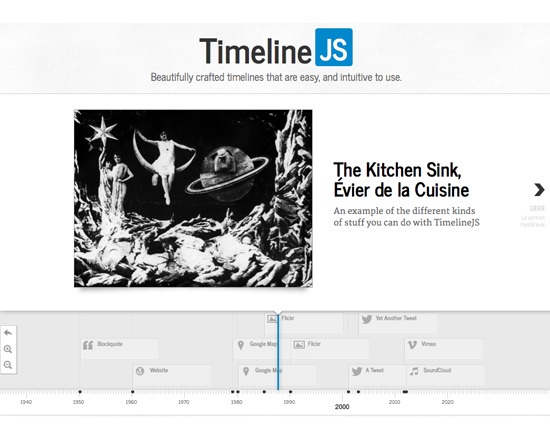
<p>Timeline JS is a free timeline tool that can be poplulated from either a Google spreadsheet or a JSON file, and can draw media material from a variety of sources, such as Twitter, Flickr, Wikipedia, YouTube and more. It has been designed to be both easy to use and easy to embed the results in another web page.</p>
Other list by Grady Zielke
Wikipedia Scraping and Analysis
Twitter Extraction Code Tools