Sentiment Analysis
This list highlights some sentiment analysis tools.
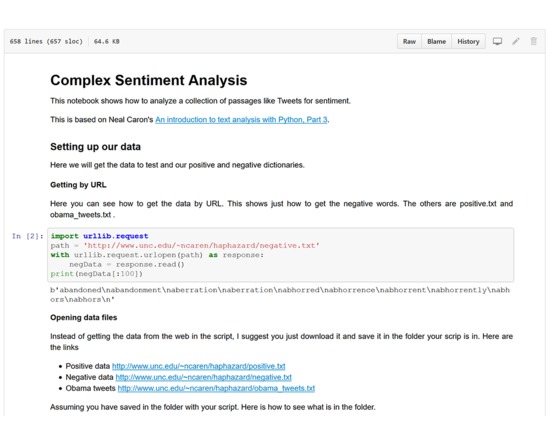
Code from an iPython notebook, based on:
http://nealcaren.web.unc.edu/an-introduction-to-text-analysis-with-python-part-3/
This notebook shows how to conduct sentiment analysis on a collection of passages (e.g. Tweets) using dictionaries of positive and negative words.
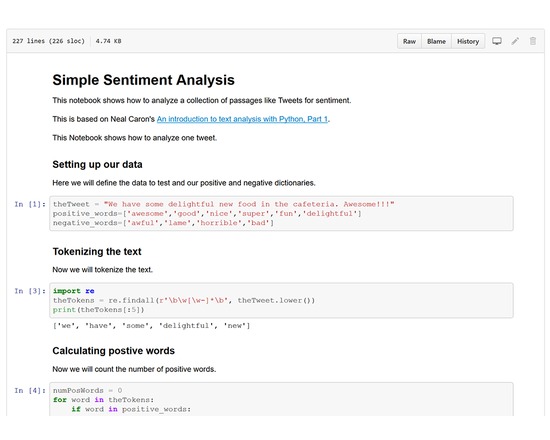
Code from an iPython notebook, based on:
http://nealcaren.web.unc.edu/an-introduction-to-text-analysis-with-python-part-1/
This notebook walks the user through analyzing a single string of text by creating custom dictionaries of positive and negative words.
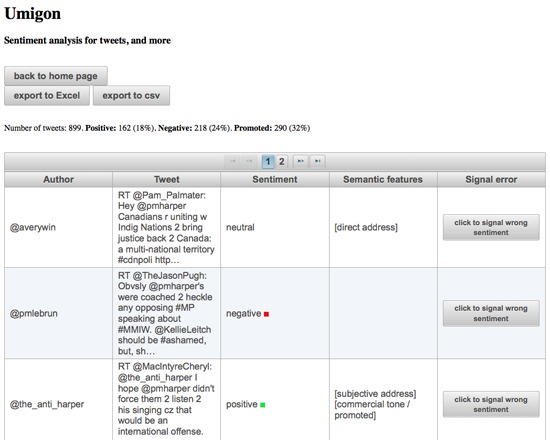
<p>Umigon is a tool used for the sentiment analysis of texts. It is one of the tools of the <a href="http://tapor.ca/tools/1668">Nocode app</a> which is a suite of text analysis tools. Results can be exported in Excel or CSV format for further analysis.</p> <p>It was formerly a stand alone web-based and open-source tool for the sentiment analysis of tweets. From a person's Twitter handle, Umigon retrieved that account's tweets and processed them for sentiment while accounting for factual statements (ex: "I hate war" will be classified has negative, and "war in Syria" will be classified as neutral). Tweets could also be pasted manually in the entry box provided. Beyond sentiment analysis, Umigon could identify characteristics such as whether the tweet contains a question, whether it contains possible promotional/commercial subject matter, or temporal indicators based on tense.</p> <p>The developer of this application can be reached on <a href="http://twitter.com/seinecle">Twitter.</a></p>
<br>As of April 2022, Umigon has been archived after a long period without new developments.
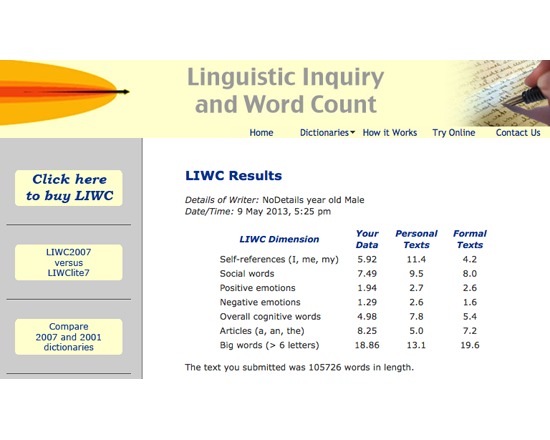
<p>LIWC (Linguistic Inquiry and Word Count) is a text analysis program available for purchase. It calculates the degree to which various categories of words are used in a text, and can process texts ranging from e-mails to speeches, poems and transcribed natural language in either plain text or Word formats. A free, minimalist web version is available through the website.</p>
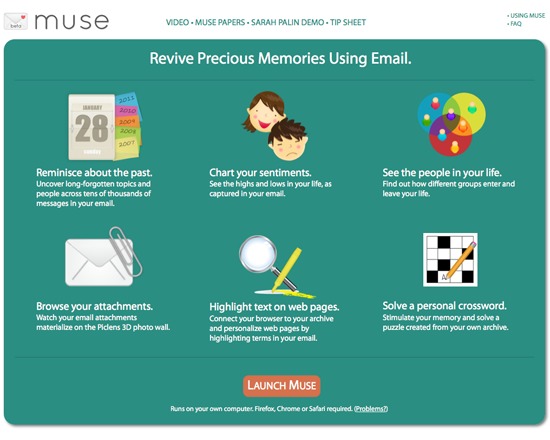
<p>Muse is a free, open source JavaScript tool for reflecting on and searching for patterns in the past by examining one's personal e-mail archive. It analyses e-mail to generate several views including a sentiment graph from messages that may reflect particular emotions or feelings, inferred groups based on communications with various contacts, a calendar view, or an an attachment wall of all documents attached to e-mails.</p>
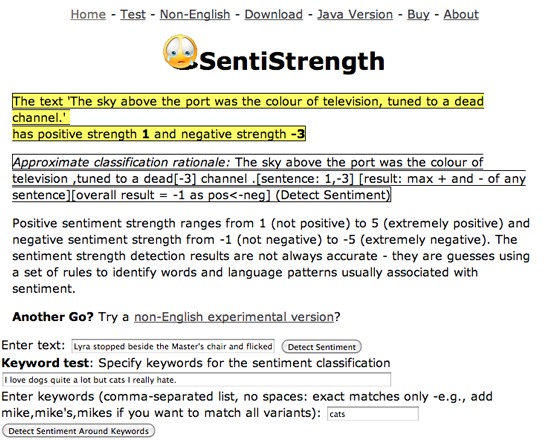
<p>SentiStrength is a tool for sentiment analysis available for free to academic users (with registration), in Java and Windows-optimized versions. It estimates the strength of sentiment in short texts, and can handle informal language. Strength is expressed in a scale of 1 to 5 for positive sentiments, and -1 to -5 for negative; it also includes an option for assessing neutrality. SentiStrength is available for multiple languages, with extensibility for languages and contexts not already included. According to the developers, SentiStrength has human-level accuracy for short English texts. Commercial users must purchase a license.</p>
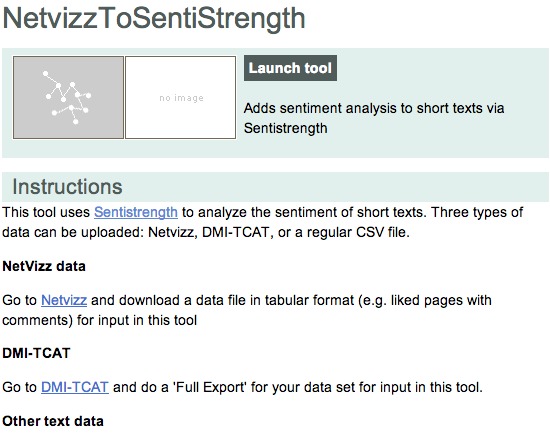
<p>NetvizzToSentiStrength is a free, web-based sentiment analysis tool for short texts, designed to work particularly with a Netvizz search of Facebook data. In addition to Netvizz data, it also accepts DMI-TCAT and CSV files. </p>
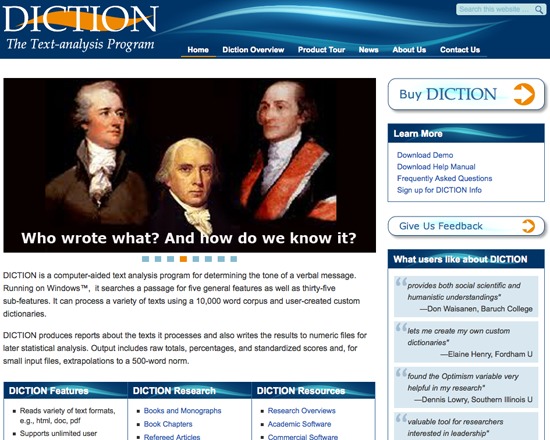
<p>Diction is a text analysis program for purchase, designed to determine the tone of a text, and generate reports and statistical analysis from it. DICTION versions are available for Windows® on a PC and Mac®.</p>
Other list by Gregory Whistance-Smith
Web Scrapers