nodegoat creates visualizations and provides a graphical user interface for the maintenance of data. It combines a variety of data management functions into one program.
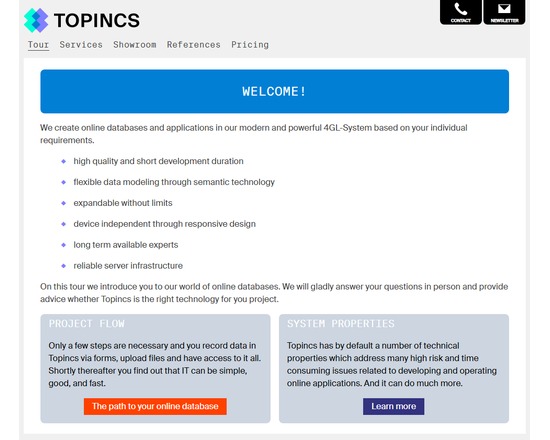
Topincs is a online database software. Given a data model, it allows data to be recorded and files to be uploaded and annotated through forms, data and files to be displayed and navigated through interconnected data sheets, and all that searched in the index. It overcomes the rigidity of relational databases by using semantic technology. In the simplest use case, a group of users can collaboratively edit information and upload files from any device with a web browser and an internet connection. Development time ranges between 1 and 8 hours.
By designing and implementing services, the data can be manipulated, transformed and aggregated through an virtual object oriented programming interface driven by the data model. This allows sophisticated use cases where different user groups with different rights are presented a completely different application working on the same database. In these cases development time ranges between 2 and 20 days.
A Topincs online database can be rented for a monthly fee. Topincs provide all services related to an online database: data modeling, programming, and support. They have special rates for educational institutions. Topincs can also be used as a Platform as a Service where the dark art of Topincs modeling and development must be studied online. The underlying semantic technology, Topic Maps, is taught there through hands on examples and will change your view on information technology.
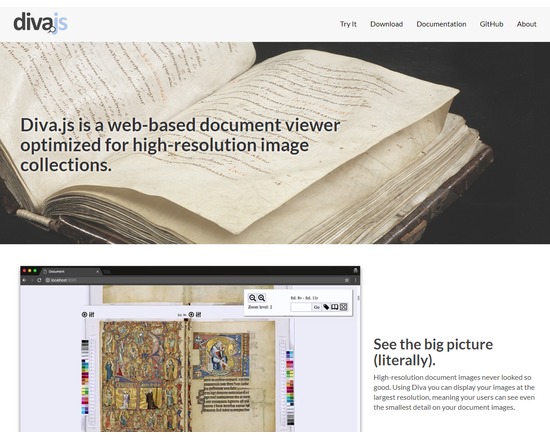
Diva.js (Document Image Viewer with AJAX) is a JavaScript book image viewer designed to present multi-page documents at multiple resolutions. Using Diva.js, high resolution images can be delivered to scholars interested in studying fine details of archival collection images.
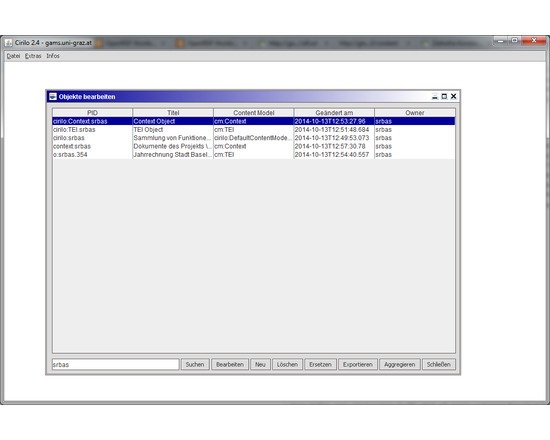
GAMS/Cirilo is an application developed for content preservation and data curation in FEDORA-based repository systems. Content preservation and data curation include object creation and management, versioning, normalization and standards, and the choice of data formats. The client offers functionalities which are especially prone to be used as tools for mass operations on FEDORA objects, such as ingest or replacement processes. Cirilo uses a collection of predefined content models, which can be used without further adjustments for standard workflow scenarios like the management of collections of TEI objects. It encapsulates functions for the resolvement of place names or ontology concepts, thus semantically enriching resources in the digital archive. Various dissemination options can also be assigned with the client. Cirilo is a contribution to the DARIAH-EU task “Reference Software Packages. The source code of the client can be found at https://github.com/acdh/cirilo, the documentation is available at http://gams.uni-graz.at/doku. An „archive-in-a-box“-installation package (Client including a FEDORA 3.5 instance) for Debian-based Linux-distributions can be downloaded from http://gams.uni-graz.at/download/cirilo-installer-2.4.tar.gz
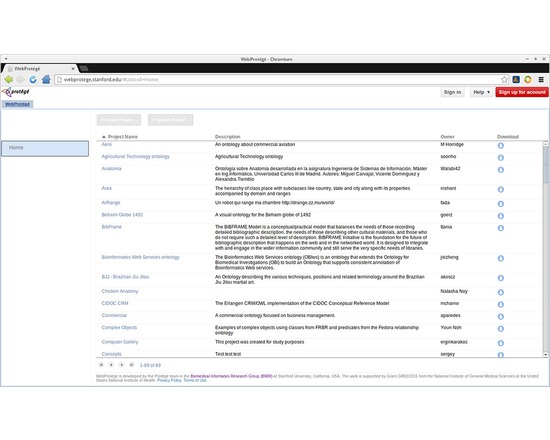
The Protege Project offers WebProtege and Protege Desktop, which are free and open source ontology editing applications.
WebProtégé is an ontology development environment for the Web that makes it easy to create, upload, modify, and share ontologies for collaborative viewing and editing. WebProtégé fully supports the latest OWL 2 Web Ontology Language. The highly configurable user interface creates the perfect environment for beginners and experts alike. Collaboration features abound, including sharing and permissions, threaded notes and discussions, watches and email notifications. RDF/XML, Turtle, OWL/XML, OBO, and other formats available for ontology upload and download.
Protégé Desktop is a feature rich ontology editing environment with full support for the OWL 2 Web Ontology Language, and direct in-memory connections to description logic reasoners like HermiT and Pellet. Protégé Desktop supports creation and editing of one or more ontologies in a single workspace via a completely customizable user interface. Visualization tools allow for interactive navigation of ontology relationships. Advanced explanation support aids in tracking down inconsistencies. Refactor operations available including ontology merging, moving axioms between ontologies, rename of multiple entities, and more.
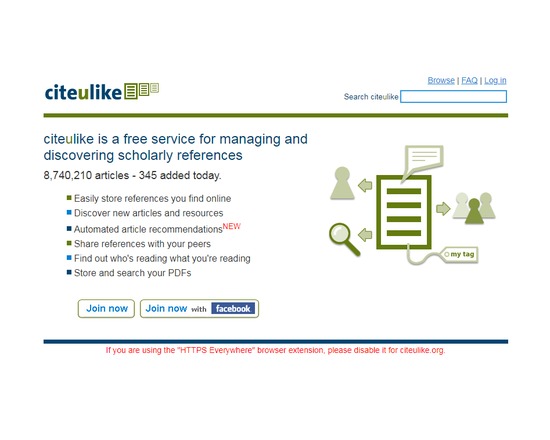
CiteULike is a free service to help you to store, organise and share the scholarly papers you are reading. When you see a paper on the web that interests you, you can click one button and have it added to your personal library. CiteULike automatically extracts the citation details, so there's no need to type them in yourself. It all works from within your web browser so you can access it from any computer with an Internet connection. CiteULike supports annotation and rating of items, and upload of attachments (e.g. PDF file). (Attachments are only accessible privately by individual users). Bibliographic entries can be imported singly or in batches using BibTex or RIS formats.
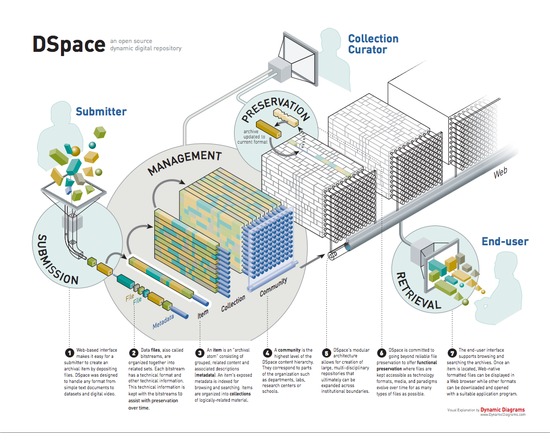
DSpace is the software of choice for academic, non-profit, and commercial organizations building open digital repositories. It is free and easy to install "out of the box" and completely customizable to fit the needs of any organization.
DSpace preserves and enables easy and open access to all types of digital content including text, images, moving images, mpegs and data sets. DSpace has an active community of developers and is used by thousands of institutions worldwide.
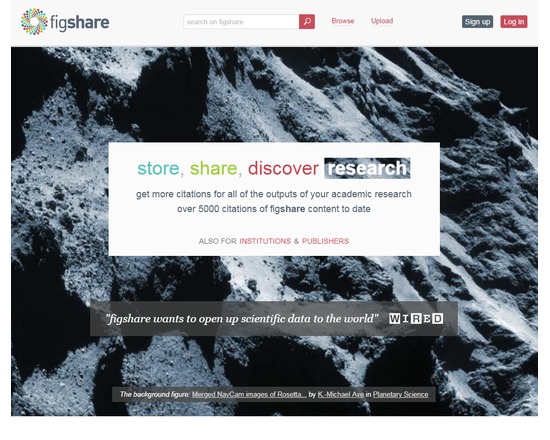
Figshare is a repository where users can make all of their research outputs available in a citable, shareable and discoverable manner. All file formats can be published, including videos and datasets that are often demoted to the supplemental materials section in current publishing models. Users of the site maintain full control over the management of their research whilst benefiting from global access, version control and secure backups in the cloud.
By opening up the peer review process, researchers can easily publish null results, avoiding the file drawer effect and helping to make scientific research more efficient. Figshare uses creative commons licensing to allow frictionless sharing of research data whilst allowing users to maintain their ownership.
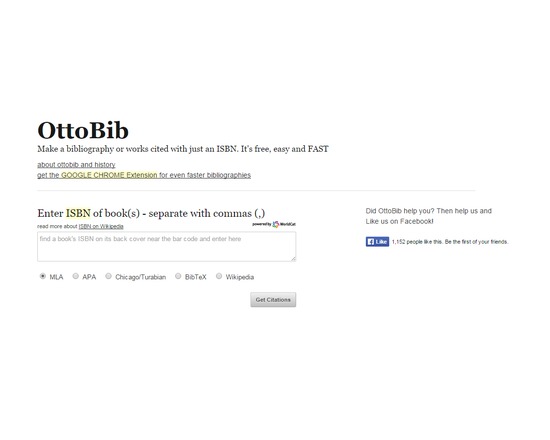
OttoBib generates a bibliography or citation with just an ISBN. Additionally, the reader or teacher can see the books, their covers, links to Amazon or other online references.