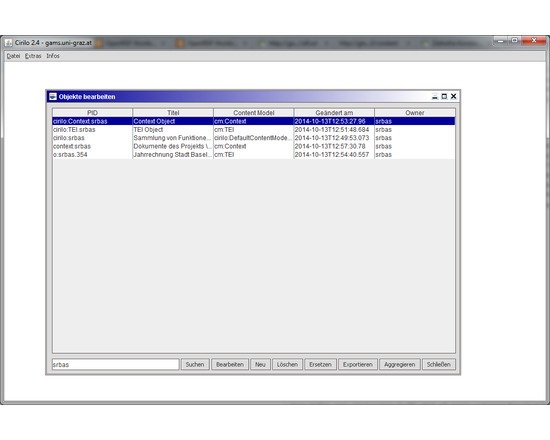
GAMS/Cirilo is an application developed for content preservation and data curation in FEDORA-based repository systems. Content preservation and data curation include object creation and management, versioning, normalization and standards, and the choice of data formats. The client offers functionalities which are especially prone to be used as tools for mass operations on FEDORA objects, such as ingest or replacement processes. Cirilo uses a collection of predefined content models, which can be used without further adjustments for standard workflow scenarios like the management of collections of TEI objects. It encapsulates functions for the resolvement of place names or ontology concepts, thus semantically enriching resources in the digital archive. Various dissemination options can also be assigned with the client. Cirilo is a contribution to the DARIAH-EU task “Reference Software Packages. The source code of the client can be found at https://github.com/acdh/cirilo, the documentation is available at http://gams.uni-graz.at/doku. An „archive-in-a-box“-installation package (Client including a FEDORA 3.5 instance) for Debian-based Linux-distributions can be downloaded from http://gams.uni-graz.at/download/cirilo-installer-2.4.tar.gz
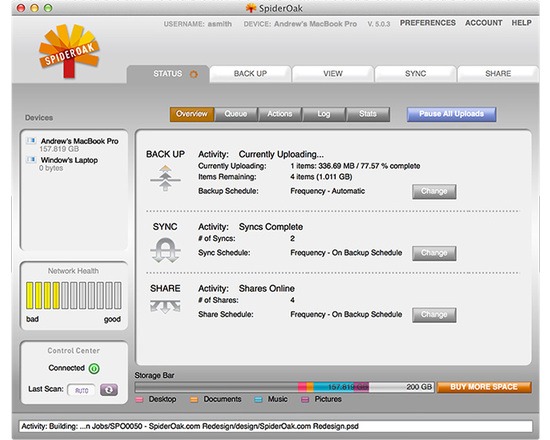
SpiderOak provides an private and secure online backup, sync, sharing, access & storage solution for all file and data types. It was designed with a 'Privacy-as-a-Platform' approach. The 'Zero-Knowledge' privacy cloud technology provides a central, private place to store data, free from surveillance by private and public entities. Data is fully encrypted end-to-end (not only during transit) and only the user is able to unlock it using their password. Passwords are never stored by SpiderOak and the company cannot see the names of files or folders in your account.
SpiderOak allows you to securely backup files (including a built-in versioning system), choose to sync data across all of your devices, and share folders or files privately using a password-protected link. Users can have unlimited devices connected to their SpiderOak account which backs up your data so you are able to restore files, even if they are deleted.
Some components of SpiderOak are open source (See GitHub Page). The company intends to be fully open source in the future but as of 2014 their source is not available.
New users get 2GB free (no time limit) and can upgrade to more storage as required.
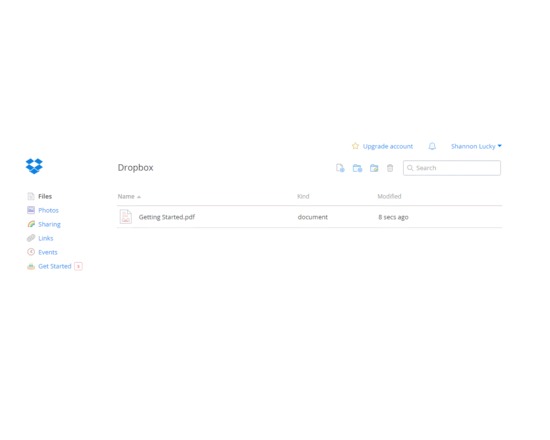
Dropbox is a file hosting service that includes cloud storage, personal cloud, file synchronization, and client software across multiple platforms. Dropbox allows users to create a folder on each of their computers where any type of file can be saved, synchronized, and made available across all computers. Contents of the Dropbox folder are also accessible via dropbox.com and mobile applications. Individual files and folders can be shared with other Dropbox users or made publicly accessible.
Dropbox for Business is a paid service targeting organizations by providing administrative controls and auditing functionality while allowing users to create a work account that is completely separate from their personal account but the two are viewable side by side.

BuzzData was a website that allowed users to create accounts to share and follow datasets. Data was shared in public rooms under open licenses. The service included tools to help visualize and present data.
BuzzData was closed on August 1, 2013.
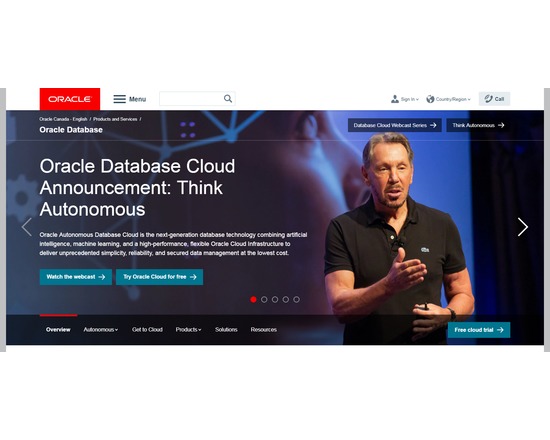
Oracle Database is a powerful and extensive relational database management system (RDBMS). There are restrictions on the free version of the software.
Features:
Supports symmetric multiprocessing (SMP)
Stores data logically in the form of tablespaces and physically in the form of datafiles
Transportable tablespaces
Advanced Queuing (AQ)
64-bit database
Data Mining Option
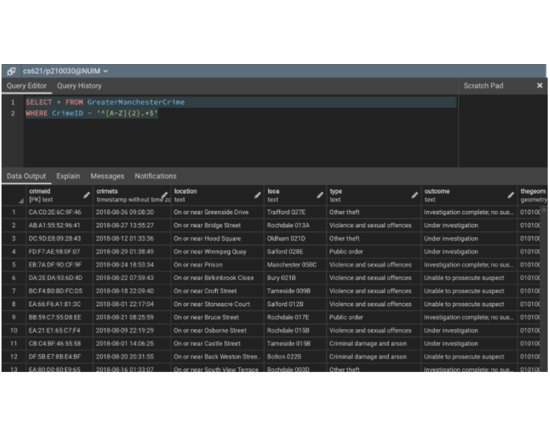
PostgreSQL is a powerful, open source object-relational database system running on all major platforms. It supports native programming interfaces for C/C++, Java, .Net, Perl, Python, Ruby, Tcl and ODBC among others.
Features:fully ACID compliant
full support for foreign keys, joins, views, triggers, and stored procedures (in multiple languages)
includes most SQL 2008 data types, including INTEGER, NUMERIC, BOOLEAN, CHAR, VARCHAR, DATE, INTERVAL, and TIMESTAMP
supports storage of binary large objects, including pictures, sounds, or video
multi-Version Concurrency Control (MVCC)
Highly customisable
TwapperKeeper is now called Hootsuite Archives and can be accessed from within Hootsuite.
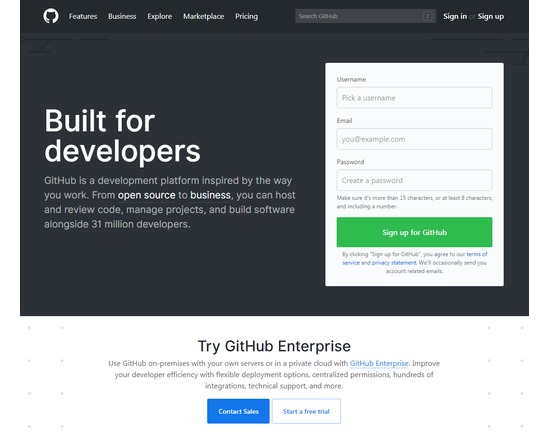
GitHub is a web-based repository service which offers the distributed revision control and source code management (SCM) functionality of GIT with a graphical user interface, desktop, and mobile integration. It also provides collaboration tools such as access control, wikis, task management, code review, bug tracking, and feature requests. It offers free accounts, often used to host opensource software projects, and private (paid) repositories.
Projects on GitHub can be accessed and manipulated using the git command-line interface and all of the standard git commands work with it. GitHub also allows registered and non-registered users to browse public repositories on the site. Multiple desktop clients have also been created by GitHub and other third parties which integrate with the platform.
GitHub is mainly used for code but can also be used for non-code files, it supports the following formats and features:
3D render files
Photoshop's native PSD format can be previewed and compared to previous versions of the same file.
Nested task-lists
Documentation and wikis
Small websites can be hosted from public repositories on GitHub. The URL format is http://projectname.github.io.
Issue tracking (including feature requests)
Visualization of geospatial data
Gantt charts
GitHub is a heavily used in the opensource development community but does not require hosted projects to meet the definition of Open Source.
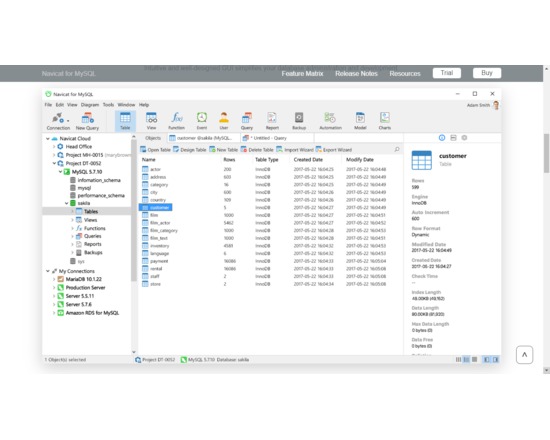
Navicat for MySQL is an interface for working with MySQL databases, including importing data from CSV or Excel, exporting, reporting, querying, and for developing scripts etc, and general database exploration
Navicat for MySQL can also be used with MariaDB databases