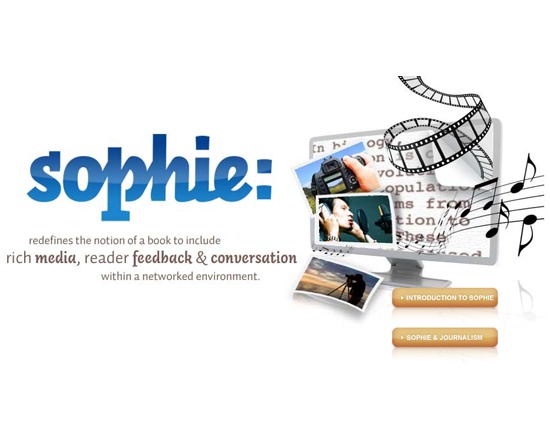
Sophie is a free, creative commons authoring tool from the Institute for the Future of the Book and the University of Southern California's School of Cinematic Arts that enables collaboration, reading and publication. Its highlights include an authoring environment that allows users to create complex networked multimedia documents, a reader than opens books in a browser without downloading additional software, comment frames for adding discussions within books, digital libraries compatible with the Sophe iPad app, timeline creation and collaborative book creation. As of version 2.1, Sophie includes HTML5 export for data integrating multimedia content and for use on a wide variety of devices.
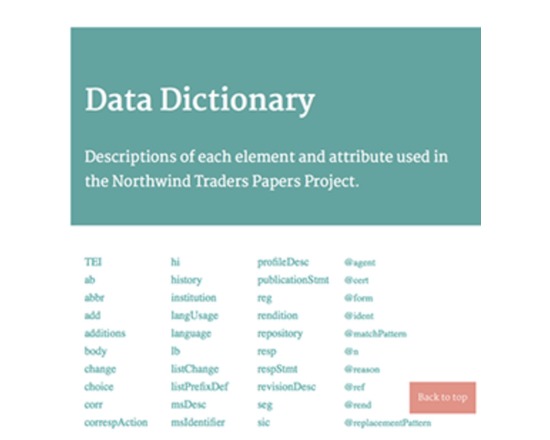
Aimed at the TEI editing community and intended to be run inside oXygen, the Data Dictionary Generator (DDG) generates profiles of every element and attribute appearing in a TEI file. Each entry includes a definition from the TEI Guidelines, a local, project-specific definition (if provided), and a brief snapshot of how the element or attribute is actually being used. By making it easy to compare these three things, the DDG aims to help project editors reflect on current practice within their projects and quickly create stronger encoding guidelines for their collaborators.

Lucidpress is a free online editor for making pamphlets, brochures, flyers, magazines, and more. Features include real-time collaboration, digital publishing, and easy sharing, all of which come in an intuitive, drag-and-drop interface. Upgrade to a professional account for increased storage space and access to additional templates.
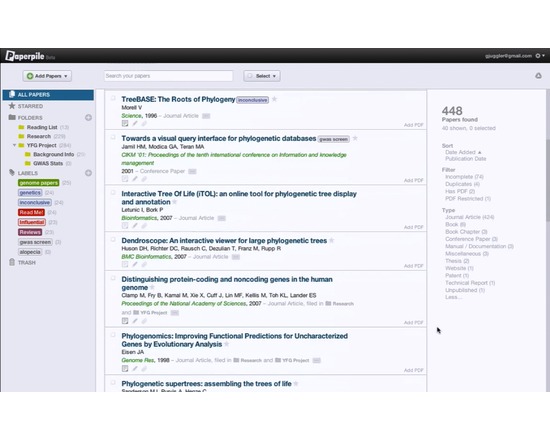
Paperpile is a web-based commercial reference management software with special emphasis on integration with Google Docs and Google Scholar. It imports data from academic publisher websites and from databases such as PubMed, Google Scholar, Google Books, and arXiv. Paperpile can retrieve and store publication PDF files to the user's Google Drive account.
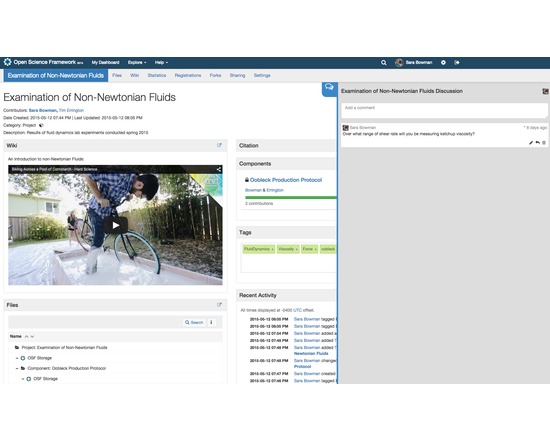
The Open Science Framework (OSF) is a free, open source tool designed to help researchers manage the entire research workflow: planning, execution, reporting, archiving and discovery. It is part collaboration software and part version control system. The OSF can be used to manage individual projects or large collaborative ones. Privacy and sharing settings allow for fine-grained control over access to files and materials stored on the platform - share privately with collaborators or publicly with the community at large. Each project, contributor, and file on the OSF is given a persistent unique identifier, making all research products citable. The platform also mints DOIs and ARKs through DataCite. A collaborative wiki allows contributors to work on writing materials simultaneously.
API connections with other services (Github, Dropbox, Box, Dataverse, Google Drive, figshare, Zotero, Mendeley, Amazon S3) allow researchers to connect other services they already use in order to see all their materials in one place. The OSF also offers a registry for preregistering research projects and/or analysis plans.
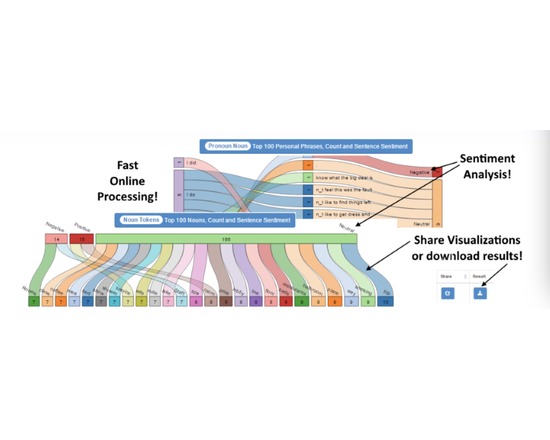
SentimentBuilder is an online tool that performs text analytics on emails, reviews, feedback, chat data or any unstructured texts via Natural Language Processing. It's the only tool where you can upload a file for processing and then visually view the results in a Sankey Flow Report to quickly identify trends, issues and strengths and then customize each view, save and share! Export any result for your own offline analysis! Try the Always Free version today and upload your own data or try one of our sample files.

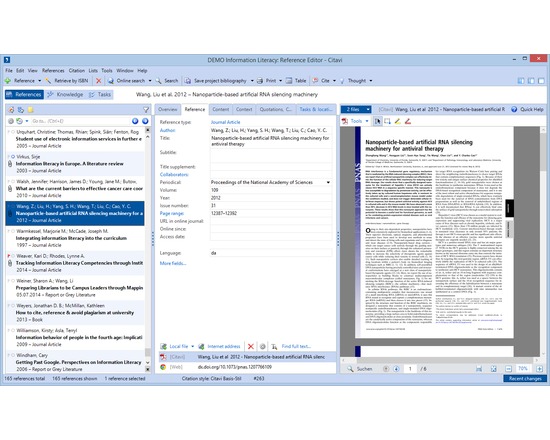
Citavi's core features are reference management, knowledge organization, and task planning.
Reference management
Search in thousands of databases and library catalogs from within Citavi
Organize references
Annotate and automatically rename PDF files
Batch import PDF files and import their metadata automatically
Find fulltext to references
Collaborate with others on a local network (no need to have your data in the cloud)
Import from other reference management programs and formats, including RIS and BibTeX
Import ISBNs, DOIs and PubMed-IDs on web pages with a click
Import web pages with a click
Transform web pages into PDF files to save their content
Work seamlessly with Word (versions from 2003)
Send references to Open Office and LibreOffice Writer and any program that can process files in RTF (i.e. Scrivener)
Use with LaTeX editors
Create subject bibliographies with a click
Publish in all common citation styles. Styles for journals can be requested" target="_blank" for free
Integrated citation style editor
Advanced style finder
Integrated quick help
Interface and quick help in seven languages (English, French, German, Italian, Polish, Portuguese, Spanish)
Knowledge organization
Import text excerpts and images from documents as quotations and organize them together with summaries, comments and own ideas imported as "thoughts"
Quotations, summaries, comments and thoughts can be outlined directly in Citavi to reflect the structure in chapters of the publication prior to the actual writing, thus permitting to separate the construction of the argumentative structure from the actual writing process
Task planner
Schedule tasks related to titles (order, photocopy, extract citations, read, check, ...) and milestones
Print lists of to do lists with a click
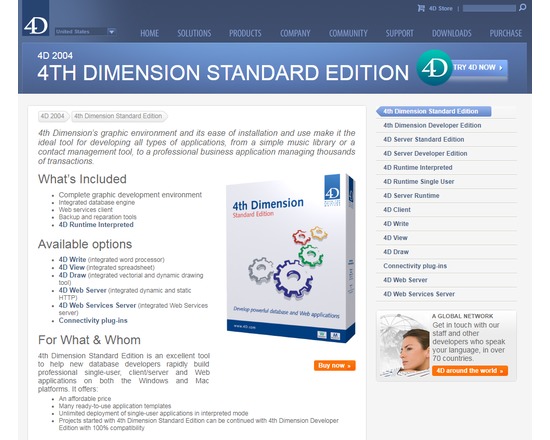
4th Dimension Standard Edition is an excellent tool to help new database developers rapidly build professional single-user, client/server and Web applications on both the Windows and Mac platforms. It offers:
- An affordable price
- Many ready-to-use application templates
- Unlimited deployment of single-user applications in interpreted mode
- Projects started with 4th Dimension Standard Edition can be continued with 4th Dimension Developer Edition with 100% compatibility
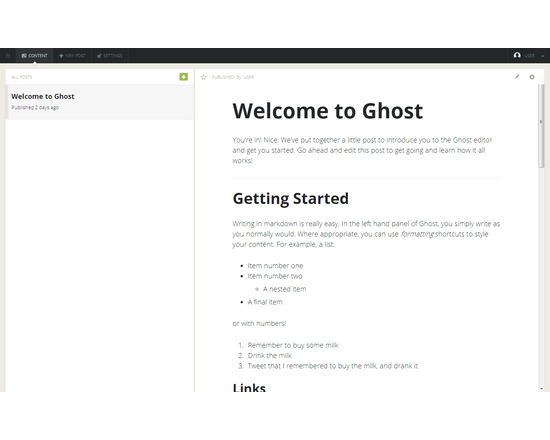
Ghost is a free, open source publishing platform. Also available as a hosted service for a monthly subscription cost.