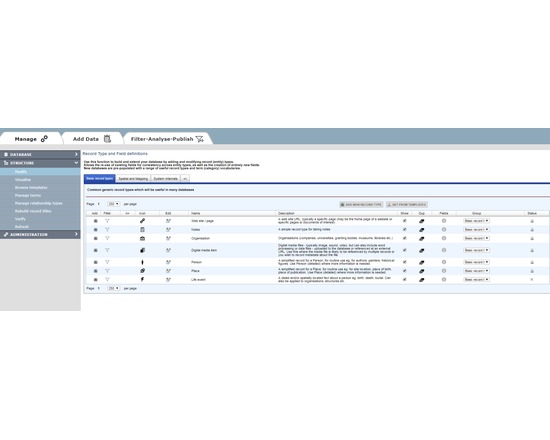
HEURIST (http://HeuristNetwork.org) is an extremely flexible, end-user oriented, web-based data management system designed specifically for Humanities data. Developed since 2005, it has been in active use across many projects since 2009. It is available both as a free web service for researchers (hosted at the University of Sydney Data Centre) or for installation on a physical or virtual server (Open Source on gitHub).
Researchers can design, create, manage, analyse, visualise and publish their own richly-structured database(s) through a simple web interface, without the need for programmer(s). Quite complex databases can be built in a few hours by borrowing structures and vocabularies published by other users. Databases can be designed and built incrementally, as existing data are not affected by changes in structure. Databases created by Heurist are stored in MySQL with a repeatable structure facilitating sustainability and independent access by other software.
Advanced features include record linking, graph structure, drill-down facet searches, rule-based queries, custom reports, linked map-timelines, network visualisation, normalised spreadsheet import, crosstabulation, XML feeds, XSLT transforms. The team provides initial email and skype assistance for project setup at no cost, and special customisations at modest cost.
Heurist is applicable in many domains including History, Archaeology, Anthropology, Cultural Research, Linguistics, Media Studies etc. It handles everything from text, tags and categories, through networks of rich relationships and offset annotations, to images, video, spatial data and dating (including non-western systems and dating uncertainty).
Sophisticated searches (including faceted and rule-based) can be saved, organised and rendered as layered interactive maps, timelines, network visualisations, crosstabulations, lists, custom reports, XML and XSLT transforms, all of which can easily be printed or embedded (live) in a website - Heurist provides the html code required to embed results in a web page or CMS.
Databases can easily be migrated later to a personal or institutional server. Since the data are stored in a standard MySQL database with a fixed and well-documented structure, the data can be accessed directly via SQL from most programming languages independently of Heurist.
Version 4.2 (Jan 2016 onwards) is available as a service via the Heurist website. Version 4 delivers a user-customisable interface of widgets, along with better mapping and visualisation. Existing version 3 databases are bidirectionally compatible with version 4.

iSpring is an authoring tool that allows you to create online presentations with slides synced with audio and video narration. You can create quizzes and courses, add attachments and web links, and integrate these courses with BlackBoard LMS. Additionally, you can download iSpring Free which allows you to convert PowerPoint to Flash for free to view your presentations online.
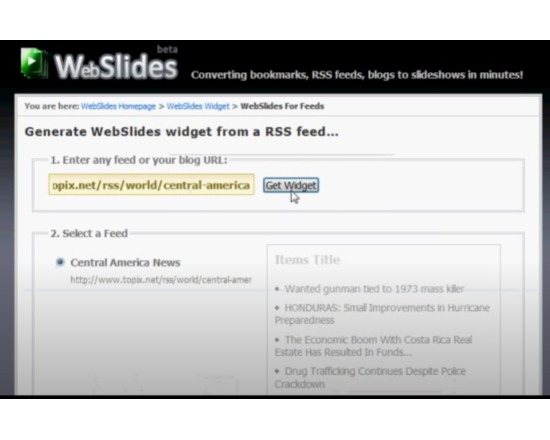
WebSlides allows you to convert your bookmarks and feeds to present them as live web pages in an interactive slideshow. Each WebSlide has a unique URL, or comes as a widget. Users may create a guided tour of any website, group course information for students, provide a simple tutorial on any subject, or share images on the web. Additionally, content publishers may use this presentation format for repacking and remixing content.
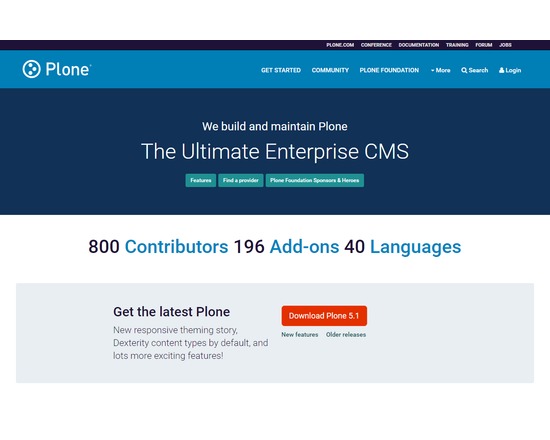
Plone is a powerful, flexible, open source Content Management System (CMS) built on top of Zope application server and CMF.
Features:
- Flexible and adaptable workflow
- Customisable
- Free add-ons
- Versioning, history and reverting content
- Support for multiple mark up formats
- Multilingual content management
- RSS feed support
- WebDAV and FTP support
- WYSIWYG
- Integrates with Active Directory, Salesforce, LDAP, SQL, Web Services, LDAP and Oracle
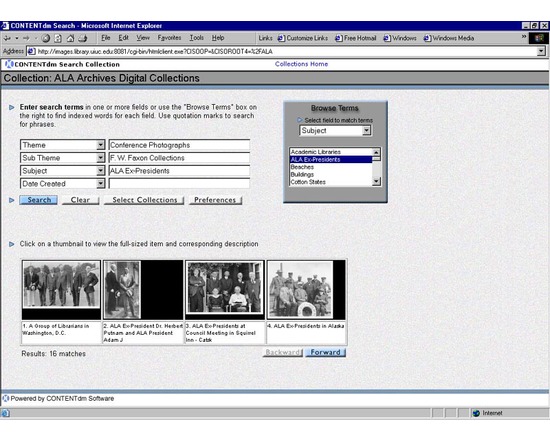
CONTENTdm is digital collection management software that allows for the upload, description, management, and access of digital collections. CONTENTdm is mostly used by libraries, archives, museums, government agencies, universities, corporations, historical societies, and other organizations that wish to host a digital collection.
Collection storage, management, and delivery to users across the web, in any format (e.g., local history archives, newspapers, books, maps, slide libraries, audio, video)
Integrated OCR capability for full-text searching
Support for complex media; import tools and wizards
Controlled vocabulary for consistent, uniform metadata entry
Standards support (e.g., Unicode, Z39.50, Qualified Dublin Core, VRA, XML, JPEG2000, OAI-PMH)
Collection metadata harvesting to WorldCat
Flexible and fully customizable; integration with OCLC products
Website configuration tools and hosting services
Advanced customizations can be made using the CONTENTdm API
Free, 60-day evaluation available by request. CONTENTdm offers multiple licensing options based on collection size.