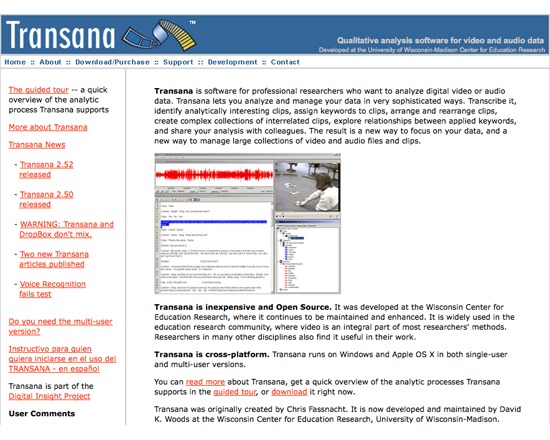
Transana is a free, open source program offered by the University of Wisconsin-Madison Center for Education Research for transcribing and analyzing large collections of video and audio data aimed at academic researchers. It enables users to manually transcribe in a variety of levels of detail, identify and access analytically significant sections of their data, manage collections, organize video clips into categories, apply keywords to sections or clips, generate graphical or textual reports, data mine and share markup.
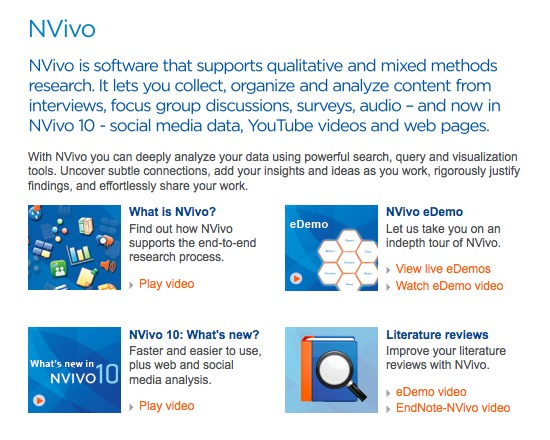
NVivo is a commercial software package for creating workspaces and corpuses. Its features include importing YouTube videos and comments, social media posts and discussions, web page and PDF capture, multiple language support and support for a wide variety of data formats such as spreadsheets, images, database tables and so on. Users can query their data in a variety of ways, annotate, cross-link and visualize connections, ideas and findings with charts, maps and models
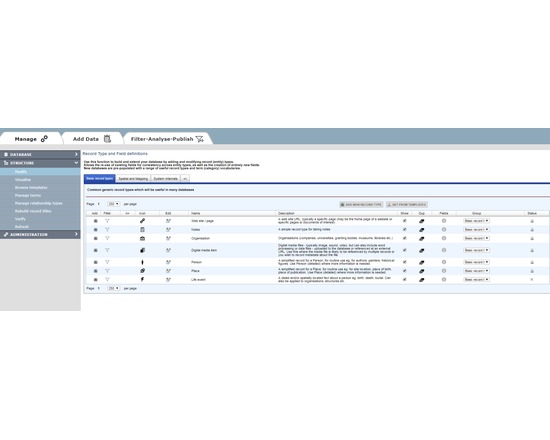
HEURIST (http://HeuristNetwork.org) is an extremely flexible, end-user oriented, web-based data management system designed specifically for Humanities data. Developed since 2005, it has been in active use across many projects since 2009. It is available both as a free web service for researchers (hosted at the University of Sydney Data Centre) or for installation on a physical or virtual server (Open Source on gitHub).
Researchers can design, create, manage, analyse, visualise and publish their own richly-structured database(s) through a simple web interface, without the need for programmer(s). Quite complex databases can be built in a few hours by borrowing structures and vocabularies published by other users. Databases can be designed and built incrementally, as existing data are not affected by changes in structure. Databases created by Heurist are stored in MySQL with a repeatable structure facilitating sustainability and independent access by other software.
Advanced features include record linking, graph structure, drill-down facet searches, rule-based queries, custom reports, linked map-timelines, network visualisation, normalised spreadsheet import, crosstabulation, XML feeds, XSLT transforms. The team provides initial email and skype assistance for project setup at no cost, and special customisations at modest cost.
Heurist is applicable in many domains including History, Archaeology, Anthropology, Cultural Research, Linguistics, Media Studies etc. It handles everything from text, tags and categories, through networks of rich relationships and offset annotations, to images, video, spatial data and dating (including non-western systems and dating uncertainty).
Sophisticated searches (including faceted and rule-based) can be saved, organised and rendered as layered interactive maps, timelines, network visualisations, crosstabulations, lists, custom reports, XML and XSLT transforms, all of which can easily be printed or embedded (live) in a website - Heurist provides the html code required to embed results in a web page or CMS.
Databases can easily be migrated later to a personal or institutional server. Since the data are stored in a standard MySQL database with a fixed and well-documented structure, the data can be accessed directly via SQL from most programming languages independently of Heurist.
Version 4.2 (Jan 2016 onwards) is available as a service via the Heurist website. Version 4 delivers a user-customisable interface of widgets, along with better mapping and visualisation. Existing version 3 databases are bidirectionally compatible with version 4.
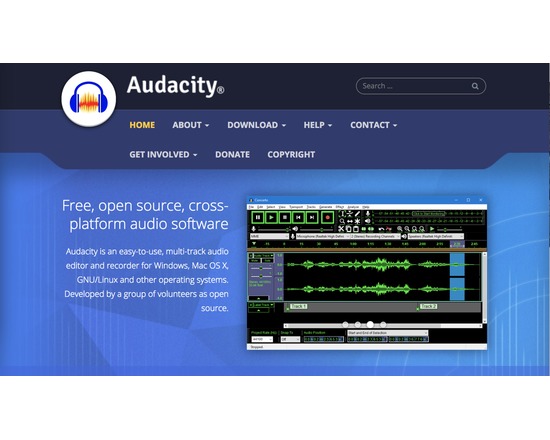
Audacity is a free, easy-to-use and multilingual audio editor and recorder. Basic features, as listed on their website, include:
Record live audio.
Record computer playback on any Windows Vista or later machine.
Convert tapes and records into digital recordings or CDs.
Edit WAV, AIFF, FLAC, MP2, MP3 or Ogg Vorbis sound files.
Cut, copy, splice or mix sounds together.
Change the speed or pitch of a recording.

flokoon displays search results from Last.fm, YouTube, and Fotolia in a graphic interactive map, that connects related topics through a series of spiderweb-like graphics.
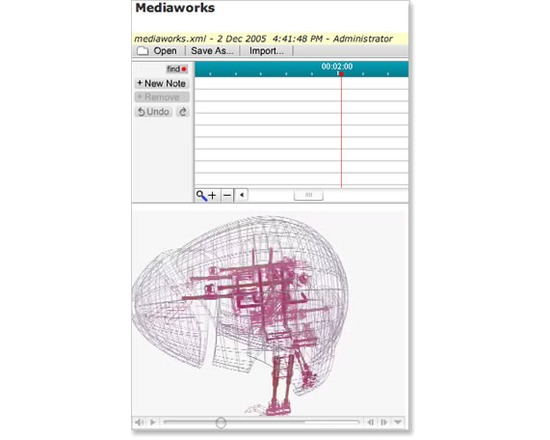
Project Pad is web-based system for media annotation and collaboration for teaching and learning and scholarly applications. Project Pad provides tools for browsing and working with audio, video, and images from digital repositories. The user may organize and annotate excerpts within their own "online notebook." Available as a standalone web application or set of Sakai tools.
ELAN is a tool for creating annotations on multiple layers on audio and video resources. The textual content of annotations is in Unicode and the transcription is stored in XML.
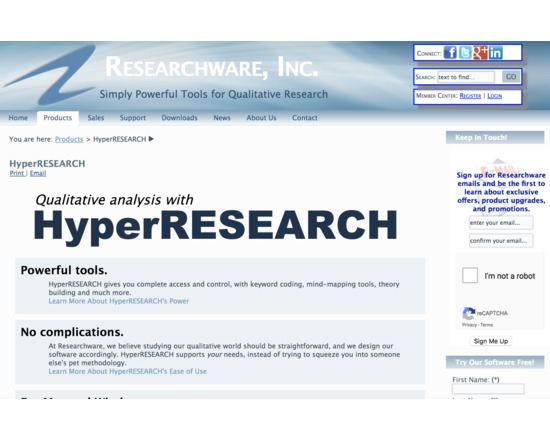
HyperRESEARCH enables users to code and retrieve, build theories, and conduct analyses of your data. You may work with text, graphics, audio and video sources.
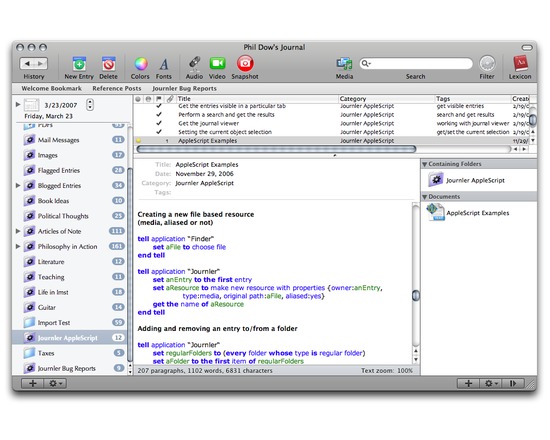
Journler is a daily notebook and entry based information manager. Scholars, teachers, students, writers, and everyday users may use this on a daily basis to integrate their notebook content to other sources of media such as audio and video.
The site has not been updated since 201. It looks like Journaler is now available open source though the option to purchase is still displayed.
Stories Matter is an oral history database that allows you to cut, index, and export audio and video recordings.