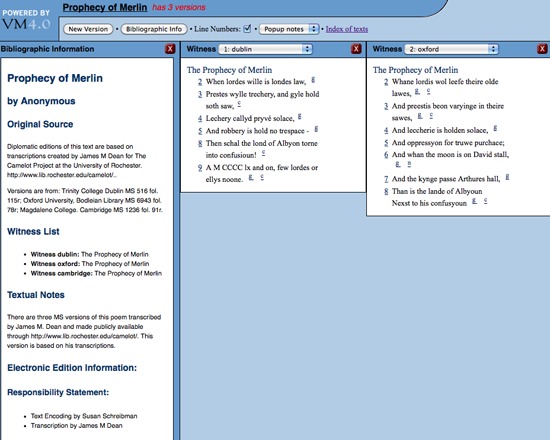
The Versioning Machine, now in version 4.0, is a framework and an interface for displaying multiple versions of text, and encodes the text according to TEI guidelines. It incorporates features found in both critical editions and electronic publication, in addition to providing an environment for textual editors to comparatively view the results of their edits. This tool may be downloaded for use on a local machine, or hosted on one's server for web usage.
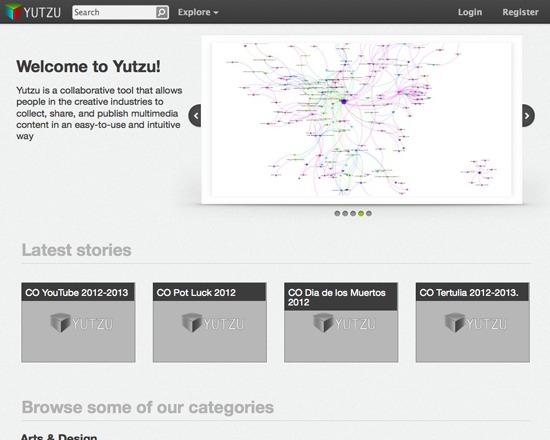
Yutzu is a collaborative tool for collecting and publishing multimedia content online, offered by the Cultureplex Lab at the University of Western Ontario. It is a web environment, designed to assist in the creative process, publication and visualization, and integrating a variety of multimedia tools. Yutzu has been used to showcase work, curate exhibitions and collections, and to facilitate teaching and learning.
SwiftRiver is a free, open source platform for filtering and processing large amounts of information. In particular, it can gather and filter data from common web sources such as email, Twitter or RSS. It also enables users to define 'buckets' according to their own criteria rather than relying on, for example, the information's social media popularity status. Utilizing a combination of filters and buckets, users create 'rivers' of data populated by their chosen sources. Developer Ushahidi has made all code available for general access via Github, though a custom, full-service, hosted version is available for a fee by contacting the company directly.
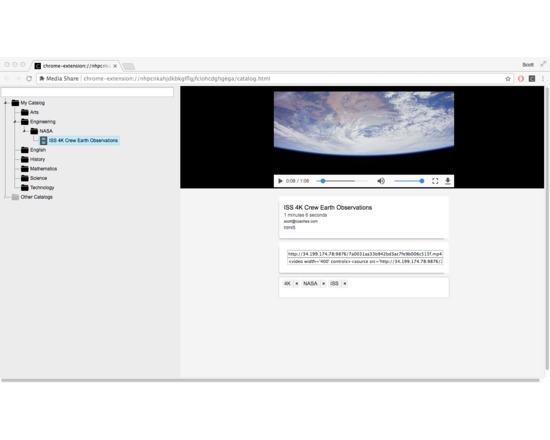
There is an unlimited number of videos, PDFs, etc. that can be used for education, training, instruction, or professional development.
Finding and curating them into playlists, integrating with existing workflow, and sharing with others is time consuming, inefficient, and often limited by ‘vendor lock-in.’
Media Share is a productivity tool that saves time, requires no training to use, and does not limit how or where content can be used.
Content curation and topic discovery website based primarily on publishers the user follows through social media.
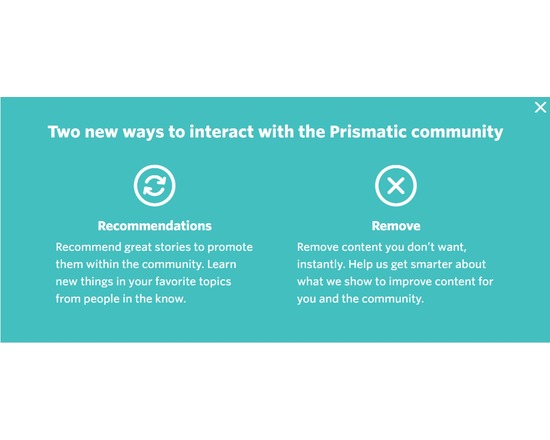
Upon signing up, users are asked to select a number of topics that fall within their fields of interest. Relevant content is shown in a vertical feed. Users have the option to recommend, comment, share, remove the content from their feed, or save it. Prismatic "learns" from your behaviour which topics and publishers are of most interest to you. They say the more people who use it the better it gets, as recommendations figure greatly into popularity rankings. There are no human editors, just algorithms.
Promoted features include connecting with communities who share your interests, learning from users who work in your field, the ability to share your discoveries with friends, and taking a "deep dive on any topic."
According to Aria Haghighi, one of the founders "...we have an architecture similar to a search engine: polling and crawling the open web and activity on social networks." A 2013 article on Slate.com refers to Prismatic as "the world's smartest news reader". It's a good addition to other search and curation tools such as Google Alerts and saved Twitter hashtag searches. It aims to be better than the rest through use of parameters that are not static; it adjusts to your preferences as well as trending content on other social media sites.
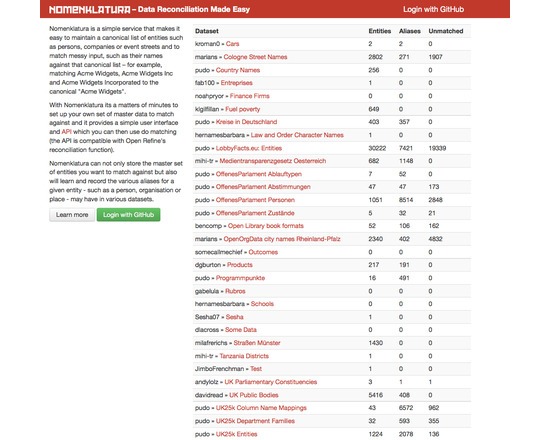
Nomenklatura is a reference data recon server. It is a service that allows users to define and manage manage lists of canonical entities (e.g. person or organization names) and aliases that connect to one of the canonical entities. This helps to clean up messy data in which a single entity may be referred to by many names.It includes a user interface, an API, and a reconciliation endpoint for OpenRefine for matching data from data sets with the canonical entries.
By submitting data to Nomenklatura, users agree to license it under the terms of the Open Database License.
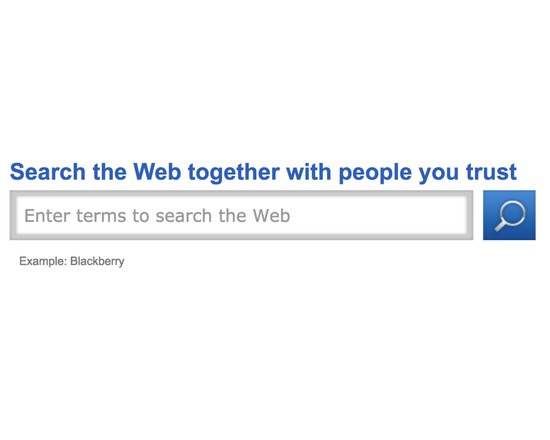
SearchTeam is a collaborative search engine that allows individuals and groups to curate search results in a public or shared SearchSpace.
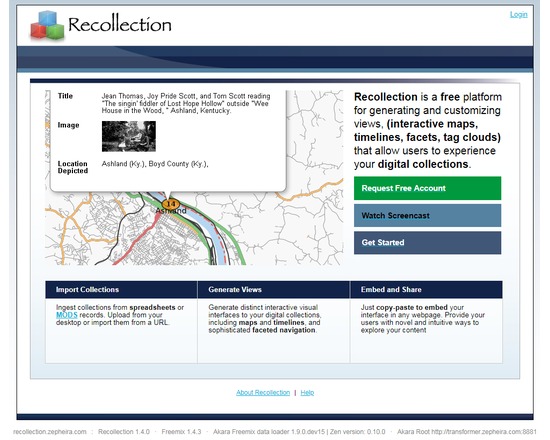
Recollection was a platform developed by Zepheira for the Library of Congress National Digital Information Infrastructure and Preservation Program (NDIIPP), allowing users to create and share embeddable interfaces to digital cultural heritage collections. The Library of Congress released its latest version of Recollection as Viewshare, built to increase the ease of finding, using, and sharing the project's software.
Recollection incorporates a series of web-based open standards and open source tools, including RDF, Simile Exhibit, Akara, and Django.
Recollection is no longer supported.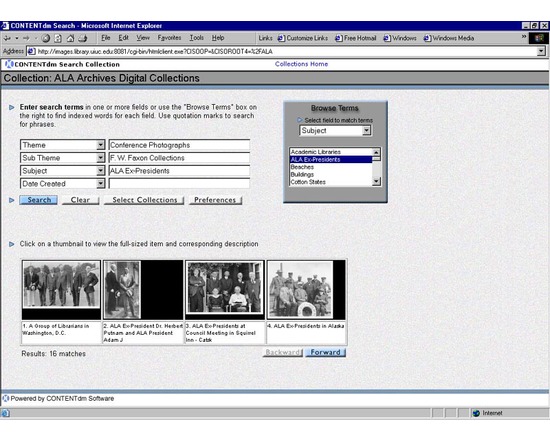
CONTENTdm is digital collection management software that allows for the upload, description, management, and access of digital collections. CONTENTdm is mostly used by libraries, archives, museums, government agencies, universities, corporations, historical societies, and other organizations that wish to host a digital collection.
Collection storage, management, and delivery to users across the web, in any format (e.g., local history archives, newspapers, books, maps, slide libraries, audio, video)
Integrated OCR capability for full-text searching
Support for complex media; import tools and wizards
Controlled vocabulary for consistent, uniform metadata entry
Standards support (e.g., Unicode, Z39.50, Qualified Dublin Core, VRA, XML, JPEG2000, OAI-PMH)
Collection metadata harvesting to WorldCat
Flexible and fully customizable; integration with OCLC products
Website configuration tools and hosting services
Advanced customizations can be made using the CONTENTdm API
Free, 60-day evaluation available by request. CONTENTdm offers multiple licensing options based on collection size.

Netvibes offers a free personal web dashboard for following feeds, friends and using the provided apps. A premium account includes functionality for analytics, tagging, curation, alerts, sentiment analysis, and search.