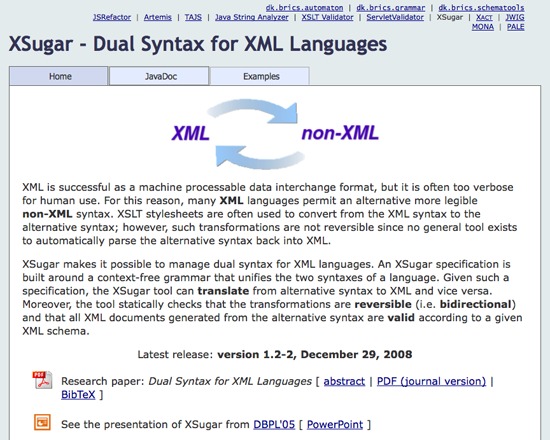
XSugar is a tool designed to manage dual syntaxes when working with XML documents, developed by the Department of Computer Science, Aarhus University. From a user-provided specification, XSugar translates between XML syntaxs, and makes statistical checks to ensure transformations will be reliably bidirectional and contain valid syntax in accordance with the schema.
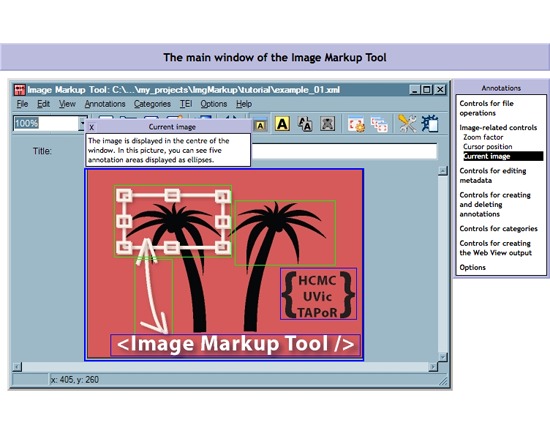
The UVic Image Markup Tool is a free tool for annotating images and storing the annotations in XML files from the University of Victoria's Humanities Computing and Media Centre. Its interface is designed for users without prior XML experience with additional functions for users familiar with XML, and supports multiple languages. The Image Markup Tool is available for Windows, and will also run in Linux with Wine.
Geographically Encoded Objects for RSS feeds. GeoRSS was designed as a lightweight, community driven way to extend existing feeds with geographic information.
As RSS and Atom become more prevalent as a way to publish and share information, it becomes increasingly important that location is described in an interoperable manner so that applications can request, aggregate, share and map geographically tagged feeds.RSS Map of Digital Humanities centers
Two primary GeoRSS encoding exist, including GeoRSS Geography Markup Language (GML) and GeoRSS Simple. GeoRSS-Simple is a lightweight format that supports basic geometries of point, line, box, polygon. GeoRSS GML is a Open Geospatial Consortium (OGC) GML Application Profile, and supports a greater range of features than GeoRSS Simple.
A Python-based XML web publishing framework which enables dynamic pipelining of XSLT transformations. Data is processed by an XML pipeline composed of several WSGI applications and middleware components.
Features:
Apache Cocoon Sitemap 1.0 compatible
WSGI modularity
URI pattern matching
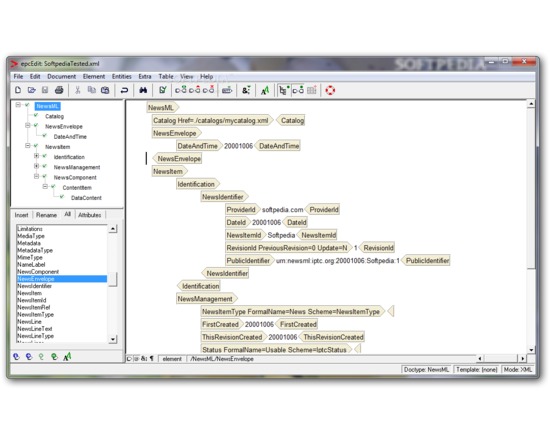
A structured text editor that may be used to create, edit, validate and convert XML and SGML documents. EpcEdit contains an integrated validating parser, an editor for CALS and HTML tables, an attribute editor and an element manipulation tool.
Features:
XML/SGML parser with full support of Oasis SGML-Open catalog files
Document structure mapping, enabling users to visualise the construction of an XML/SGML document without a DTD
Attribute editor that supports conformance checking of attribute values and has special support for ID and IDREF attributes
Configurable user interface that may be integrated with other tools through use of Tcl programming language
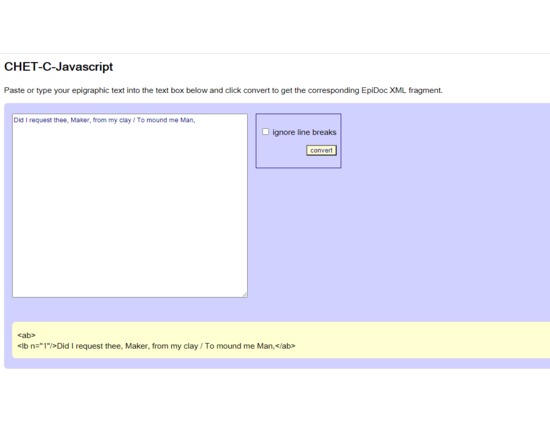
CHET-C, or Chapel Hill Electronic Text-Converter, is a browser based software tool designed to convert digital texts that employ standard epigraphic conventions such as the Leiden sigla into EpiDoc-compliant XML files.
The tool can be accessed online at http://www.stoa.org/projects/epidoc/stable/chetc-js/chetc.html. Fragments of epigraphic text using standard sigla (eg Leiden convention markup) are pasted into the tool and Epidoc compliant XML is generated.
Prior versions exist (MSAccess + VBA and Java, both now deprecated) for use by those without stabel web access or who wish to customise the underlying regular expressions to process non standard sigla
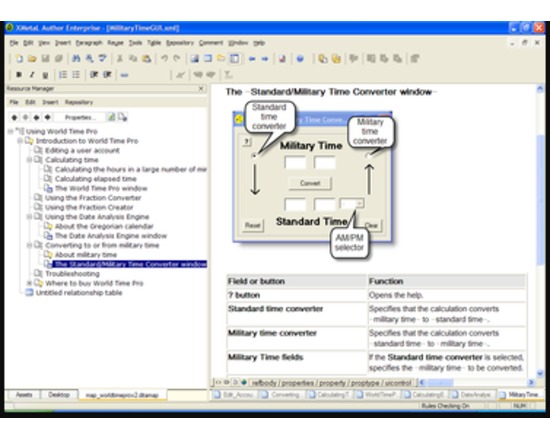
XML-based software application for structured authoring and editing documents and content collaboration.
Features:
Spellchecker, thesaurus, track changes and other word processing functionality
Configurable document view (normal, tagged, plain text)
Resource Manager may be used to locate and insert items such as image files and text fragments.
It works on the Microsoft operating system.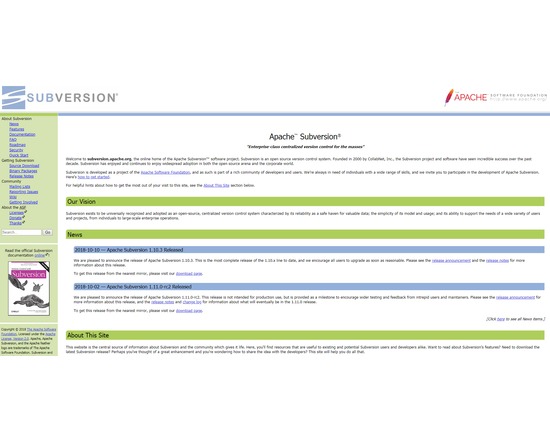
Apache Subversion Version System (SVN) is an open source version control system. Access and revision to objects are carefully controlled, to prevent unauthorized access and alteration. Developers use SVN to maintain current and historical versions of files such as source code, web pages, and documentation.
Their Vision:
Subversion exists to be universally recognized and adopted as an open-source, centralized version control system characterized by its reliability as a safe haven for valuable data; the simplicity of its model and usage; and its ability to support the needs of a wide variety of users and projects, from individuals to large-scale enterprise operations.
Features:
Version support for all files and directories in repository, enabling administrator to track changes that have occurred and obtain earlier versions of files
Renamed/copied/moved/removed files retain full revision history
Free-form versioned metadata
Atomic commits
Merge tracking
File locking
Changelists to organize commits into commit groups
Preservation of file attributes, such as executable and read/write status
Apache network server support with WebDAV/DeltaV protocol
Write-through proxy using WebDAV
Interactive conflict resolution
Repository read-only mirroring
Parsable output, including XML log output
Full MIME support - users can view or change the MIME type of each file, with the software knowing which MIME types can have their differences from previous versions shown
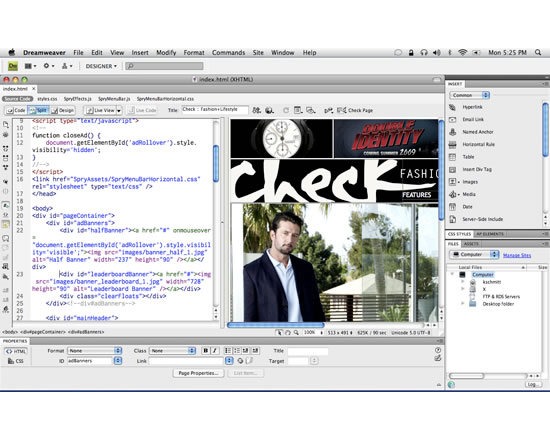
A visual development tool for creating, publishing, and managing websites and mobile content: Dreamweaver offers a graphics-based WYSIWYG (What You See Is What You GET pronounced wizzywig) and code-based user interface for the development of web pages and sites. The tool may be used to simplify the process of web site development (in comparison to creation of individual web pages), through the provision of a templating system that allows single-source update of shared code and layout across entire sites without server-side includes or scripting.
Features:
WYSIWYG
Code hinting for Ajax and JavaScript frameworks
Subversion integration
FTP/SFTP support
WebDav support
Web site template system
Adobe Spry AJAX framework support
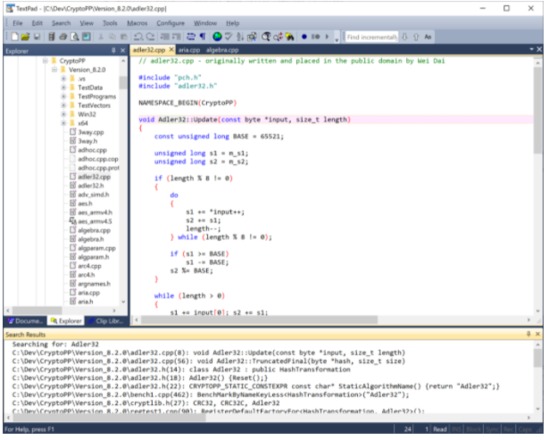
TextPad is a text editor. It may be used as a basic text editor, web page editor, or as part of a programming IDE.
Features:
Universal Naming Convention (UNC) style names support
Files up to the limits of 32-bit virtual memory can be edited
Spell checker with dictionaries in 10 languages
Multi file editing support
Commands to change case, and transpose words, characters and lines
Commands to indent blocks of text, split or join lines, and insert whole files
Change tracking