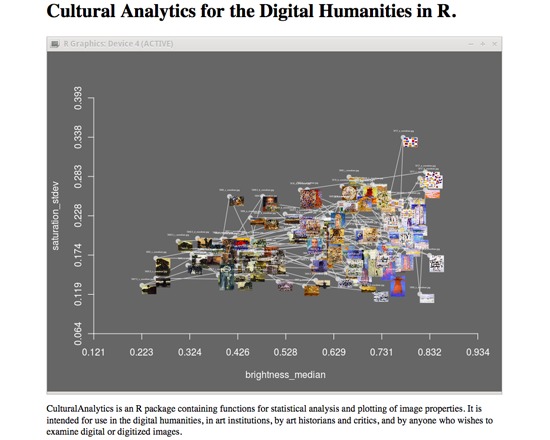
CulturalAnalytics, also known as Cultural Analytics for the Digital Humanities in R, is a free R package of functions for statistical analysis and plotting image properties, developed by Rob Myers specifically for the Digital Humanities, and of value to anyone else with an interest in examining digital or digitized images. It includes statistical functions and can generate histograms, colour clouds, image scatter charts and more.
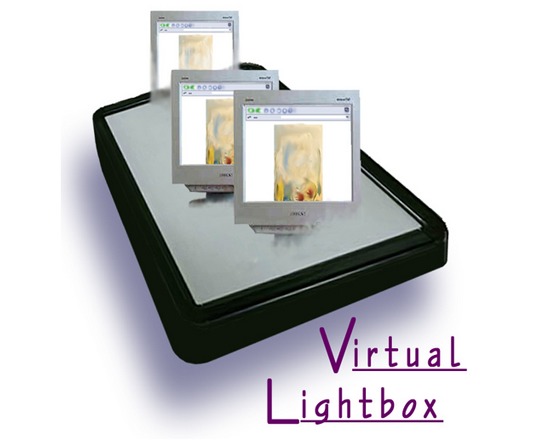
Virtual Lightbox is a Java-base tool for comparing images online developed for the academic humanities, the library and museum community, and any users who use images as an important data type. It is available as both an application, which functions as a virual whiteboard and includes peer-to-peer, and an applet, which provides a flexible environment for image comparison. Virtual Lightbox was first developed in 2000, with version 2.0 of applet released in 2004.
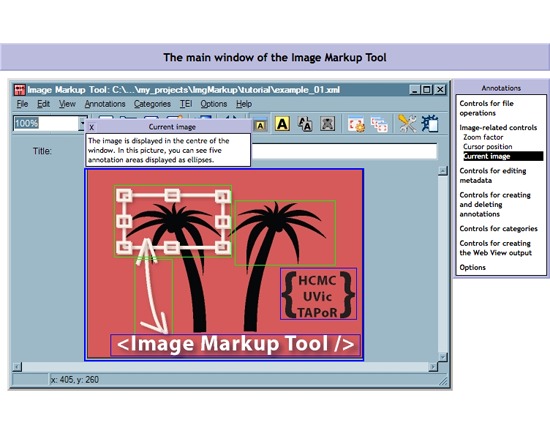
The UVic Image Markup Tool is a free tool for annotating images and storing the annotations in XML files from the University of Victoria's Humanities Computing and Media Centre. Its interface is designed for users without prior XML experience with additional functions for users familiar with XML, and supports multiple languages. The Image Markup Tool is available for Windows, and will also run in Linux with Wine.
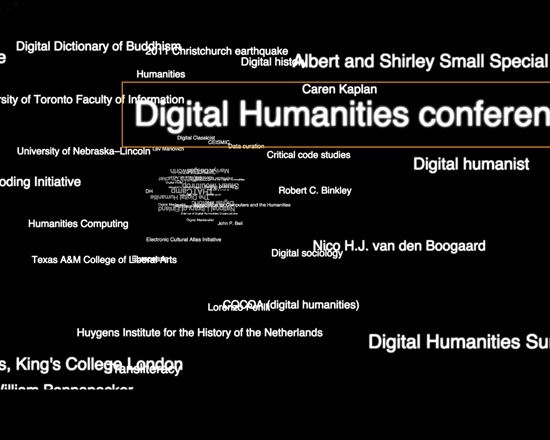
Casual is a free, open source tool for generating a visualization of concepts from a key word search. It uses Wikipedia for conceptual information, and can also include Google Image search results where applicable. Users can click on a term to generate a new search from that term, while image results can be rearranged by clicking and dragging them to the desired location. Casual can produce visualizations ranging from 10 to 400 concepts in size, and can retrieve information for queries in a wide variety of languages. This tool is no longer supported; development appears to have ceased in 2009.
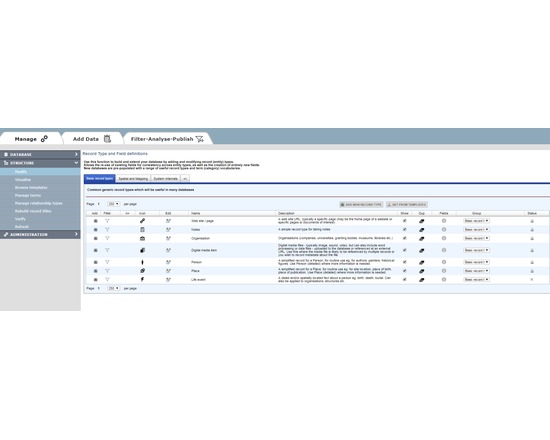
HEURIST (http://HeuristNetwork.org) is an extremely flexible, end-user oriented, web-based data management system designed specifically for Humanities data. Developed since 2005, it has been in active use across many projects since 2009. It is available both as a free web service for researchers (hosted at the University of Sydney Data Centre) or for installation on a physical or virtual server (Open Source on gitHub).
Researchers can design, create, manage, analyse, visualise and publish their own richly-structured database(s) through a simple web interface, without the need for programmer(s). Quite complex databases can be built in a few hours by borrowing structures and vocabularies published by other users. Databases can be designed and built incrementally, as existing data are not affected by changes in structure. Databases created by Heurist are stored in MySQL with a repeatable structure facilitating sustainability and independent access by other software.
Advanced features include record linking, graph structure, drill-down facet searches, rule-based queries, custom reports, linked map-timelines, network visualisation, normalised spreadsheet import, crosstabulation, XML feeds, XSLT transforms. The team provides initial email and skype assistance for project setup at no cost, and special customisations at modest cost.
Heurist is applicable in many domains including History, Archaeology, Anthropology, Cultural Research, Linguistics, Media Studies etc. It handles everything from text, tags and categories, through networks of rich relationships and offset annotations, to images, video, spatial data and dating (including non-western systems and dating uncertainty).
Sophisticated searches (including faceted and rule-based) can be saved, organised and rendered as layered interactive maps, timelines, network visualisations, crosstabulations, lists, custom reports, XML and XSLT transforms, all of which can easily be printed or embedded (live) in a website - Heurist provides the html code required to embed results in a web page or CMS.
Databases can easily be migrated later to a personal or institutional server. Since the data are stored in a standard MySQL database with a fixed and well-documented structure, the data can be accessed directly via SQL from most programming languages independently of Heurist.
Version 4.2 (Jan 2016 onwards) is available as a service via the Heurist website. Version 4 delivers a user-customisable interface of widgets, along with better mapping and visualisation. Existing version 3 databases are bidirectionally compatible with version 4.
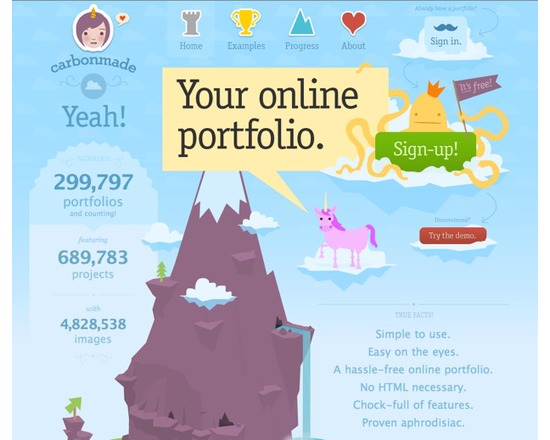
An easy and user-friendly online portfolio web based tool. Suitable for illustrators, graphic designers, photographers, writers, journalists, marketers, public relations, communications work.
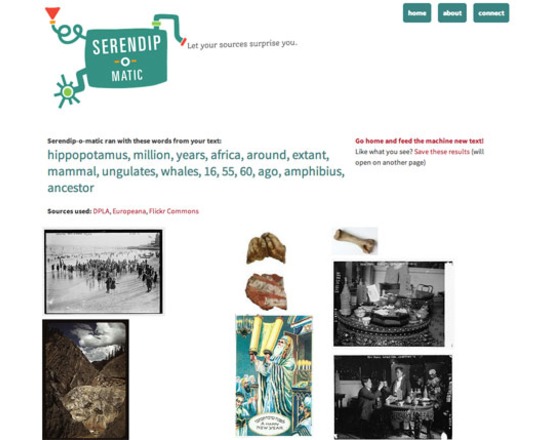
Serendip-o-matic extracts keywords from your Zotero library or from text that you've pasted into the web interface, and finds related content in locations such as the Digital Public Library of America (DPLA), Europeana, and Flickr Commons, including photographs, documents, maps and other primary sources.
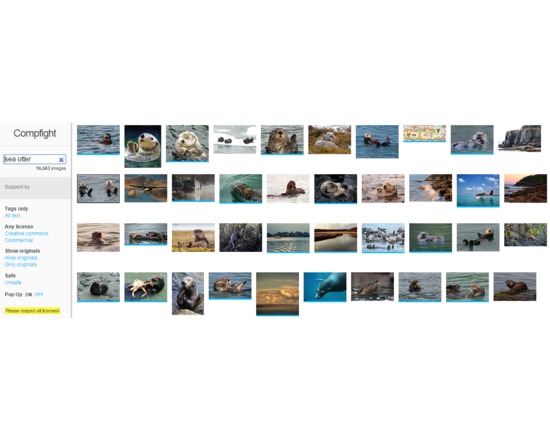
Search Flickr for photos, sort according to license types. Contains commercial as well as Creative Commons licensed photos.

oSkope is a visual search assistant that allows you to browse and organize items from Amazon, eBay, Flickr, Fotolia, Yahoo!Image Search and YouTube. Results are displayed on an interactive Flash grid of thumbnails.
flokoon displays search results from Last.fm, YouTube, and Fotolia in a graphic interactive map, that connects related topics through a series of spiderweb-like graphics.