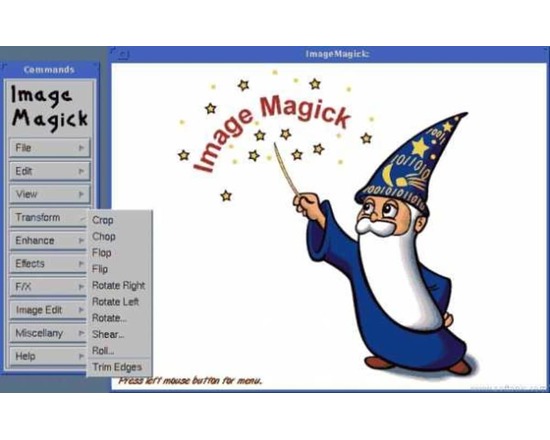
A software suite for displaying, converting and editing still images stored in a raster image format. Image manipulation may be performed via the command line, API libraries, or through a simply graphical user interface. With recent development, it can now be used to store images in over 200 different image formats.
Features:
Software control through API and command line
Format conversion
Image transformation
Transparency support
Format identification
Text to image conversion
Read, process, or write mega-, giga-, or tera-pixel image sizes
Distributed pixel cache
Perceptual hash
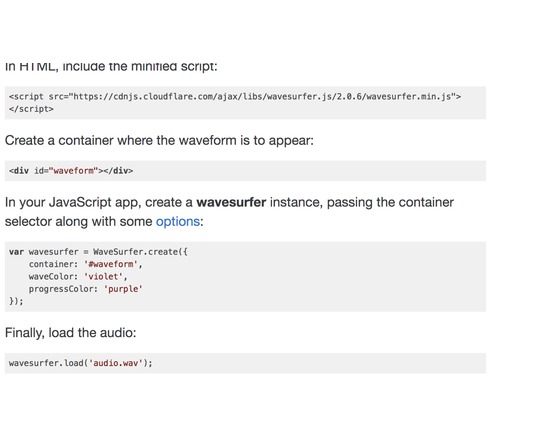
A software tool for the manipulation of audio recordings. Wavesurfer provides basic audio editing function, such as excision, copying, pasting, zero-crossing adjustment, and effects such as fading, normalization, echo, inversion, reversal, replacement with silence, and DC-removal.
Features:
Audio format support, including WAV, AU, AIFF, MP3, CSL, SD, Ogg/Vorbis, and NIST/Sphere
Read/write support for HTK (and MLF), TIMIT, ESPS/Waves+, and Phondat transcription formats
Direct-to-disk playback/recording enabling use of audio recordings larger than available memory
Plug-in architecture
built-in script interpreter
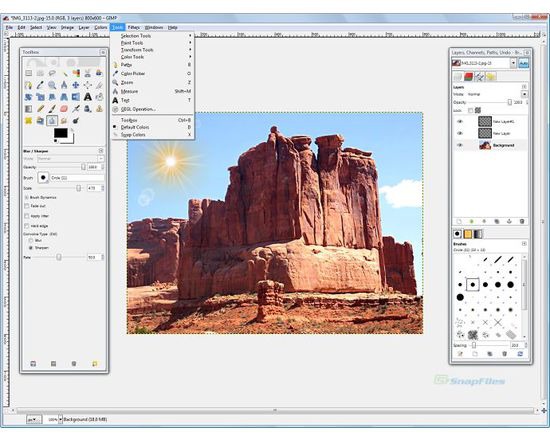
GIMP is image editing software, much like Photoshop. It is a multi-platform software application primarily used for image composition and editing. The basic tool may be augmented by plug-ins and extensions that allow the use of new file formats, effects filters and batch processing capabilities. GIMP was initially created to manipulate raster images, but has been extended to provide limited vector image and moving image support. A number of free extensions are available in the plugin registry.