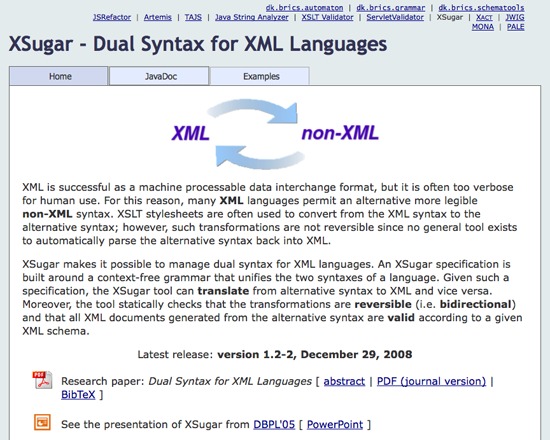
XSugar is a tool designed to manage dual syntaxes when working with XML documents, developed by the Department of Computer Science, Aarhus University. From a user-provided specification, XSugar translates between XML syntaxs, and makes statistical checks to ensure transformations will be reliably bidirectional and contain valid syntax in accordance with the schema.
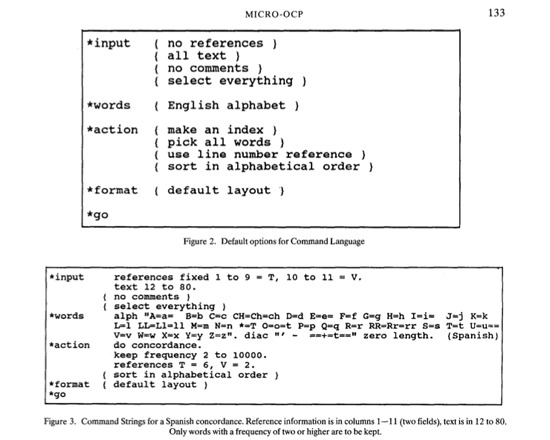
Micro-OCP (Oxford Concordance Program) was a major and historically important textual analysis tool for microprocessor computers. It enabled users to generate concordances, word lists and indexes, in addition to facilitating text markup in COCOA or other markup languages. Micro-OCP was written in FORTRAN, ran primarily in a DOS environment and could be ported to other operating systems including UNIX.
GRIPHOS (General Retrieval and Information Processor for Humanities Oriented Studies) is a historically important suite of programs used extensively within the Museum Computer Network, a shared information management system developed jointly by fifteen New York area museums. Designed by Dr. Jack Heller of New York University's Institute for Computer Research in the Humanities (ICRH) and debuting in 1967, GRIPHOS enabled museums to store, retrieve and apply textual markup to their records.
TATOE (Text Analysis Tool with Object Encoding) was a tool for developing limited-context grammar rules for automated markup.

nanoc is a Ruby-based, "static site generator" --it works as a tool that runs on your local computer and compiles documents written in formats such as Markdown, Textile, Haml… into a static web site consisting of simple HTML files, ready for uploading to any web server.
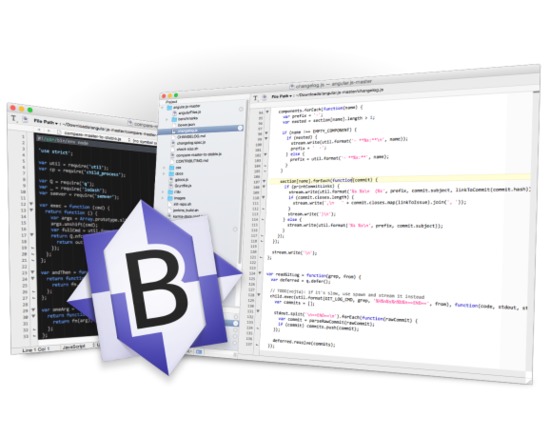
A text editor designed for use by software developers and web designers to edit, search, and manipulate text. BBEdit provides native support for several programming and scripting languages. Third party custom modules are available, created by users, to handle languages that are not supported in the native application.
Features:
Multi-file text searching
Scripting
Syntax highlighting for ANSI C, C++, CSS, Fortran (through Fortran 95), HTML, Java, JavaScript, JSP, Object Pascal, Objective-C, Objective-C++, Perl, PHP, Python, Rez, Ruby, Setext, SQL, Tcl, Tex, UNIX shell scripts, XML and YAML
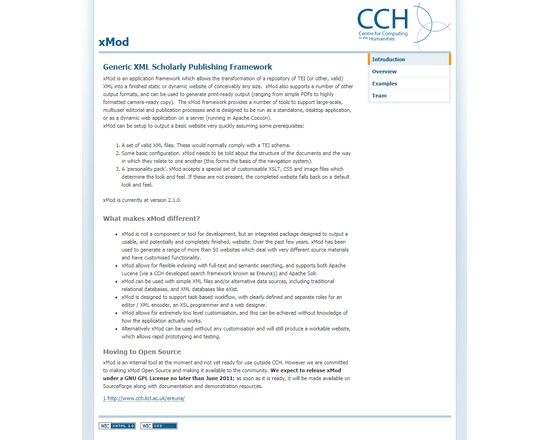
The entire process can be setup and run to produce a basic website assuming some prerequisites:
- a set of valid XML files. These would normally comply with a TEI DTD.
- a configuration script that indicates the relationship between files
- a 'personality pack' (CSS and image files) that determine its visual appearance.
However if they are not present, the completed website falls back on a default look and feel.
Some features include:
- Batch file processing
- Modular XSLT structure, with special libraries for different transformation scenarios
- Ability to group files for generation of indices at document and intra-document level
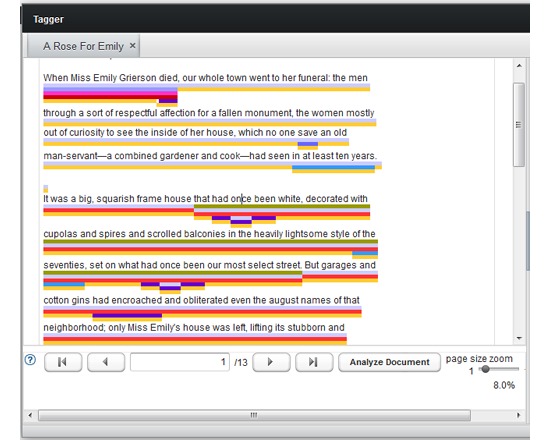
CATMA (Computer Aided Textual Markup & Analysis) is a free, open source markup and analysis tool from the University of Hamburg's Department of Languages, Literature and Media. It incorporates three interactive modules: (1) The tagger enables flexible and individual textual markup and markup editing. (2) The analyzer incorporates a query language and predefined functions. It also includes a query builder that allows users to construct queries from combinations of pre-defined questions while allowing for manual modification for more specific questions. (3) The visualizer provides basic visualization options for texts and corpora. CATMA also interfaces with the Voyant toolset. As of version 4.1, CATMA is a web application with collaborative work functions, and improvements to its user interface, queries and corpus analysis capacity. Version 4.2 offers, among others, new visualization options.