Islandora is an open-source software framework designed to help institutions and organizations and their audiences collaboratively manage, and discover digital assets using a best-practices framework. Islandora was originally developed by the University of Prince Edward Island's Robertson Library, but is now implemented and contributed to by an ever-growing international community.
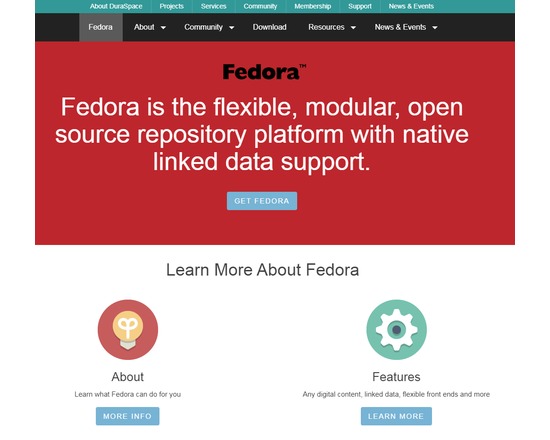
Fedora (Flexible Extensible Digital Object Repository Architecture) was originally developed by researchers at Cornell University as an architecture to store, manage, and access digital content in the form of digital objects. Fedora defines a set of abstractions for expressing digital objects, asserting relationships among digital objects, and linking behaviors to digital objects. Developed by the community and stewarded by Duraspace — a nonprofit involved with open source technology projects including VIVO and DSpace — Fedora Commons implements the Fedora abstractions in an open source, modular repository system for managing and disseminating digital content.
Fedora Commons is widely used in the academic sector as a basis for digital libraries, archives, or repository systems. Its worldwide installed user base includes academic and cultural heritage organizations, universities, research institutions, university libraries, national libraries, government agencies, and more.
Management and maintenance of any digital content type and of metadata about content in any format
Scale to millions of objects
Access data via APIs (REST/SOAP)
Provide RDF search (SPARQL)
Rebuilder utility (for disaster recovery and data migration)
Entire repository can be rebuilt from the digital object and content files
Content model architecture (define "types" of objects by their content)
Many storage options (database and file systems)
JMS messaging (your apps can "listen" to repository events)
Web-based administrator GUI (low-level object editing)
OAI-PMH provider service
GSearch (fulltext) search service
Multiple, customer driven front-ends
A digital repository software package that may be used to accept, manage and publish digital objects. It is widely used in academia as a system to manage academic research papers, electronic theses and other distinct digital resources. EPrints offers an extensible plug-in architecture, enabling data processing activities to be tailored to the requirements of the institution.
Features:
LOAI-PMH support
Deposit interface for mediated or self-deposit
PRONOM integration
PLANETS PLATO integration (forthcoming)
Dublin Core, EP3-XML, METS, MODS metadata format support
Extensible plug-in architecture
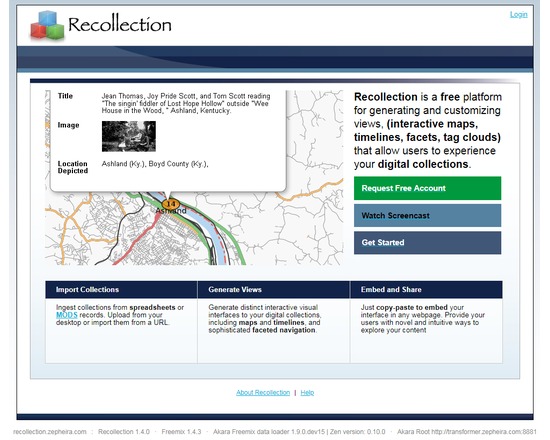
Recollection was a platform developed by Zepheira for the Library of Congress National Digital Information Infrastructure and Preservation Program (NDIIPP), allowing users to create and share embeddable interfaces to digital cultural heritage collections. The Library of Congress released its latest version of Recollection as Viewshare, built to increase the ease of finding, using, and sharing the project's software.
Recollection incorporates a series of web-based open standards and open source tools, including RDF, Simile Exhibit, Akara, and Django.
Recollection is no longer supported.