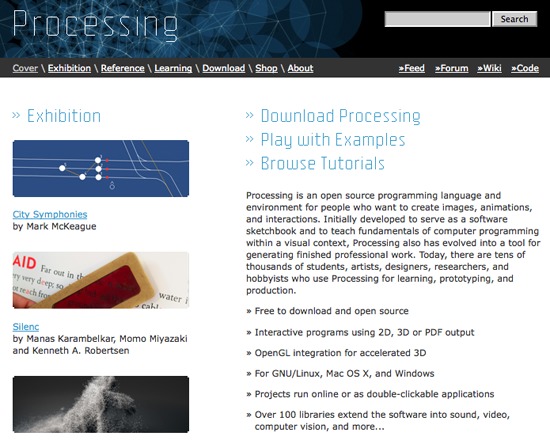
Processing is a free, open source programming language and development library for the visual arts. It is a software sketchbook, a way to visually learn programming fundamentals, and a tool for creating finished professional work, including mapping networks, textual analysis and producing visualizations. It runs under Windows, OSX and Linux environments, and can export graphics and applets in a variety of formats.
Features:
- C, shell scripting (sh), AWK, and sed
- Powerful text processing facilities
- Flexibility and adaptability
-Support for multiple programming paradigms
-Reference counting memory management
Scratch is a programming language, designed for children, for creating interactive stories, animations, games, music and art and publishing them online.
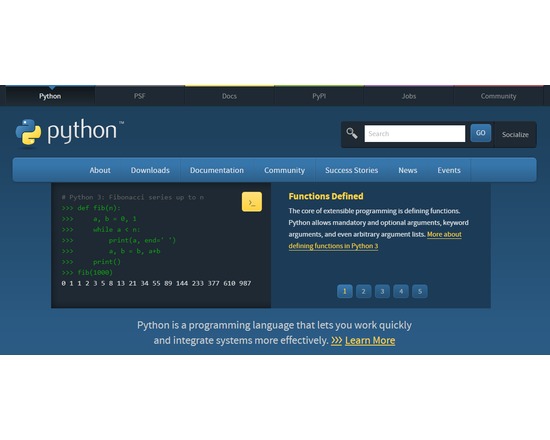
A general-purpose high-level programming language that places an emphasis upon code readability. Python supports a number of development models, including object oriented, imperative, and functional design. It provides automatic memory management and a fully dynamic type system.
Features:
Very clear, readable syntax
Strong introspection capabilities
Intuitive object orientation
Natural expression of procedural code
Full modularity, supporting hierarchical packages
Exception-based error handling
Very high level dynamic data types
Extensive standard libraries and third party modules for virtually every task
Extensions and modules easily written in C, C++ (or Java for Jython, or .NET languages for IronPython)
Embeddable within applications as a scripting interface