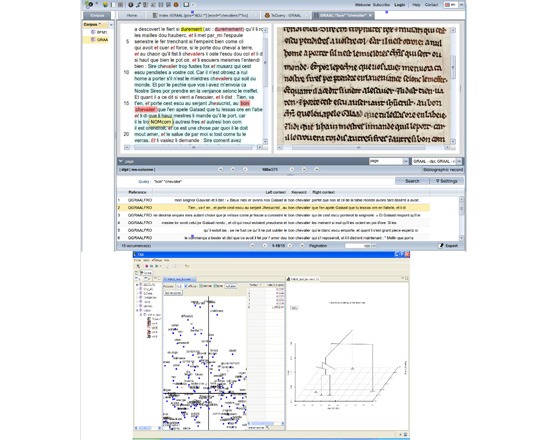
TXM is a free, open source text corpus analysis environment. Its features include concordance, collocate search, frequencies based on the CQP full text search engine and statistical functions based on R packages. It can export results in CSV, XML or SVG format, and runs as a standalone desktop application in Windows, OS X and Linux environments, or as a web portal (download the leaflet for more).
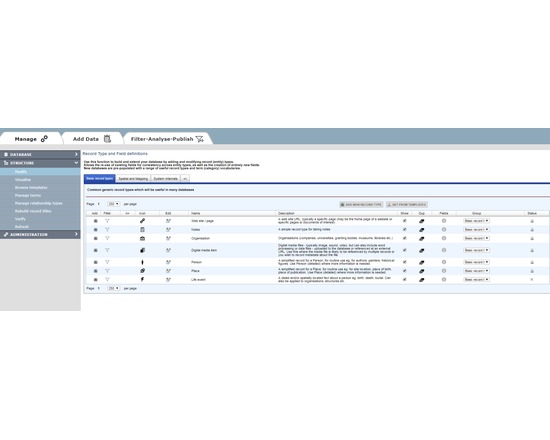
HEURIST (http://HeuristNetwork.org) is an extremely flexible, end-user oriented, web-based data management system designed specifically for Humanities data. Developed since 2005, it has been in active use across many projects since 2009. It is available both as a free web service for researchers (hosted at the University of Sydney Data Centre) or for installation on a physical or virtual server (Open Source on gitHub).
Researchers can design, create, manage, analyse, visualise and publish their own richly-structured database(s) through a simple web interface, without the need for programmer(s). Quite complex databases can be built in a few hours by borrowing structures and vocabularies published by other users. Databases can be designed and built incrementally, as existing data are not affected by changes in structure. Databases created by Heurist are stored in MySQL with a repeatable structure facilitating sustainability and independent access by other software.
Advanced features include record linking, graph structure, drill-down facet searches, rule-based queries, custom reports, linked map-timelines, network visualisation, normalised spreadsheet import, crosstabulation, XML feeds, XSLT transforms. The team provides initial email and skype assistance for project setup at no cost, and special customisations at modest cost.
Heurist is applicable in many domains including History, Archaeology, Anthropology, Cultural Research, Linguistics, Media Studies etc. It handles everything from text, tags and categories, through networks of rich relationships and offset annotations, to images, video, spatial data and dating (including non-western systems and dating uncertainty).
Sophisticated searches (including faceted and rule-based) can be saved, organised and rendered as layered interactive maps, timelines, network visualisations, crosstabulations, lists, custom reports, XML and XSLT transforms, all of which can easily be printed or embedded (live) in a website - Heurist provides the html code required to embed results in a web page or CMS.
Databases can easily be migrated later to a personal or institutional server. Since the data are stored in a standard MySQL database with a fixed and well-documented structure, the data can be accessed directly via SQL from most programming languages independently of Heurist.
Version 4.2 (Jan 2016 onwards) is available as a service via the Heurist website. Version 4 delivers a user-customisable interface of widgets, along with better mapping and visualisation. Existing version 3 databases are bidirectionally compatible with version 4.
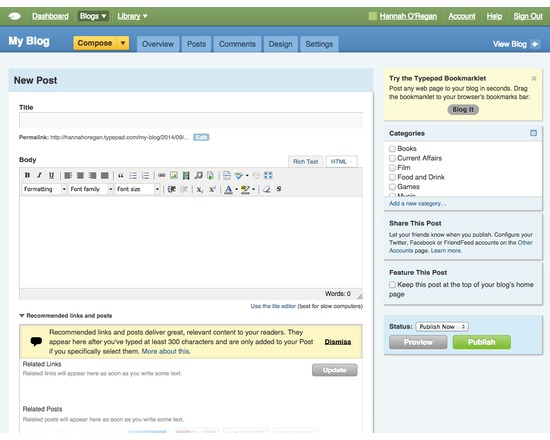
TypePad is a commercial, fully hosted blogging platform. Provides library of customizable blog designs.
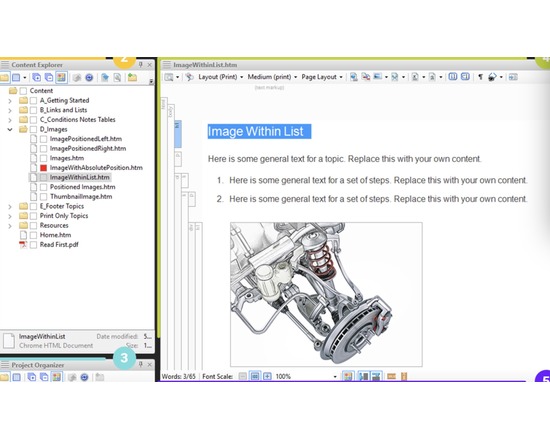
Flare is an ActionScript library for creating visualizations that run in the Adobe Flash Player. From basic charts and graphs to complex interactive graphics, the toolkit supports data management, visual encoding, animation, and interaction techniques. Flare features a modular design that lets developers create customized visualization techniques without having to reinvent the wheel.
Exhibit 3.0 is a publishing framework for large scale data-rich interactive Web pages. The beta version is scalable up to 100k items.
Exhibit lets you easily create Web pages with advanced text search and filtering functionalities, with interactive maps, timelines, and other visualizations. The Exhibit 3.0 software has two separate modes: Scripted for building smaller in-browser Exhibits, and Staged for bigger server-based Exhibits.
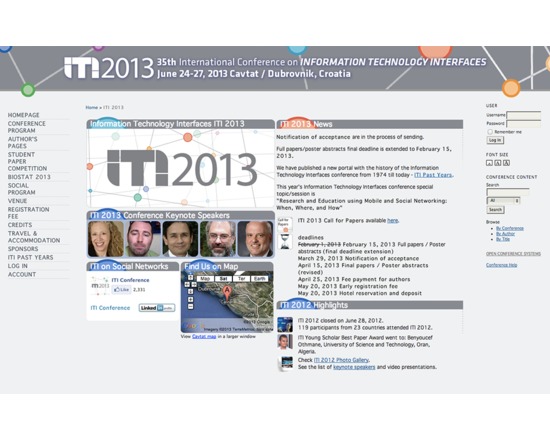
Open Conference Systems (OCS) is a free Web publishing tool that can create a complete Web presence for scholarly conferences. It is a highly flexible management and publishing system that can be downloaded for free and installed on a local Web server. It has been designed to reduce the time and energy devoted to the clerical and managerial tasks associated with managing a conference, while improving the record-keeping and efficiency of editorial processes. It seeks to improve the scholarly and public quality of conference publishing through a number of innovation, from making policies more transparent to improving indexing.
Features:
- create a conference Web site
- Manage conferences that occur more than once (e.g., yearly)
- compose and send a call for papers
- electronically accept paper and abstract submissions
- allow paper submitters to edit their work
- Conduct peer reviews
- post conference proceedings and papers in a searchable format
- Schedule a Conference
- post the original data sets
- register participants, including accepting payments
- integrate post-conference online discussions
- utilize an e-mail template system
- support multiple languages with localization files
- Take advantage of more customizable, scalable and secure code
System Requirements:
A server environment meeting the following requirements is recommended:
- PHP >= 4.2.x (including PHP 5.x); Microsoft IIS requires PHP 5.x
- MySQL >= 3.23.23 (including MySQL 4.x) or PostgreSQL >= 7.1 (including
- PostgreSQL 8.x)
- Apache >= 1.3.2x or >= 2.0.4x or Microsoft IIS 6
Operating system: Any OS that supports the above software, including
Linux, BSD, Solaris, Mac OS X, Windows

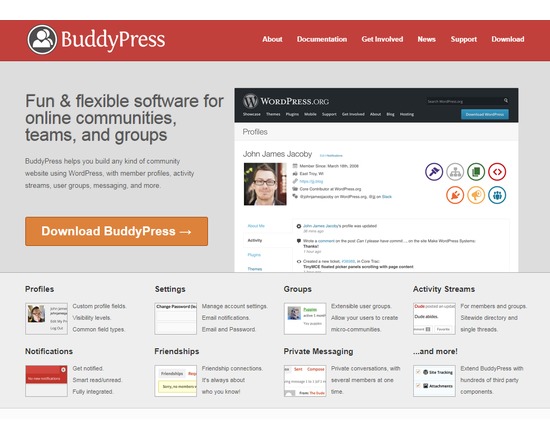
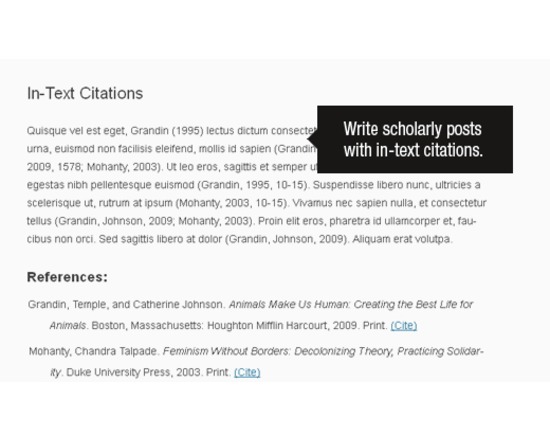
Zotpress is a WordPress plugin that enables users to easily add Zotero citations to a WordPress site by using a special syntax that turns a Zotero citation key into a well-formatted inline citation and bibliography, based on the data stored in Zotero.
Drupal is an extremely flexible general content management system with numerous plugins that provide scholar-oriented functionality.