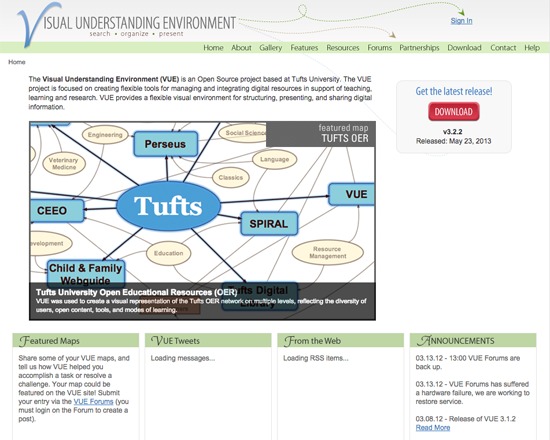
Visual Understanding Environment (VUE) is a free, open source application for mapping concepts, ideas and digital content. It enables users to generate nodes and links, and apply a simple set of tools to explore the relationships. VUE is, in the words of its developers, an application to "integrate, organize and contextualize electronic content" in research or learning environments. Its tools include visualization, dynamic content mapping, semantic mapping, enhanced pathways and search functions.
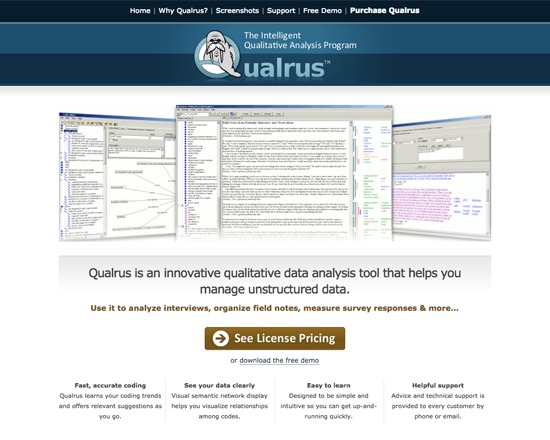
Qualrus is a commercial application for qualitative data analysis, including data coding and statistics functions. It can analyze data from a wide variety of sources, including common text, web, image, video and audio files. The data coding functions are supplemented by machine learning processes to assist data processing and analysis. In terms of analysis, it offers a number of common text analysis functions including tokenization, co-occurences, and Boolean search, and can visualize a network view of interrelationships. It is particularly aimed at academic and institutional applications, and both student and free trial versions are avaiable.
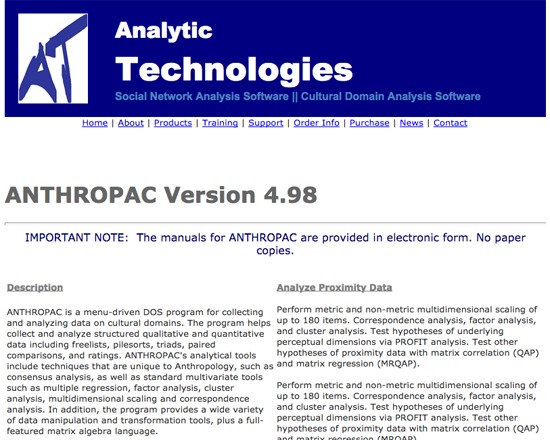
ANTHROPAC, now in version 4.98, is a long-standing menu-driven DOS program developed for working with anthropological and other cultural data. It assists both the collection and analysis of datasets, and can accommodate both qualitiative and quantitative information. ANTHROPAC includes analytic tools such as consensus analysis, factor analysis, cluster analysis and correspondance analysis, in addition to data manipulation and transformation functions. It imports and exports data via ASCII formats, and includes an extensive reference manual, a user's guide and a methods guide tailored for cultural domain analysis.
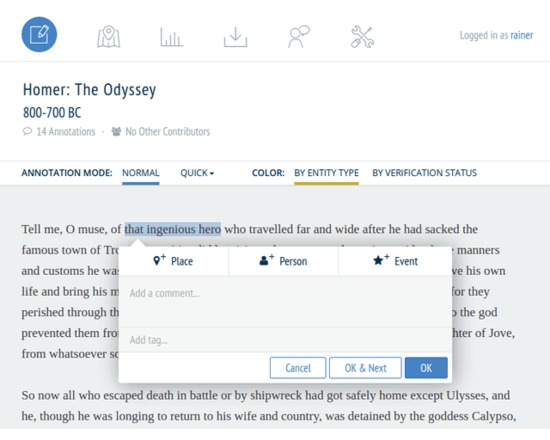
Recogito is an online platform for collaborative document annotation.
Recogito provides a personal workspace where you can upload, collect and organize your source materials - texts and images - and collaborate in their annotation and interpretation. Recogito enables you to make your work more visible on the Web more easily, and to expose the results of your research as Open Data.
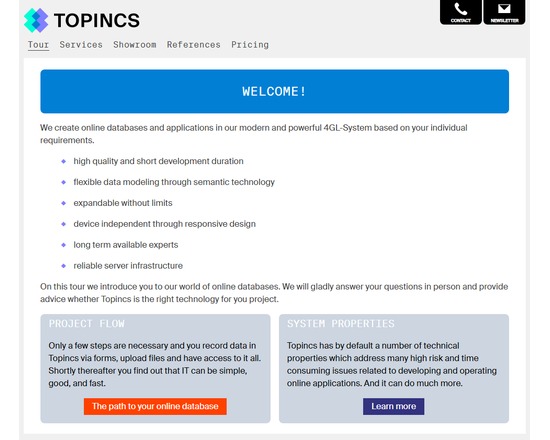
By designing and implementing services, the data can be manipulated, transformed and aggregated through an virtual object oriented programming interface driven by the data model. This allows sophisticated use cases where different user groups with different rights are presented a completely different application working on the same database. In these cases development time ranges between 2 and 20 days.
A Topincs online database can be rented for a monthly fee. Topincs provide all services related to an online database: data modeling, programming, and support. They have special rates for educational institutions. Topincs can also be used as a Platform as a Service where the dark art of Topincs modeling and development must be studied online. The underlying semantic technology, Topic Maps, is taught there through hands on examples and will change your view on information technology.
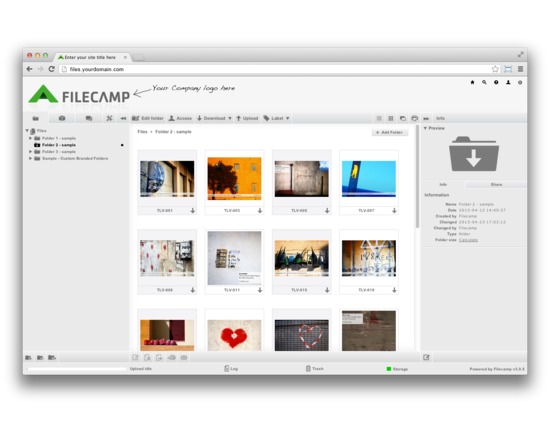
Online Digital Asset Management (DAM) and collaboration platform for business use. Offers user management, custom branding and password-protected folders. Digital Asset Management, Secure File Sharing, Media Library, Online Proofing and so much more …
Upload, manage and share your files from one good looking, easy-to-use spot in the cloud.
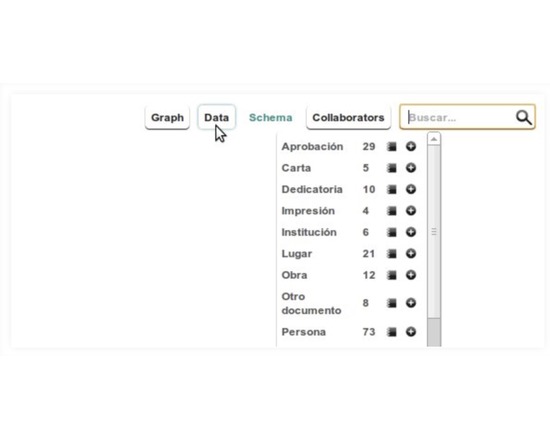
SylvaDB is a graph database management system. It allows users with no knowledge in graph theory to model, collect, query, and analyze data in a network structure. SylvaDB provides tools for easy creation of schemas and modelling, automatic forms creation to input the data, collaborative features, a visual query editor, global and local search, reports charts generation, networks metrics, and visualizations tools.
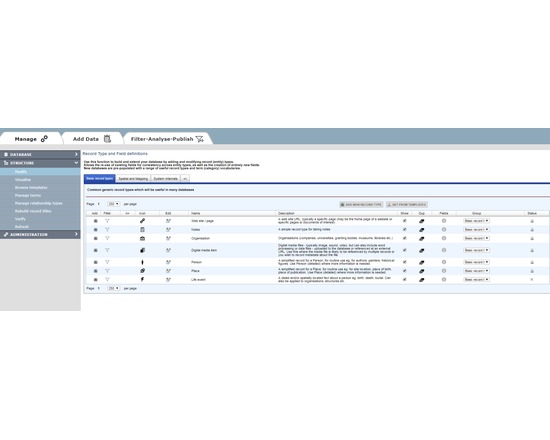
HEURIST (http://HeuristNetwork.org) is an extremely flexible, end-user oriented, web-based data management system designed specifically for Humanities data. Developed since 2005, it has been in active use across many projects since 2009. It is available both as a free web service for researchers (hosted at the University of Sydney Data Centre) or for installation on a physical or virtual server (Open Source on gitHub).
Researchers can design, create, manage, analyse, visualise and publish their own richly-structured database(s) through a simple web interface, without the need for programmer(s). Quite complex databases can be built in a few hours by borrowing structures and vocabularies published by other users. Databases can be designed and built incrementally, as existing data are not affected by changes in structure. Databases created by Heurist are stored in MySQL with a repeatable structure facilitating sustainability and independent access by other software.
Advanced features include record linking, graph structure, drill-down facet searches, rule-based queries, custom reports, linked map-timelines, network visualisation, normalised spreadsheet import, crosstabulation, XML feeds, XSLT transforms. The team provides initial email and skype assistance for project setup at no cost, and special customisations at modest cost.
Heurist is applicable in many domains including History, Archaeology, Anthropology, Cultural Research, Linguistics, Media Studies etc. It handles everything from text, tags and categories, through networks of rich relationships and offset annotations, to images, video, spatial data and dating (including non-western systems and dating uncertainty).
Sophisticated searches (including faceted and rule-based) can be saved, organised and rendered as layered interactive maps, timelines, network visualisations, crosstabulations, lists, custom reports, XML and XSLT transforms, all of which can easily be printed or embedded (live) in a website - Heurist provides the html code required to embed results in a web page or CMS.
Databases can easily be migrated later to a personal or institutional server. Since the data are stored in a standard MySQL database with a fixed and well-documented structure, the data can be accessed directly via SQL from most programming languages independently of Heurist.
Version 4.2 (Jan 2016 onwards) is available as a service via the Heurist website. Version 4 delivers a user-customisable interface of widgets, along with better mapping and visualisation. Existing version 3 databases are bidirectionally compatible with version 4.
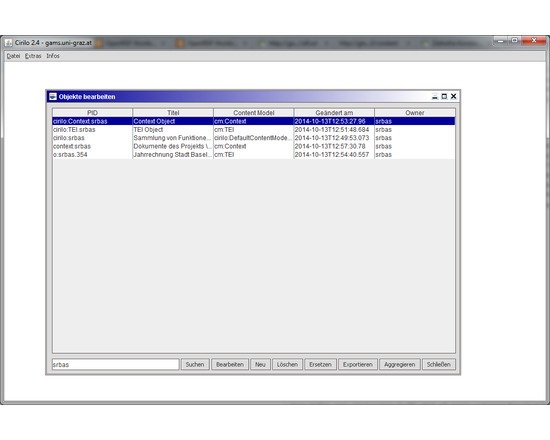
GAMS/Cirilo is an application developed for content preservation and data curation in FEDORA-based repository systems. Content preservation and data curation include object creation and management, versioning, normalization and standards, and the choice of data formats. The client offers functionalities which are especially prone to be used as tools for mass operations on FEDORA objects, such as ingest or replacement processes. Cirilo uses a collection of predefined content models, which can be used without further adjustments for standard workflow scenarios like the management of collections of TEI objects. It encapsulates functions for the resolvement of place names or ontology concepts, thus semantically enriching resources in the digital archive. Various dissemination options can also be assigned with the client. Cirilo is a contribution to the DARIAH-EU task “Reference Software Packages. The source code of the client can be found at https://github.com/acdh/cirilo, the documentation is available at http://gams.uni-graz.at/doku. An „archive-in-a-box“-installation package (Client including a FEDORA 3.5 instance) for Debian-based Linux-distributions can be downloaded from http://gams.uni-graz.at/download/cirilo-installer-2.4.tar.gz
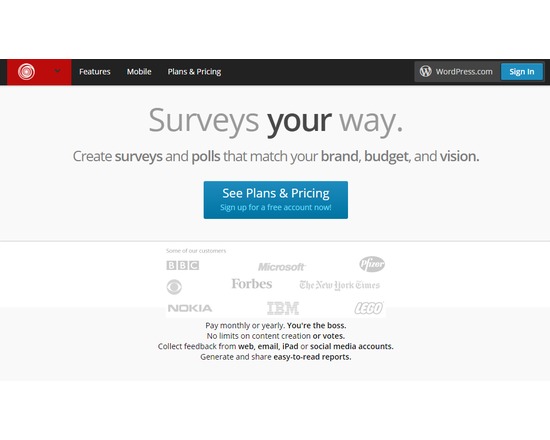
Create polls, surveys and quizzes and get ratings/feedback on content from users. "All languages supported." The free version has fewer options.
At the paid levels there are design options such as customized branding and CSS control; collection options include 10k-50k (depending on purchased plan) of monthly participants and password restriction; and it is in the reporting methods that this program has the most depth: real-time results, charts, the ability to export responses and reports as Excel, PDF, Google Docs, CSV or XML, filtering options, text analysis, tagging, email notifications of new responses, and priority customer service. Also, you can add images, videos, and content from YouTube, Flickr, and Google Maps.
This works with Wordpress.
This was previously Surveydaddy and has been upgraded to Polldaddy.