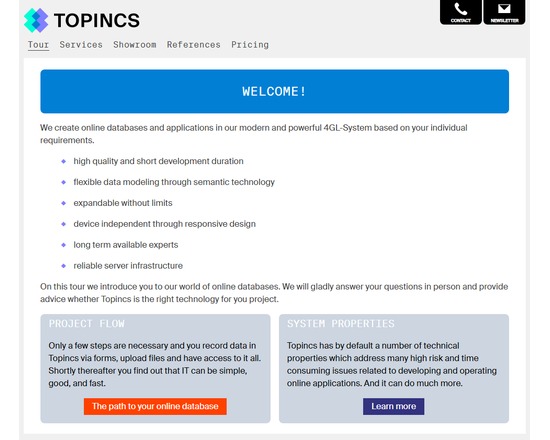
By designing and implementing services, the data can be manipulated, transformed and aggregated through an virtual object oriented programming interface driven by the data model. This allows sophisticated use cases where different user groups with different rights are presented a completely different application working on the same database. In these cases development time ranges between 2 and 20 days.
A Topincs online database can be rented for a monthly fee. Topincs provide all services related to an online database: data modeling, programming, and support. They have special rates for educational institutions. Topincs can also be used as a Platform as a Service where the dark art of Topincs modeling and development must be studied online. The underlying semantic technology, Topic Maps, is taught there through hands on examples and will change your view on information technology.
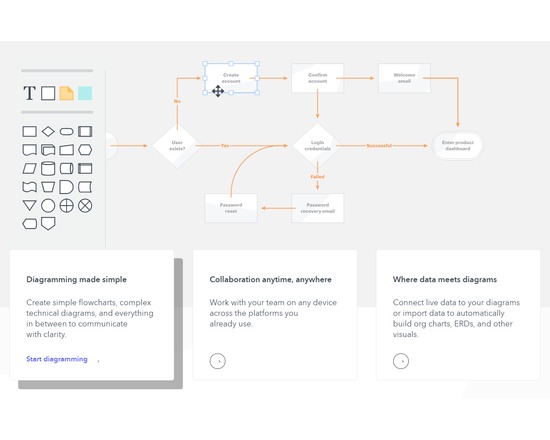
Lucidchart is an online diagram tool that enables users to easily visualize complex information through flow charts, mind maps and other diagram types. Multiple users can work together simultaneously to edit a document. Lucidchart integrates with many platforms including Google Apps/Drive, Confluence, JIRA, Slack, ec. Free accounts are provided for educational use.
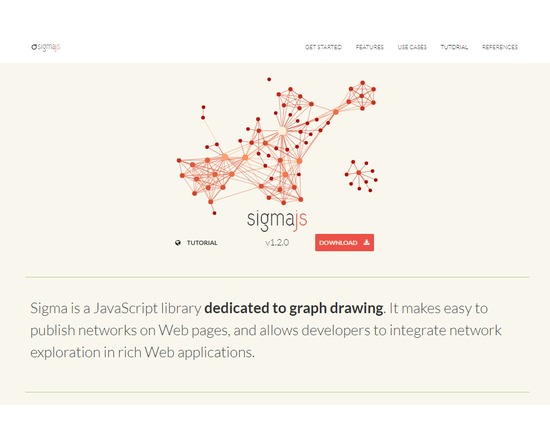
It is highly interactive and allows a researcher to extend their work from a dedicated graph analysis package such as Gephi and share it via the web to allow for communication of research outputs, while permitting viewers to explore and discover their own findings from the raw graph network.
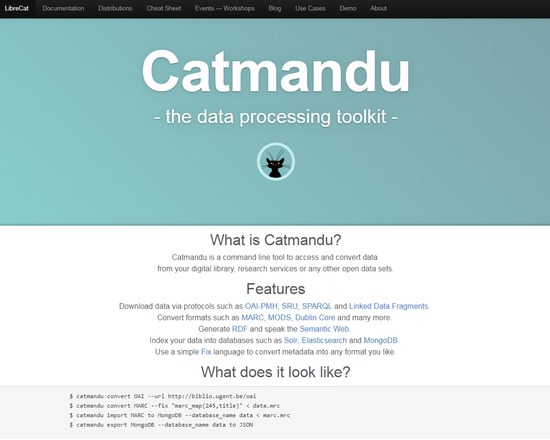
Importing, transforming, storing and indexing data should be easy.
Catmandu is a command line tool to access and convert data from your digital library, research services or any other open data sets. Catmandu provides a suite of Perl modules to ease the import, storage, retrieval, export and transformation of metadata records. Combine Catmandu modules with web application frameworks such as PSGI/Plack, document stores such as MongoDB and full text indexes such as Solr to create a rapid development environment for digital library services such as institutional repositories and search engines.
In the http://librecat.org/ project it is our goal to provide an open source set of programming components to build up digital libraries services suited to your local needs.
Read an in depth introduction into Catmandu programming at https://github.com/LibreCat/Catmandu/wiki/Introduction.
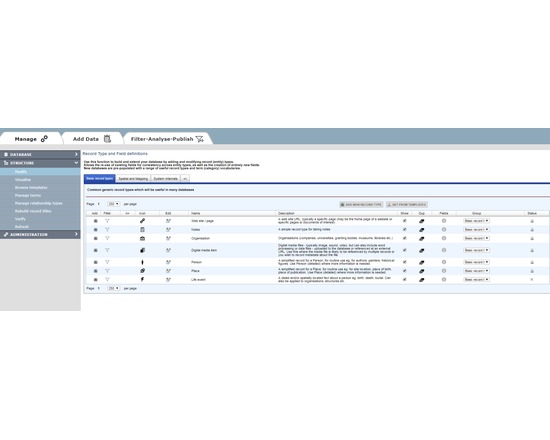
HEURIST (http://HeuristNetwork.org) is an extremely flexible, end-user oriented, web-based data management system designed specifically for Humanities data. Developed since 2005, it has been in active use across many projects since 2009. It is available both as a free web service for researchers (hosted at the University of Sydney Data Centre) or for installation on a physical or virtual server (Open Source on gitHub).
Researchers can design, create, manage, analyse, visualise and publish their own richly-structured database(s) through a simple web interface, without the need for programmer(s). Quite complex databases can be built in a few hours by borrowing structures and vocabularies published by other users. Databases can be designed and built incrementally, as existing data are not affected by changes in structure. Databases created by Heurist are stored in MySQL with a repeatable structure facilitating sustainability and independent access by other software.
Advanced features include record linking, graph structure, drill-down facet searches, rule-based queries, custom reports, linked map-timelines, network visualisation, normalised spreadsheet import, crosstabulation, XML feeds, XSLT transforms. The team provides initial email and skype assistance for project setup at no cost, and special customisations at modest cost.
Heurist is applicable in many domains including History, Archaeology, Anthropology, Cultural Research, Linguistics, Media Studies etc. It handles everything from text, tags and categories, through networks of rich relationships and offset annotations, to images, video, spatial data and dating (including non-western systems and dating uncertainty).
Sophisticated searches (including faceted and rule-based) can be saved, organised and rendered as layered interactive maps, timelines, network visualisations, crosstabulations, lists, custom reports, XML and XSLT transforms, all of which can easily be printed or embedded (live) in a website - Heurist provides the html code required to embed results in a web page or CMS.
Databases can easily be migrated later to a personal or institutional server. Since the data are stored in a standard MySQL database with a fixed and well-documented structure, the data can be accessed directly via SQL from most programming languages independently of Heurist.
Version 4.2 (Jan 2016 onwards) is available as a service via the Heurist website. Version 4 delivers a user-customisable interface of widgets, along with better mapping and visualisation. Existing version 3 databases are bidirectionally compatible with version 4.
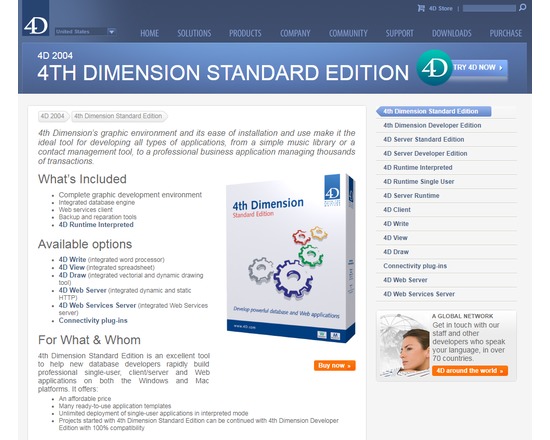
4th Dimension Standard Edition is an excellent tool to help new database developers rapidly build professional single-user, client/server and Web applications on both the Windows and Mac platforms. It offers:
- An affordable price
- Many ready-to-use application templates
- Unlimited deployment of single-user applications in interpreted mode
- Projects started with 4th Dimension Standard Edition can be continued with 4th Dimension Developer Edition with 100% compatibility
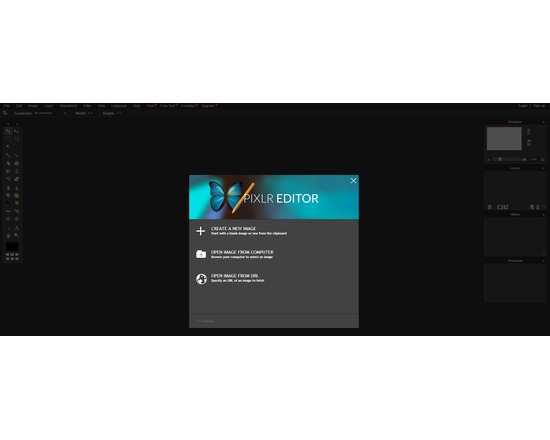
This is a free to use online image editor with a fair amount of features. I use this primarily for quick editing jobs such as resizing and cropping small images. The online editor will load images from your computer or via url which is incredibly handy. There is a firefox plug-in available too which makes the time it takes to view an image, edit, and save it, a fast process. The source code for the application is closed, but the dev team does offer a free API. Pixlr also has tools for mobile devices, one of which is paid app for $1.