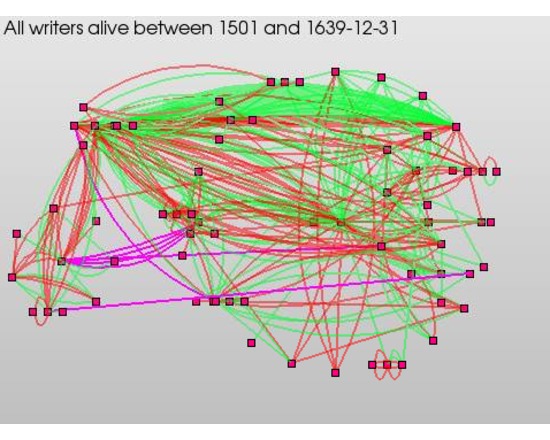
An application for visualizing a specific collection of authors, and the links or associations between them. Links are determined by co-occurrence in the Orlando dataset. The current dataset consists of authors, other people associated with them, and the text entries upon which these associations are based. The application is designed in such a way that it could be extended to use other datasets as well.
The display can be customized in the several ways. Node colours, shapes and sizes can be altered. More significantly, the layout of the graph can be chosen from amongst several different algorithms.
As the collection is quite large, there are many filtering options available. In terms of author, the following categories can be specified: gender, author/non-author, and author nationality. The user can create complex search queries of the authors and the text, and specify a date restriction for the authors' life span.
Each association in the text has been tagged with one or more semantic attributes, i.e. the type or meaning of the relation between the people. These tags have been organized into a tree, moving from general to more specific relations. Each tag in the tree can be checked/unchecked, further filtering the results.
Finally, a data set and customizations can be saved as a session which can then be loaded at a later time. In addition, screenshots of the current layout can be saved to an image file.
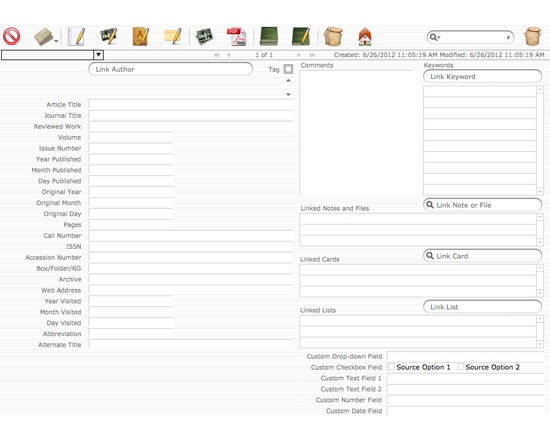
Scribe, now in version 3.5, is a free note-taking program available for both PC and Mac. Aimed particularly at historians, this program allows researchers to create digital note cards for managing sources, research notes, contacts, images, glossaries, outlines, timelines and more. Furthermore, it enables organization, keyword indexing, searching, linking and cross-referencing of all entries. Entries can be entered directly or imported from online catalogues such as Amazon.com. Information entered in Scribe can be exported directly to Zotero in addition to assembling, printing or copying formatted bibliographies directly from the program. Articles can be stored directly within the program, enabling researchers to search out and highlight particular words within the text in addition to the relevant researcher notes.
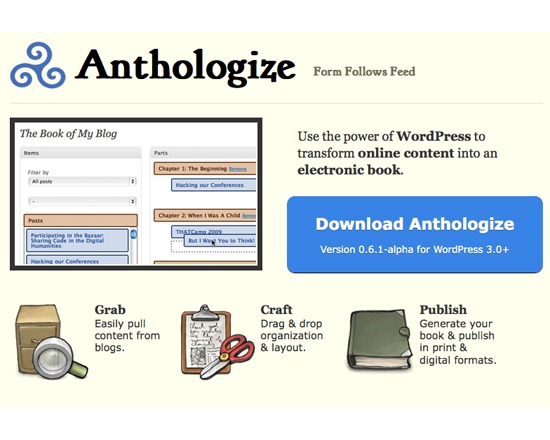
Anthologize is a free, open-source plugin for WordPress 3.0. It enables WordPress to be used as a platform for publishing electronic texts in PDF, ePUB or TEI format. The plugin enables users to grab their existing blog posts, export content from external feeds or compose new content directly in Anthologize, then apply outlining, create a custom order, and edit content into a single document for export. Anthologize requires a self-hosted or local installation of WordPress.
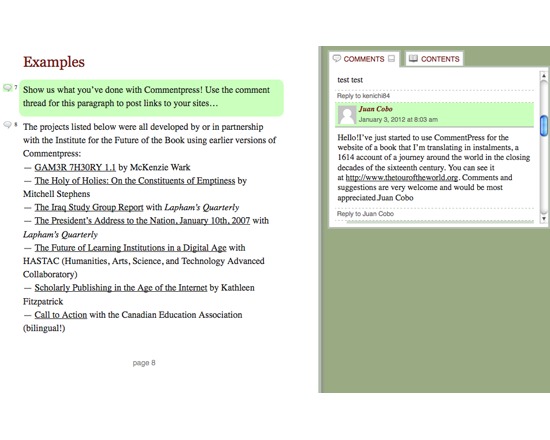
Commentpress is an open source theme and plugin for Wordpress 3.3.1 or later designed to enable readers to contribute comments to each paragraph of a text and display those comments in the margins. Commentpress turns a text into a conversation, whether a blog or a fixed document such as an essay, book or article. It may also be used to add a gloss or annotations to a document. This tool is also available for BuddyPress and BP Group Blog.
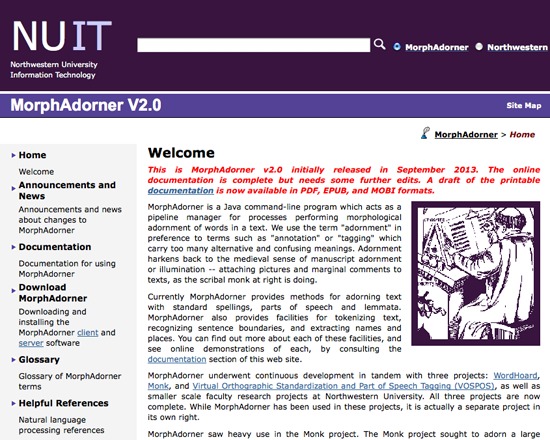
MorphAdorner, now in version 2.0, is a Java command-line program for the adornment of words in a text. At present, available adornments include standard spellings, parts of speech and lemmata, in addition to tokenization, the recognition of sentence boundaries and extracting names and places. Version 2.0 features a separate MorphAdorner Server, an improved integration with MONK's Abbot and improved processing of the Early English Books Online (EEBO), Eighteenth Century Collections Online (ECCO) and Evans Early American Imprint Collection corpori.
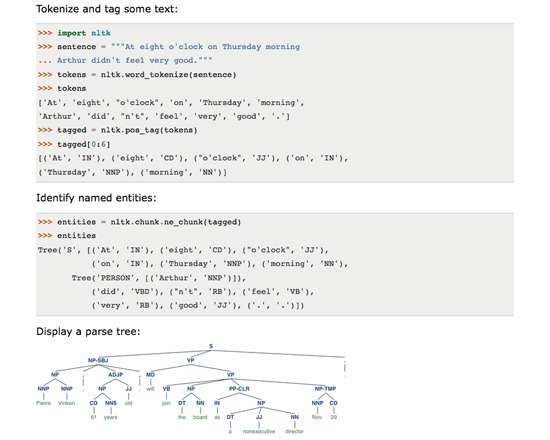
NLTK 2.0 (Natural Language Tooklt) is a free, open source collection of Python modules, linguistic data and documentation for research and development in natural language processing and text analytics, with distributions for Windows, Mac OS X and Linux. It offers a platform for building Python programs to work with human language data, and integrates a guide to programming fundamentals.
WordHoard is a tool for the study of large texts or transcribed speech. It annotates or tags texts by applying morphological, lexical, prosodic, and narratological criteria. Users may apply WordHoard to their own texts, or to the corpora included with the tool. At present, that corpora includes the entire canon of Early Greek epic (original and in translation), Chaucer, Shakespeare and Spencer.
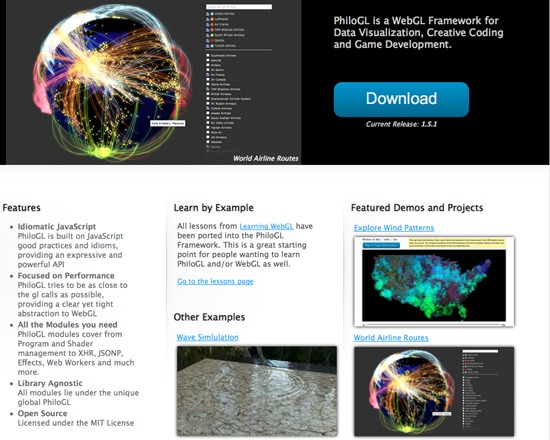
PhiloGL is an open source WebGL Framework for advanced data visualization, creative coding and game development. It includes a module system encompassing Program and Shader management, IO, XHR, JSONP, Web Worker management, Effects and Tweening, among others.
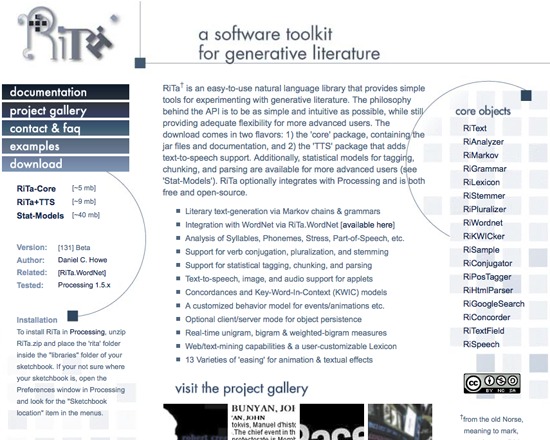
RiTa is a free, open-source natural language library for work with generative literature, offered as both a 'core' package of jar files and documentation, and a text-to-speech package. It is designed to be simple and intuitive while still offering flexibility to advanced users via statistical models for tagging, chunking and parsing. RiTa may also be integrated with Processing.