Skip to content
TAPoR Text Analysis Portal for Research

Tools

Sort by Name Rating Date ↓

Creation

Ginger

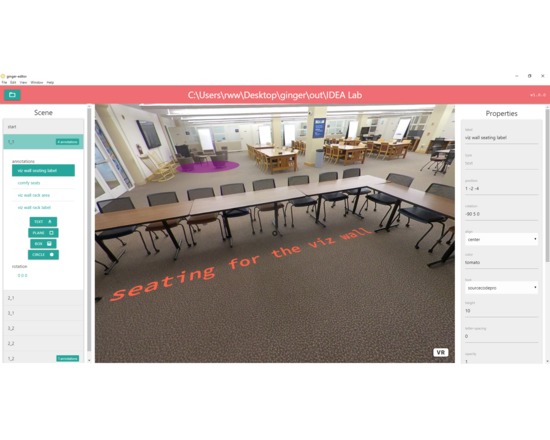
Ginger is an application that is used to generate 360 Virtual reality tours from 360 images located in a folder. It uses a command line tool to generate the virtual reality tour which can be viewed with a web browser. It also comes with the Ginger Editor which is used to preview, annotate and edit the generated tour. It was developed under the Immersive Scholar project hosted by the University of Illinois. The last commit on GitHub was over two years ago so it is no longer in active development.
Rated 0.0 out of 5.

Search

AudiAnnotate

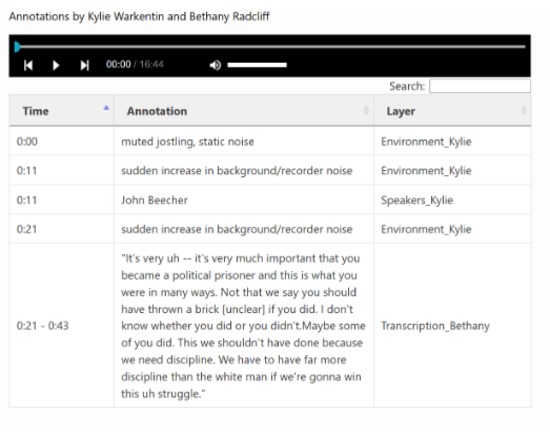
AUdiAnnotate is a web applications that is used to create IIIF file of audios and videos but adding annotations and/metadata. This makes the audiovisual material more accessible to users since the file can be queried using the metadata. Users will need a GitHub account to access the AudiAnnotate application and to host the files generated. The resulting IIIF object will be made available through an HTML link. The HTML files produced are hosted on GitHib and can be edited to change the way it if displayed. The AudiAnnotate is still active and the applications is constantly being updated. A review of AudiAnnotate can be found at https://reviewsindh.pubpub.org/pub/audiannotate/release/3

Rated 0.0 out of 5.

Search

CollectiveAcces

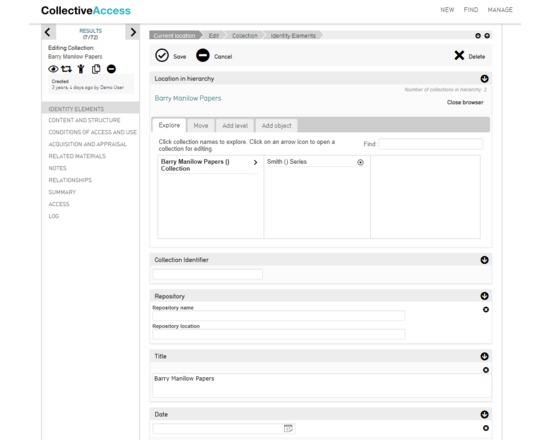
CollectiveAccess is free, open-source software for cataloguing and publishing museum and archival collections. The collection can then be published while requiring (or not) login. It has got built in search function and can display media files. The users can annotate their media files. It has many other functions. Documentation can be found here https://manual.collectiveaccess.org/

Rated 0.0 out of 5.

Annotating

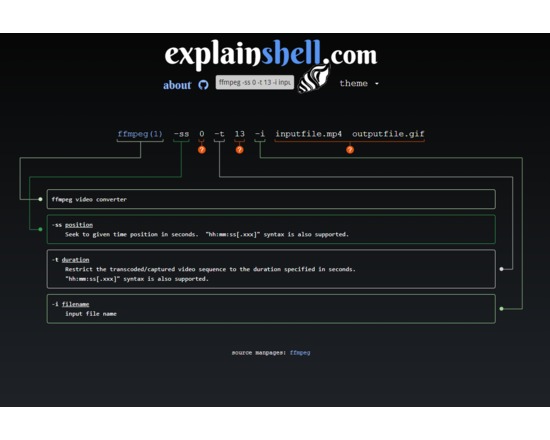
Explainshell

The Explainshell website contains 29761 parsed manpages (a form of software documentation) from sections 1 and 8 found in Ubuntu's manpage repository. It used python and some NLTK to parse code to retrieve information and documentation for each part of the code. The user pastes the command line code into the search box and the code is annotated using D.js visualization.

Rated 0.0 out of 5.

Annotating

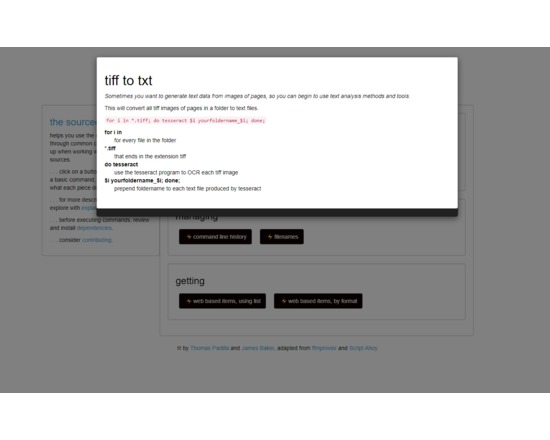
the sourcecaster

The sourcecaster helps users work in the windows command line. It contains short lines of code that can be used to manipulate files for analysis. File types include image, video, text, audio, etc. Below each line of code are explanations that tell what each part of the code does and so the user can modify the code to suite his/her objectives. The sourcecaster relies on contributions from the community. There are currently very few entries.

Rated 0.0 out of 5.

Visualization

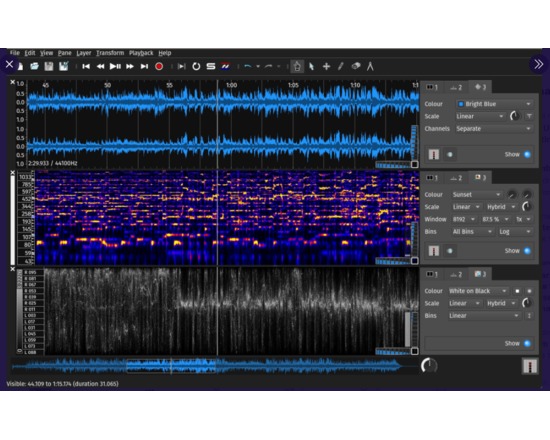
Sonic Visualiser

Sonic Visualiser is a free, open-source application for Windows, Linux, and Mac, designed to study a music recording closely. It's designed for musicologists, archivists, signal-processing researchers, and anyone else looking for a friendly way to look at what lies inside the audio file. Its latest release was September 2021. Its main functions are visualisation, analysis, and annotation of music audio recordings.

Rated 0.0 out of 5.

Visualization

Praat

Praat is a free software package for phonetic analysis. Some of the functionalities include spectral analysis (spectrograms) pitch analysis, formant analysis, intensity analysis, jitter, shimmer, voice breaks cochleagram, excitation pattern, speech manipulation, etc

Rated 0.0 out of 5.

Natural Language Processing

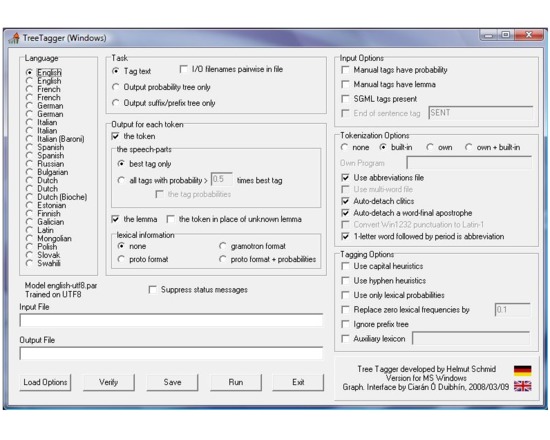
TreeTagger

The TreeTagger is a program developed by Helmut Schmid at the University of Stuttgart (now at the University of München), for part-of-speech tagging and lemmatization. Language models (known as “parameters”, file extension .par) are supplied on the TreeTagger webpage for using the program with texts in English, French, German, Italian, Spanish, Russian, Bulgarian, Dutch, Estonian, Finnish, Galician, Latin, Mongolian, Polish, Slovak and Swahili, and models for some other languages are available from sites linked to the TreeTagger webpage. For a language for which no model exists, it is necessary to hand-tag some text, and then run a training program (provided with the TreeTagger) to create the model.

Rated 0.0 out of 5.

Visualization

VAnnotatoR

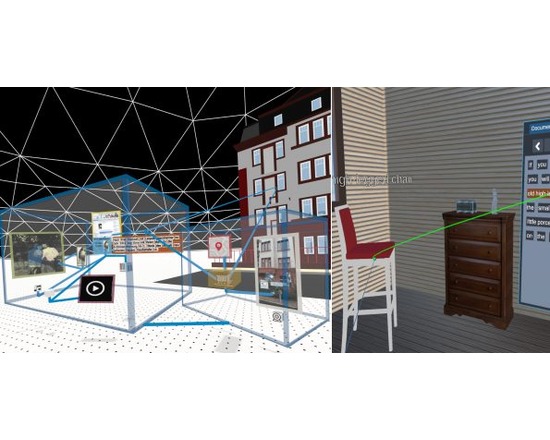
VAnnotatoR is a system that massively supports the annotation of multimedia, multimodal networks of linguistic and object-related data in virtual 3D environments. VAnnotatoR allows for segmenting and linking texts and images with other multimedia, multimodal data to ultimately create spatial hypertexts. It can be used to support concrete technical applications, e.g. the reconstruction of 3D scenes from texts as a preparatory step for the training of Text2Scene systems, or for applications in the digital humanities, such as the spatial reconstruction and linking of historical scenes or biographies with corresponding media content, such as images or 3D reconstructions of historical buildings. The entire system is interactively accessible with VR glasses in Virtual Reality (VR) and can be controlled and experienced accordingly. VAnnotatoR uses TextAnnotator as technological backbone and thus all its functions for annotation, task management, annotation evaluation as well as for collaborative and simultaneous processing of resources. Furthermore, VAnnotatoR uses TextImager to benefit from its NLP routines for automatic text analysis. VAnnotatoR is implemented on the basis of Unity3D and OpenVR and therefore runs with both systems and several VR glasses – it was tested on Oculus Rift, Oculus Rift S, Oculus Quest, HTC Vive and HTC Vive Cosmos under Windows 10. A demonstration of its usage can be found here https://www.youtube.com/watch?v=BBUg8mHT0iI

Rated 0.0 out of 5.

Visualization

TextAnnotator

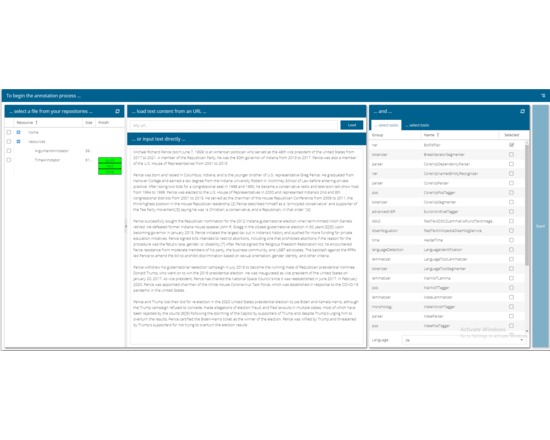
TextAnnotator is a web based annotation tool implemented with the JavaScript framework ExtJS and the visualization library d3.js that can process and annotate NLP documents in UIMA (Unstructured Information Management applications) format. TextAnnotator is a framework that offers several annotation tools for generating IMA-compliant training data that can be used to train classifiers in support of the needs of humanities scholars. Note: The tool is currently not working.

Rated 0.0 out of 5.