Skip to content
TAPoR Text Analysis Portal for Research

Tools

Sort by Name Rating Date ↓

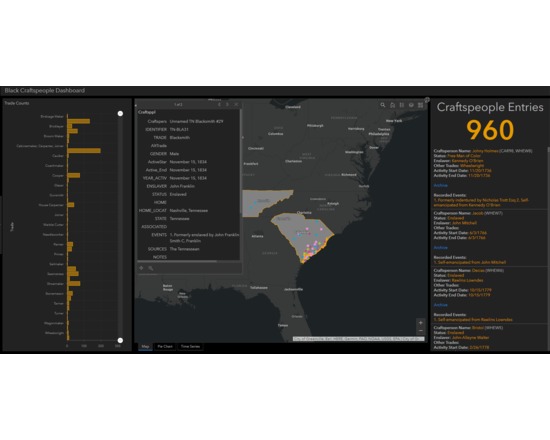
Black Craftspeople Digital Archive

This is a digital archive that keeps a record of black people both free and enslaved involved in producing the valued architecture, handcrafts, and decorative arts of the American South. The archive starts in 1619. There are currently hundreds of records of blacks involved in 45 trades. The website has an interactive and searchable map.

Rated 0.0 out of 5.

Collaboration

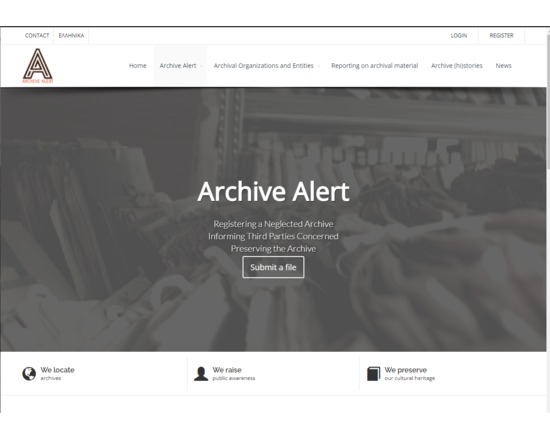
Archive Alert

Archive Alert is an online platform that allows individuals, entities, groups, and organizations to report on archives and/or other cultural material which promotes cultural heritage (audiovisual material, maps, photographs, printed material, newspapers, posters, etc.). The users may report material they are in possession of, or material threatened by ignorance, negligence, or due to lack of expert human resources. Registered users can report on their own historical documents either to inform archival organizations, or to invite specialized staff to archive, file, preserve and utilize the material. The platform allows for anonymous or eponymous/public registration, and then, depending on the material reported, it automatically informs all organizations/entities that may be concerned. The platform is free for users-informants and archival organizations; any kind of buying and selling of archival and cultural material is strictly forbidden. The homepage and introduction pages are in English while the archive report section is only available in Greek. There are currently only two reports of archives in the website.

Rated 0.0 out of 5.

Search

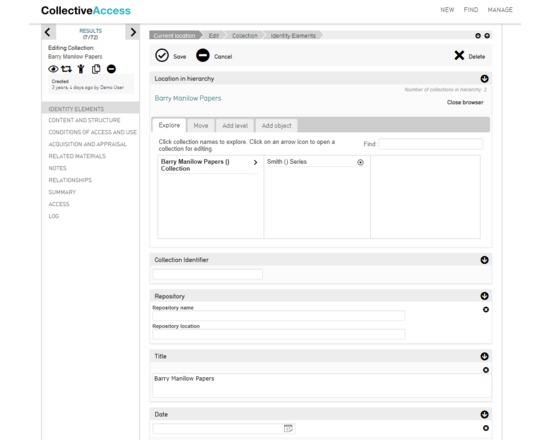
CollectiveAcces

CollectiveAccess is free, open-source software for cataloguing and publishing museum and archival collections. The collection can then be published while requiring (or not) login. It has got built in search function and can display media files. The users can annotate their media files. It has many other functions. Documentation can be found here https://manual.collectiveaccess.org/

Rated 0.0 out of 5.

Collaboration

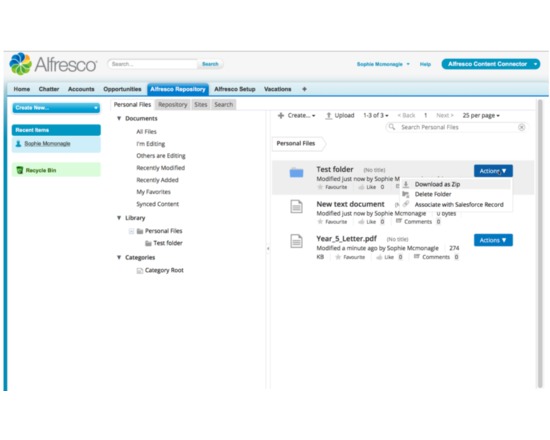
Alfresco

This is cloud-native Enterprise content management (ECM) with which you can manage content from anywhere, connect information with users everywhere and deliver apps to any device. Alfresco enables businesses to increase worker productivity, govern valuable information and deliver exceptional customer experiences.

Rated 0.0 out of 5.

Search

I-Analyzer

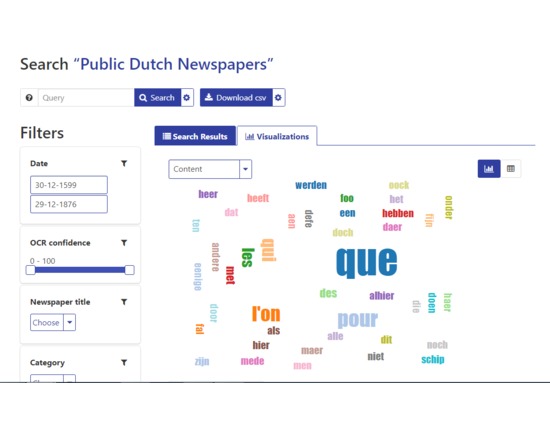
I-Analyzer is a service created by the Digital Humanities Lab of Utrecht University. It has corpora that can be search with many filtering options. It has the option of different visualisations of the search results. It currently has three corpora with most contents in Dutch and Hebrew. It is free to use upon registration.

Rated 0.0 out of 5.

Publishing

Historypin

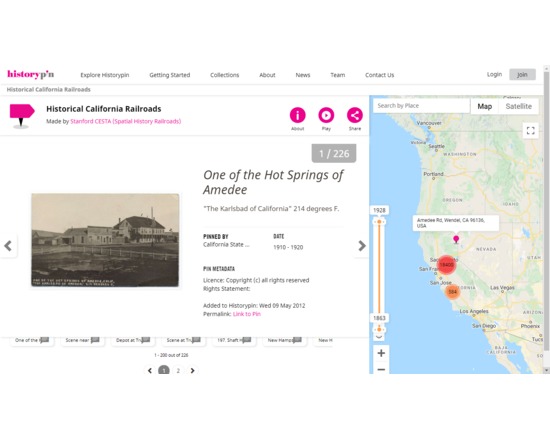
Historypin is a digital, user-generated archive of historical photos, videos, audio recordings and personal recollections. Users are able to use the location and date of their content to "pin" it to Google Maps. Where Google Street View is available, users can overlay historical photographs and compare it with the contemporary location. This content can be added and explored online and via a series of Smartphone applications

Rated 0.0 out of 5.

Gathering

Archivematica

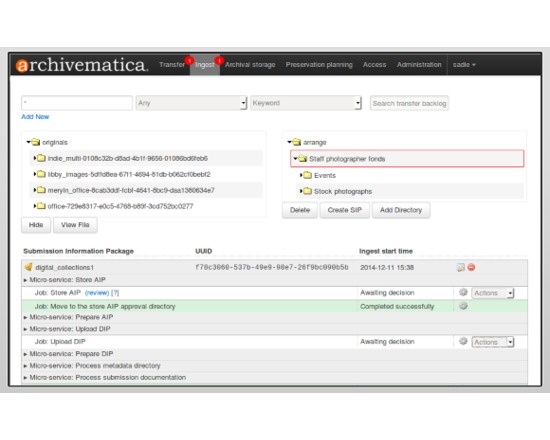
Archivematica is a web- and standards-based, open-source application which allows your institution to preserve long-term access to trustworthy, authentic and reliable digital content. Archivematica is an integrated suite of open-source software tools that allows users to process digital objects from ingest to access in compliance with the ISO-OAIS functional model. Users monitor and control ingest and preservation micro-services via a web-based dashboard. Archivematica uses METS, PREMIS, Dublin Core, the Library of Congress BagIt specification and other recognized standards to generate trustworthy, authentic, reliable and system-independent Archival Information Packages (AIPs) for storage in your preferred repository.

Rated 0.0 out of 5.

Annotating

Intelligent Archive

Intelligent Archive is a Java application for stylometry, or computational and statistical analysis of style in texts, produced by the University of Newcastle's Centre for Literary and Linguistic Computing (CLLC). It can handle corpora of plain text, HTML, XML and TEI texts. IA enables you to easily organise texts into sets, manage metadata, generate word frequencies, handle XML tags, and split texts in various ways to generate results that can be exported for further analysis in statistical software. It includes some experimental stylometry techniques developed at the CLLC and special features for handling literary texts such as generating word frequencies for speaking characters in plays.

Rated 0.0 out of 5.

Search

Scraping A Webpage - Wikipedia and New York Times

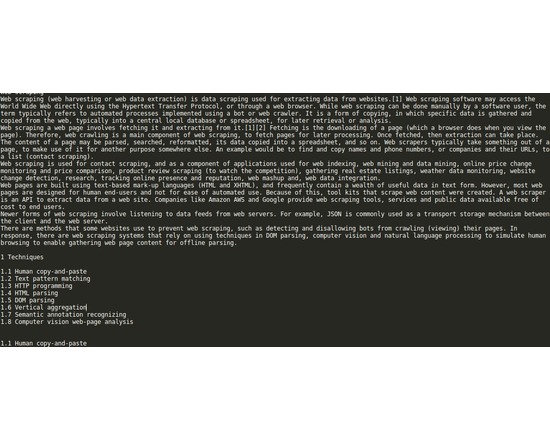
This notebook examines how to scrap a webpage. Here we will be using Wikipedia and New York Times as an example.

Rated 0.0 out of 5.

Visualization

Heurist Data Manager / Visualiser / Publisher

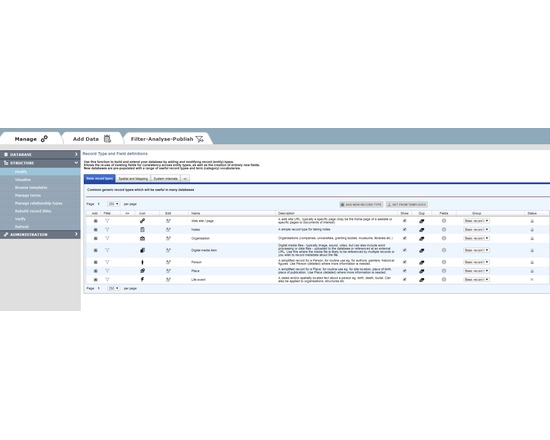
HEURIST (http://HeuristNetwork.org) is an extremely flexible, end-user oriented, web-based data management system designed specifically for Humanities data. Developed since 2005, it has been in active use across many projects since 2009. It is available both as a free web service for researchers (hosted at the University of Sydney Data Centre) or for installation on a physical or virtual server (Open Source on gitHub). Researchers can design, create, manage, analyse, visualise and publish their own richly-structured database(s) through a simple web interface, without the need for programmer(s). Quite complex databases can be built in a few hours by borrowing structures and vocabularies published by other users. Databases can be designed and built incrementally, as existing data are not affected by changes in structure. Databases created by Heurist are stored in MySQL with a repeatable structure facilitating sustainability and independent access by other software. Advanced features include record linking, graph structure, drill-down facet searches, rule-based queries, custom reports, linked map-timelines, network visualisation, normalised spreadsheet import, crosstabulation, XML feeds, XSLT transforms. The team provides initial email and skype assistance for project setup at no cost, and special customisations at modest cost. Heurist is applicable in many domains including History, Archaeology, Anthropology, Cultural Research, Linguistics, Media Studies etc. It handles everything from text, tags and categories, through networks of rich relationships and offset annotations, to images, video, spatial data and dating (including non-western systems and dating uncertainty). Sophisticated searches (including faceted and rule-based) can be saved, organised and rendered as layered interactive maps, timelines, network visualisations, crosstabulations, lists, custom reports, XML and XSLT transforms, all of which can easily be printed or embedded (live) in a website - Heurist provides the html code required to embed results in a web page or CMS. Databases can easily be migrated later to a personal or institutional server. Since the data are stored in a standard MySQL database with a fixed and well-documented structure, the data can be accessed directly via SQL from most programming languages independently of Heurist. Version 4.2 (Jan 2016 onwards) is available as a service via the Heurist website. Version 4 delivers a user-customisable interface of widgets, along with better mapping and visualisation. Existing version 3 databases are bidirectionally compatible with version 4.

Rated 5.0 out of 5.