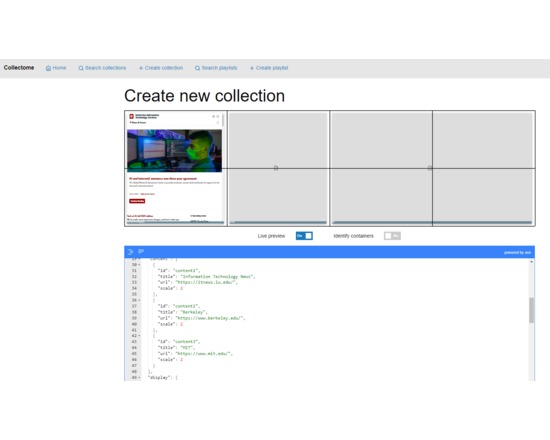
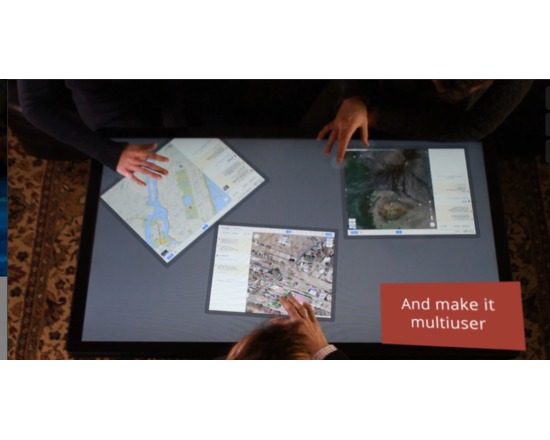
Glider is a app that facilitates the display of content on on large display walls and the interaction with this content by users from other devices. With Glider, you can format your content to fit the dimensions of your display wall, You can set timers for the display to change on the entire display wall or on different sections of the display wall, set up content to be displayed on the different connected devices and control the displays remotely. Development seems to have stopped before a stable state was reached. There is a wealth of information on the project's website.
Collectme is a content sharing platform that can be use to build content for large displays like data walls. It was developed under the immersive scholars project. It is a free to use service available online. You can curate and create a media collection that fits your display and share it with others. You can also use templates created by other users. Through your browser you can make an immersive exhibit of your collection by presenting it on a data wall.
PubPub is a free open source publishing website. Its aim is to facilitate the creation and publishing of knowledge. It is an open-source, hosted, free-to-use content management system designed to help knowledge communities of all types collaboratively create and share knowledge online. PubPub’s flexible, extensible system allows communities to create the dynamic content that best represents their work, whether it’s a traditional academic journal, a book, a repository of interactive documents, a blog, all of the above, or something in between. If needed, PubPub then helps communities integrate their work into academic infrastructure like Crossref and Google Scholar without the need to remake it to conform to legacy expectations of how academic outputs are structured.
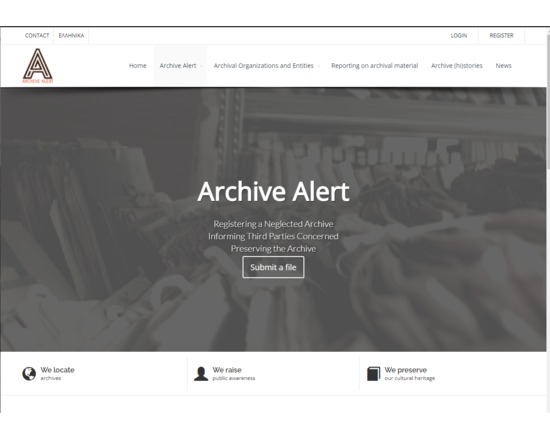
Archive Alert is an online platform that allows individuals, entities, groups, and organizations to report on archives and/or other cultural material which promotes cultural heritage (audiovisual material, maps, photographs, printed material, newspapers, posters, etc.). The users may report material they are in possession of, or material threatened by ignorance, negligence, or due to lack of expert human resources. Registered users can report on their own historical documents either to inform archival organizations, or to invite specialized staff to archive, file, preserve and utilize the material. The platform allows for anonymous or eponymous/public registration, and then, depending on the material reported, it automatically informs all organizations/entities that may be concerned. The platform is free for users-informants and archival organizations; any kind of buying and selling of archival and cultural material is strictly forbidden. The homepage and introduction pages are in English while the archive report section is only available in Greek. There are currently only two reports of archives in the website.
It is both a set of software and practices that can be used to help organizations and individuals display computer based exhibitions. It includes a variety of human and computer interactions and could be ideal from user(s) interaction with data walls. Its community is made up of a diverse group of individuals that contribute to the design of human computer interactions and experiences with digital exhibitions. They include artists, developers, designers, museum professionals, technologists, and educators. The software if free for use by museums.
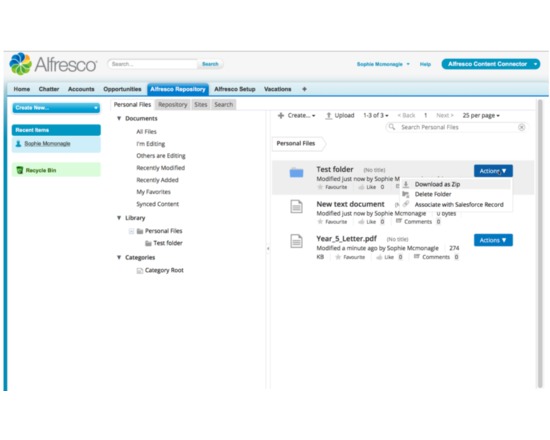
This is cloud-native Enterprise content management (ECM) with which you can manage content from anywhere, connect information with users everywhere and deliver apps to any device. Alfresco enables businesses to increase worker productivity, govern valuable information and deliver exceptional customer experiences.
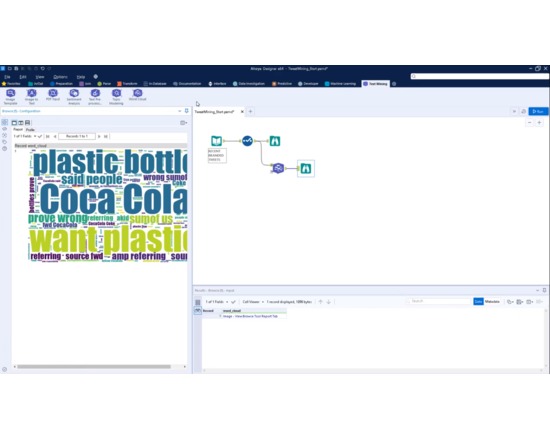
Alteryx is an online commercial data analysis service. Among its capabilities are optical character recognition, sentiment analysis, and topic modeling with Text Mining. You can quickly build predictive models without coding through its intuitive graphical user interface. It has many visualisation options among which is the word cloud.
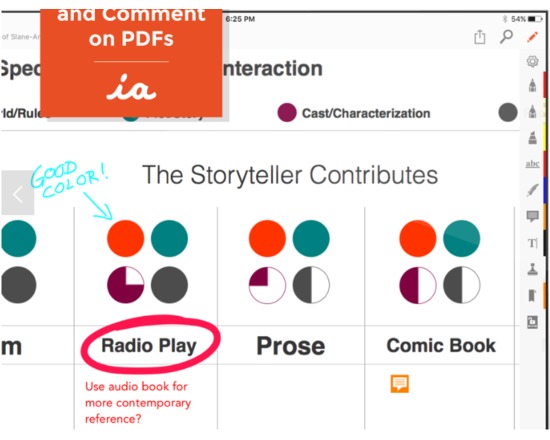
iAnnotate is a tool that works on iPhone and iPad. It is used to read, markup and share documents and web-pages. Notes can be added with pen or with the typewriter.
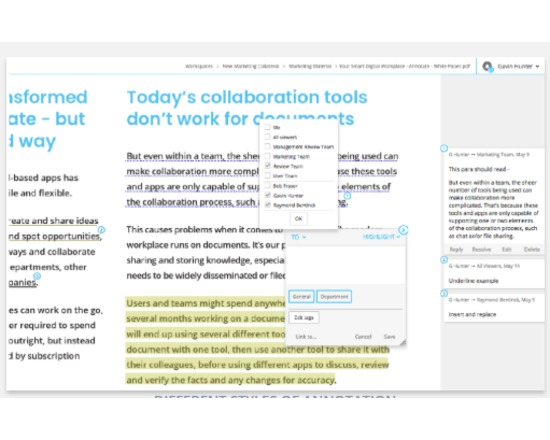
A.nnotate is the flagship product of Textensor Limited which was incorporated in Edinburgh, Scotland in 2005.Today A.nnotate is used online by thousands of individuals and groups who need to store or share comments on documents, web pages or images.
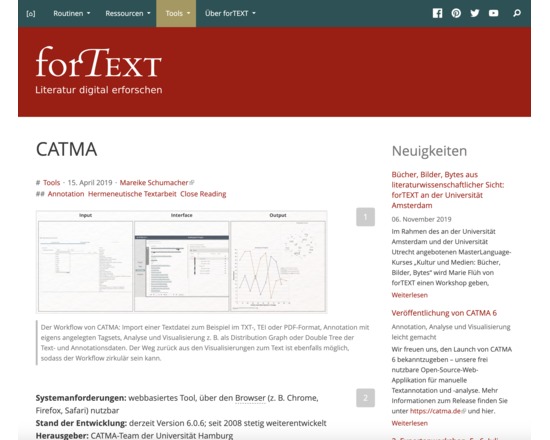
forTEXT is a free web service, which helps scholars who are interested in the Digital Humanities to choose digital methods and tools according to their research setting. forTEXT is especially designed for scholars with no or little experience in the field of Digital Humanities. The focus currently lies on literature studies and language, but will be broadened in the future. forTEXT provides scientific insights into traditions and techniques of the Digital Humanities and offers video and text tutorials as well as teaching materials. Currently, forTEXT offers content in German, but is going to be translated into English and other languages soon.