TUSTEP
- Last Updated: 11/23/2018 12:00:00 AM
- Site: http://www.tustep.uni-tuebingen.de/tustep_eng.html
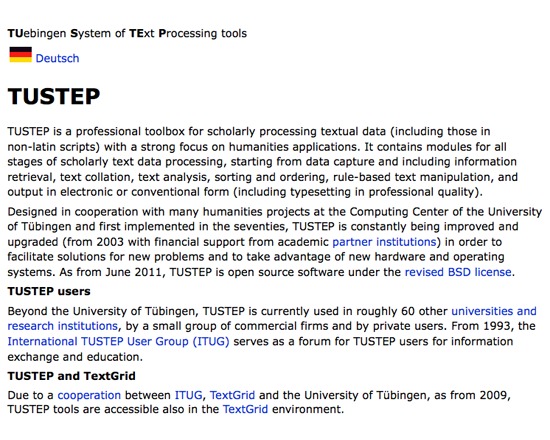
TUSTEP (Tubingen System of Text Processing Tools) is a free, open source, widely-used toolbox for text processing. It is aimed at scholarly audiences, can work with texts in both latin and non-latin scripts, and is primarily designed for humanites applications. Its modules include data capture, information retrieval, text collation, text analysis, sorting and ordering, rule-based textual manipulation, data export and typesetting. The user manual is only available in German at this time. This tool has been in continuous development since the 1960s.
Documentation
Creator(s): TUSTEP
Creator's Site: http://www.tustep.uni-tuebingen.de/tustep_eng.html
Creator's Email: tustep@zdv.uni-tuebingen.de
Repository:
Attributes
- Type of analysis: Natural Language Processing Analysis Capture Content Analysis Enrichment Gathering
- Type of license: Free Open Source
- Web Usable: Software you Download and Install
- Ease of Use: Moderate
- Usage: Widely Used
- Historic Tool (developed before 2005): Development sustained to present
- TaDiRAH Goals: Capture Enrichment Analysis
- TaDiRAH Methods: Content Analysis Editing Gathering Other (analysis) Statistical Analysis
List this tool appear on
Rating
Suggested Tools
Comments
For more information on the capabilities and use of TUSTEP, please see the 2013 edition of the official handbook:
Zentrum für Datenverarbeitung, Universität Tübingen. \"TUSTEP: Tübinger System von Textverarbeitungs-Programmen: Version 2013: Handbuch und Referenz\". Web.
More general information is available in the following:
Ott, Wilhelm. \"Modularity, Professionality, Integration: A Concept Revisited.\" ALLC-ACH '92, Conference Abstracts and Programme. Oxford: Christ Church (1992): 197-199. Web.
Ott, Wilhelm. \"TUSTEP is open source - with TXSTEP providing a new XML interface\". Humanist Discussion List, 9 Jul. 2012. Web.
Further more information can be found at:
http://tustep.wikispaces.com (a wiki with practical examples and solutions for beginners and advanced users)
as well as at
http://itug.de/ (International TUSTEP User Group).
The classical TUSTEP is a line based, parameter-driven programming language.
But there is also TUSCRIPT, the highly developed, extremely flexible and efficient scripting language of TUSTEP, in particular suitable for processing text data, especially in SGML/XML. Examples for programming with TUSCRIPT can also be found in the Rosetta Code Wiki (http://rosettacode.org/wiki/Category:TUSCRIPT).
In addition, there is TXSTEP, the XML-based interface for TUSTEP.
For further information see http://tustep.wikispaces.com
TUSTEP was mentioned in this research abstract https://dh2016.adho.org/abstracts/425