Skip to content
TAPoR Text Analysis Portal for Research

Tools

Sort by Name ↑ Rating Date

Uncategorized

Apache Xalan

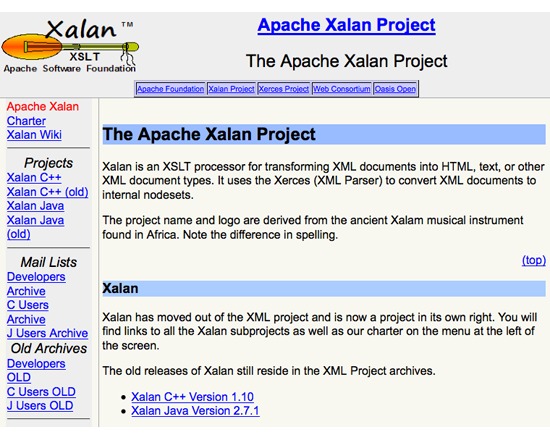
Apache Xalan is a free XSLT processor for transforming XML documents into HTML, text or other XML document types, offered by the Apache Software Foundation. This tool uses the Xerces XML parser to converty XML into internal nodesets, and is offered as both C++ and Java implementations.

Rated 0.0 out of 5.

Collation Works

CollateX-based text collation client. CollateX, run on an server independent from the URL above, is a powerful, fully automatic, baseless text collation engine for multiple witnesses. A second collation technique, ncritic, provides a slightly different baseless text collation. Each engine complements each other nicely. The user can use different files, even URLs, then output the result in GraphML, TEI, JSON, HTML, or SVG. Fuzzy matching is an option.

Rated 0.0 out of 5.

Analysis

CorpusExplorer

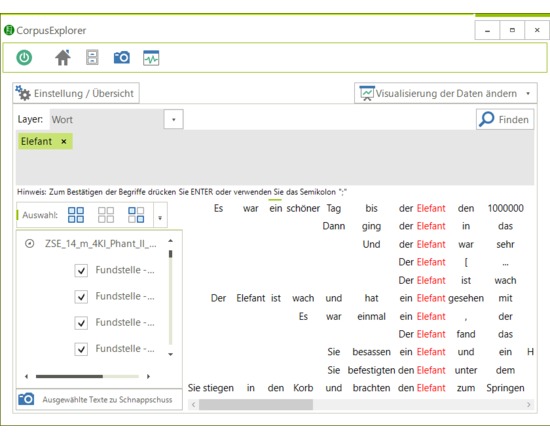
Software for corpus linguists and text/data mining enthusiasts. The CorpusExplorer combines over 50 interactive visualizations under a user-friendly interface. Routine tasks such as text acquisition, cleaning or tagging are completely automated. The simple interface supports the use in university teaching and leads users/students to fast and substantial results. The CorpusExplorer is open for many standards (XML, CSV, JSON, R, etc.) and also offers its own software development kit (SDK)

Rated 0.0 out of 5.

Annotating

Domeo Annotation Toolkit

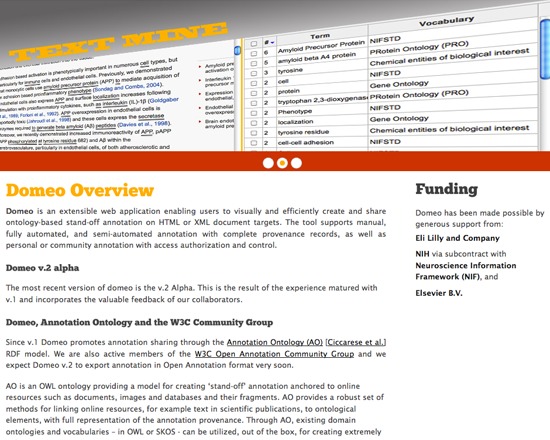
The Domeo Annotation Toolkit was an extensible web application for creating and sharing ontology-based stand-off annotations on HTML or XML documents. Users could add annotations manually, or via the tool's full or partial automation options. It also included functions for controlling access authorization and control for both personal and community annotations.

Rated 0.0 out of 5.

ediarum

With ediarum researchers can comfortably transcribe, encode and edit manuscripts in TEI-XML, as well as publish their results in an online or print edition. The solution, developed by TELOTA, is based on three software components: exist-db, Oxygen XML Author, and ConTeXt. These are combined, supplemented with additional functions, and tailored to fit a project's needs.

Rated 0.0 out of 5.

Search

eXist-db

eXist-db is an open source database management system that stores XML data according to the XML data model and features efficient, index-based XQuery processing.

Rated 5.0 out of 5.

Analysis

Hermetic Word Frequency Counter

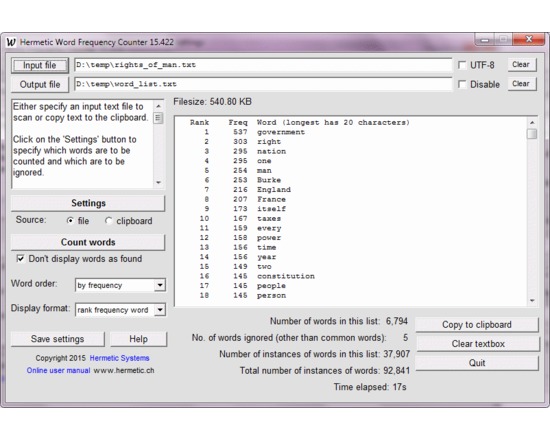
This software scans a Word DOCX file or a text file (including HTML and XML files) with text encoded via ANSI or UTF-8 and counts the frequencies of different words. The words which are found and displayed can be ordered alphabetically or by frequency. Characters which can appear in words can be specified, so the program can be told to allow or disallow words with numerals, hyphens, apostrophes, underscores or colons, to ignore words which are short or which occur infrequently, to treat upper/lower case as significant or not, and to ignore words (e.g., common words such as 'this', a.k.a. stop words) contained in a specified file. This software may be used with text in most European languages. The language of the text is detected automatically and (if supported) the corresponding stop words file is optionally loaded. Results can be exported to Excel for further processing. There is also an Advanced Version with greater functionality.

Rated 0.0 out of 5.

Analysis

Hermetic Word Frequency Counter Advanced Version

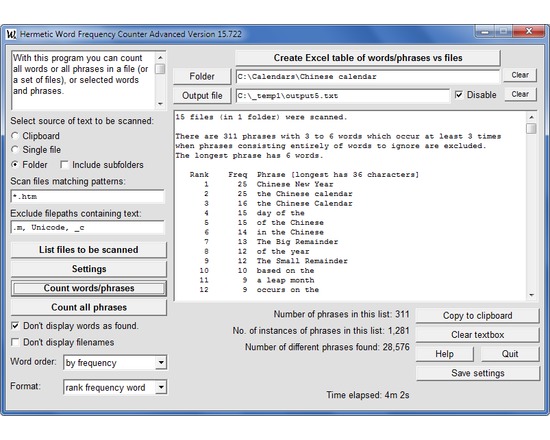
This software scans one or many Word DOCX, text and text-like files (e.g. HTML and XML files) and counts the number of occurrences of the different words or phrases. There is no limit on the size of an input text file. The words/phrases which are found can be displayed alphabetically or by frequency. The program can be told to allow or disallow words with numerals, hyphens, apostrophes, underscores or colons, to ignore words which are short or which occur infrequently, and to ignore words (e.g., common words such as 'the', a.k.a. stop words) contained in a specified file. It can also count only words or phrases in a specified list (optionally with pattern-matching). Results can be exported to Excel for further processing. The program works with text in most European languages, and supports the use of regular expressions for specifying words/phrases to count.

Rated 0.0 out of 5.

Visualization

Heurist Data Manager / Visualiser / Publisher

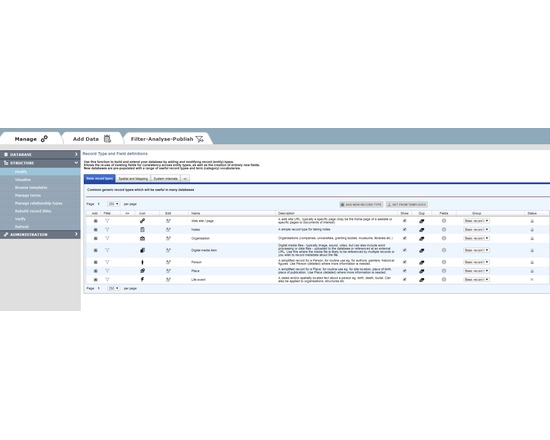
HEURIST (http://HeuristNetwork.org) is an extremely flexible, end-user oriented, web-based data management system designed specifically for Humanities data. Developed since 2005, it has been in active use across many projects since 2009. It is available both as a free web service for researchers (hosted at the University of Sydney Data Centre) or for installation on a physical or virtual server (Open Source on gitHub). Researchers can design, create, manage, analyse, visualise and publish their own richly-structured database(s) through a simple web interface, without the need for programmer(s). Quite complex databases can be built in a few hours by borrowing structures and vocabularies published by other users. Databases can be designed and built incrementally, as existing data are not affected by changes in structure. Databases created by Heurist are stored in MySQL with a repeatable structure facilitating sustainability and independent access by other software. Advanced features include record linking, graph structure, drill-down facet searches, rule-based queries, custom reports, linked map-timelines, network visualisation, normalised spreadsheet import, crosstabulation, XML feeds, XSLT transforms. The team provides initial email and skype assistance for project setup at no cost, and special customisations at modest cost. Heurist is applicable in many domains including History, Archaeology, Anthropology, Cultural Research, Linguistics, Media Studies etc. It handles everything from text, tags and categories, through networks of rich relationships and offset annotations, to images, video, spatial data and dating (including non-western systems and dating uncertainty). Sophisticated searches (including faceted and rule-based) can be saved, organised and rendered as layered interactive maps, timelines, network visualisations, crosstabulations, lists, custom reports, XML and XSLT transforms, all of which can easily be printed or embedded (live) in a website - Heurist provides the html code required to embed results in a web page or CMS. Databases can easily be migrated later to a personal or institutional server. Since the data are stored in a standard MySQL database with a fixed and well-documented structure, the data can be accessed directly via SQL from most programming languages independently of Heurist. Version 4.2 (Jan 2016 onwards) is available as a service via the Heurist website. Version 4 delivers a user-customisable interface of widgets, along with better mapping and visualisation. Existing version 3 databases are bidirectionally compatible with version 4.

Rated 5.0 out of 5.

Visualization

Juxta

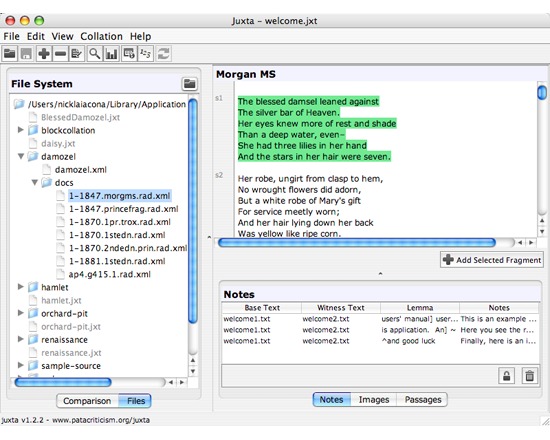
Juxta is a free, open source tool for comparing and collating texts, originally intended for comparing multiple versions of the same text. It offers several views and visualization options, including histograms and side by side comparison. Juxta is available as both a desktop application and as a web service that can be integrated into the user's own website.

Rated 0.0 out of 5.