SwiftRiver is a free, open source platform for filtering and processing large amounts of information. In particular, it can gather and filter data from common web sources such as email, Twitter or RSS. It also enables users to define 'buckets' according to their own criteria rather than relying on, for example, the information's social media popularity status. Utilizing a combination of filters and buckets, users create 'rivers' of data populated by their chosen sources. Developer Ushahidi has made all code available for general access via Github, though a custom, full-service, hosted version is available for a fee by contacting the company directly.
STACK is an extensible social media research toolkit designed to collect, process, and store data from online social networks. The toolkit is an ongoing project via the Syracuse University iSchool, and currently supports the Twitter Streaming API. Collecting from Facebook public pages and Twitter search API are under development. The toolkit architecture is modular and supports extending. Basic Linux / Mac command line skills needed.
To learn more: https://github.com/bitslabsyr/stack
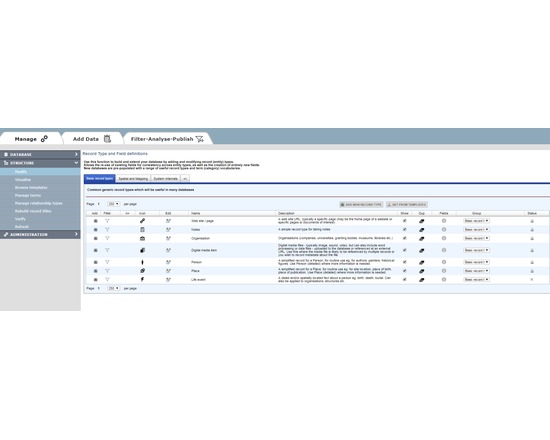
HEURIST (http://HeuristNetwork.org) is an extremely flexible, end-user oriented, web-based data management system designed specifically for Humanities data. Developed since 2005, it has been in active use across many projects since 2009. It is available both as a free web service for researchers (hosted at the University of Sydney Data Centre) or for installation on a physical or virtual server (Open Source on gitHub).
Researchers can design, create, manage, analyse, visualise and publish their own richly-structured database(s) through a simple web interface, without the need for programmer(s). Quite complex databases can be built in a few hours by borrowing structures and vocabularies published by other users. Databases can be designed and built incrementally, as existing data are not affected by changes in structure. Databases created by Heurist are stored in MySQL with a repeatable structure facilitating sustainability and independent access by other software.
Advanced features include record linking, graph structure, drill-down facet searches, rule-based queries, custom reports, linked map-timelines, network visualisation, normalised spreadsheet import, crosstabulation, XML feeds, XSLT transforms. The team provides initial email and skype assistance for project setup at no cost, and special customisations at modest cost.
Heurist is applicable in many domains including History, Archaeology, Anthropology, Cultural Research, Linguistics, Media Studies etc. It handles everything from text, tags and categories, through networks of rich relationships and offset annotations, to images, video, spatial data and dating (including non-western systems and dating uncertainty).
Sophisticated searches (including faceted and rule-based) can be saved, organised and rendered as layered interactive maps, timelines, network visualisations, crosstabulations, lists, custom reports, XML and XSLT transforms, all of which can easily be printed or embedded (live) in a website - Heurist provides the html code required to embed results in a web page or CMS.
Databases can easily be migrated later to a personal or institutional server. Since the data are stored in a standard MySQL database with a fixed and well-documented structure, the data can be accessed directly via SQL from most programming languages independently of Heurist.
Version 4.2 (Jan 2016 onwards) is available as a service via the Heurist website. Version 4 delivers a user-customisable interface of widgets, along with better mapping and visualisation. Existing version 3 databases are bidirectionally compatible with version 4.
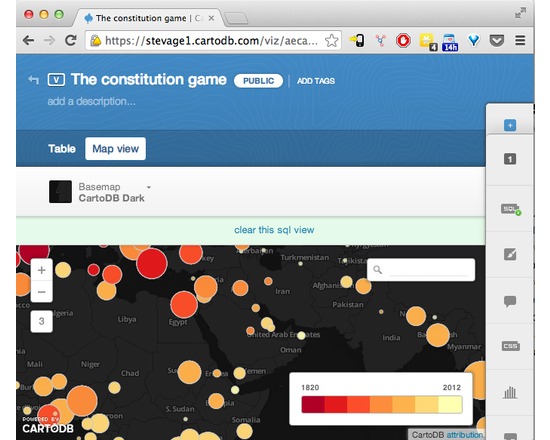
CartoDB makes data-driven map visualisation tool. It's very easy to upload a couple of spreadsheets of data, with latitudes and longitudes or addresses, and turn them into clickable markers on maps. There are several types of pre-canned visualisation, such as categories, choropleths or even animated "torque" maps. It's also a sophisticated platform allowing complex visualisations to be built up using Javascript and the CartoDB API.

LimeService is basically the hosted version of the GNU licensed LimeSurvey. It is a survey service-platform to prepare, run and evaluate on-line surveys. Besides basic free usage you are always getting the full feature set with no monthly fees or subscription plans.
I've used it before and found it to pretty robust.
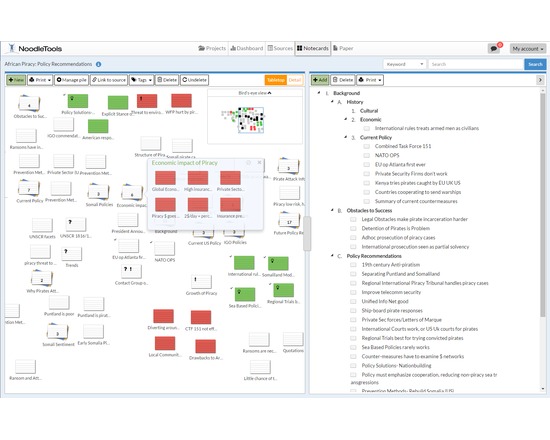
MLA, APA, Chicago / Turabian and most-common Bluebook forms as an integrated citing and note-taking platform for individual or group projects. Prompts for analysis of source types and is unique in offering teaching support and personal help on any citation. Instructor / librarian view allows teacher to comment on work-in-progress providing just-in-time feedback in-context. Archives copies of web pages and pdfs which can be annotated. Dashboard provides long-term access to a portfolio of work.
NoodleTools MLA Lite is a free version with a Bibliography component and limited set of citation types appropriate for elementary or middle-school students.