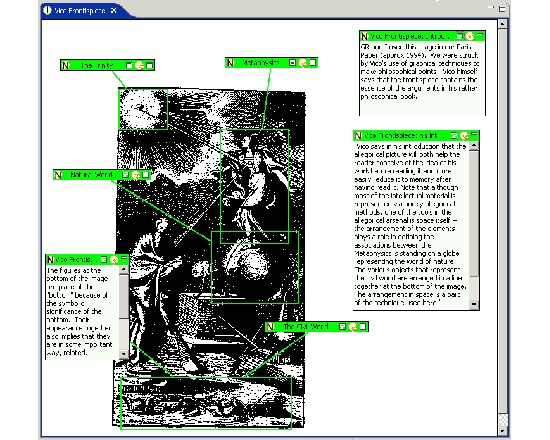
Pliny was a tool for working with annotations when conducting personal scholarly research, and can be used with both digital and print materials. It also had data manangement and organizational features, and was designed to facilitate reading, reacting to that reading and forming an interpretation. Pliny stored all data on the user's computer rather than remotely on the web.
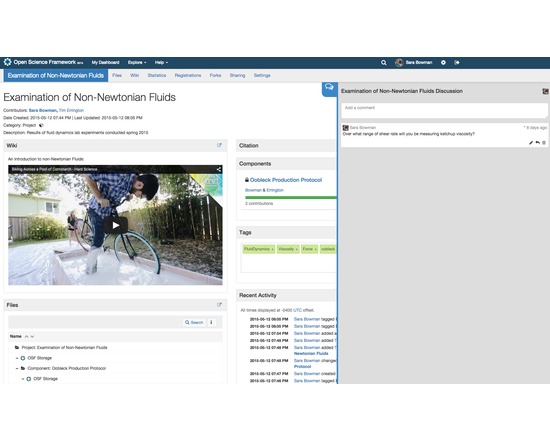
The Open Science Framework (OSF) is a free, open source tool designed to help researchers manage the entire research workflow: planning, execution, reporting, archiving and discovery. It is part collaboration software and part version control system. The OSF can be used to manage individual projects or large collaborative ones. Privacy and sharing settings allow for fine-grained control over access to files and materials stored on the platform - share privately with collaborators or publicly with the community at large. Each project, contributor, and file on the OSF is given a persistent unique identifier, making all research products citable. The platform also mints DOIs and ARKs through DataCite. A collaborative wiki allows contributors to work on writing materials simultaneously.
API connections with other services (Github, Dropbox, Box, Dataverse, Google Drive, figshare, Zotero, Mendeley, Amazon S3) allow researchers to connect other services they already use in order to see all their materials in one place. The OSF also offers a registry for preregistering research projects and/or analysis plans.
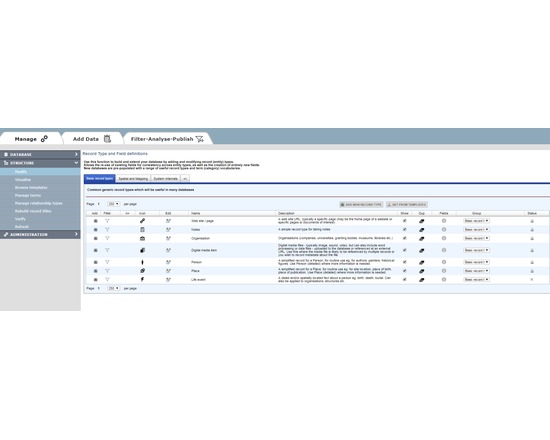
HEURIST (http://HeuristNetwork.org) is an extremely flexible, end-user oriented, web-based data management system designed specifically for Humanities data. Developed since 2005, it has been in active use across many projects since 2009. It is available both as a free web service for researchers (hosted at the University of Sydney Data Centre) or for installation on a physical or virtual server (Open Source on gitHub).
Researchers can design, create, manage, analyse, visualise and publish their own richly-structured database(s) through a simple web interface, without the need for programmer(s). Quite complex databases can be built in a few hours by borrowing structures and vocabularies published by other users. Databases can be designed and built incrementally, as existing data are not affected by changes in structure. Databases created by Heurist are stored in MySQL with a repeatable structure facilitating sustainability and independent access by other software.
Advanced features include record linking, graph structure, drill-down facet searches, rule-based queries, custom reports, linked map-timelines, network visualisation, normalised spreadsheet import, crosstabulation, XML feeds, XSLT transforms. The team provides initial email and skype assistance for project setup at no cost, and special customisations at modest cost.
Heurist is applicable in many domains including History, Archaeology, Anthropology, Cultural Research, Linguistics, Media Studies etc. It handles everything from text, tags and categories, through networks of rich relationships and offset annotations, to images, video, spatial data and dating (including non-western systems and dating uncertainty).
Sophisticated searches (including faceted and rule-based) can be saved, organised and rendered as layered interactive maps, timelines, network visualisations, crosstabulations, lists, custom reports, XML and XSLT transforms, all of which can easily be printed or embedded (live) in a website - Heurist provides the html code required to embed results in a web page or CMS.
Databases can easily be migrated later to a personal or institutional server. Since the data are stored in a standard MySQL database with a fixed and well-documented structure, the data can be accessed directly via SQL from most programming languages independently of Heurist.
Version 4.2 (Jan 2016 onwards) is available as a service via the Heurist website. Version 4 delivers a user-customisable interface of widgets, along with better mapping and visualisation. Existing version 3 databases are bidirectionally compatible with version 4.
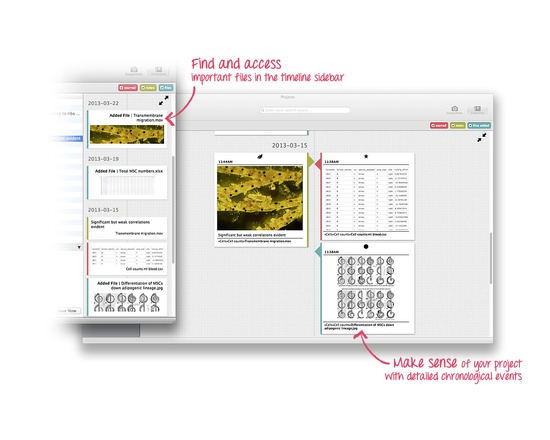
Projects allows researchers to organise and manage all their research outputs in a safe, simple and structured way. It’s designed to help academics, at any stage of their career, keep track and stay on top of all their results. It’s a light, useful and slick application that integrates into a researcher’s existing workflow to help them work more efficiently and ensure they have more time for making discoveries.
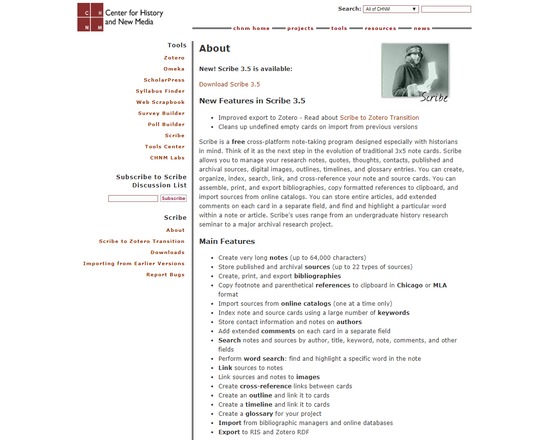
Scribe is a note-taking program that allows you to manage your research notes, quotes, thoughts, contacts, published and archival sources, digital images, outlines, timelines, and glossary entries. You can create, organize, index, search, link and cross-reference your note and source cards.
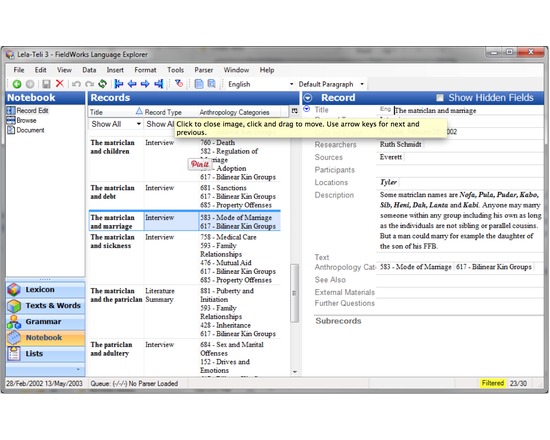
FieldWorks consists of software tools that help you manage linguistic and cultural data. FieldWorks supports tasks ranging from the initial entry of collected data through to the preparation of data for publication