Skip to content
TAPoR Text Analysis Portal for Research

Tools

Sort by Name Rating ↓ Date

Search

Pundit

Pundit is a cloud service that allows users to 'take notes' on web documents, like a web page or a PDF file. It consists of a set of components, amongst them the Annotator, a free extension for the Google Chrome browser used by users to create the annotations. Annotations can be highlights of text parts or comments, applied either on a selection of the text or on the whole document. It is also possible to create annotations to tag a selected text or an entire web page. Pundit supports semantic annotations, real RDF triples (subject - predicate -> object) to specify formal, structured and reusable statements associated to the annotated content.

Rated 5.0 out of 5.

Visualization

Heurist Data Manager / Visualiser / Publisher

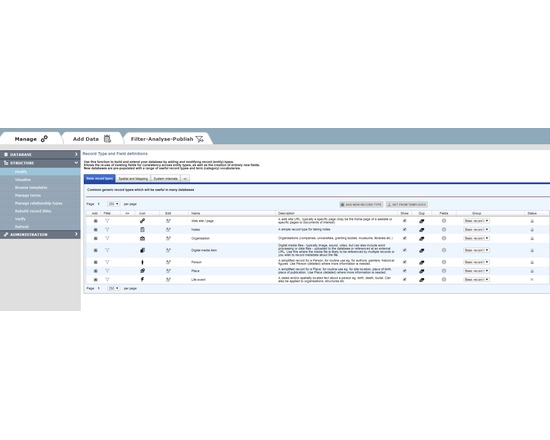
HEURIST (http://HeuristNetwork.org) is an extremely flexible, end-user oriented, web-based data management system designed specifically for Humanities data. Developed since 2005, it has been in active use across many projects since 2009. It is available both as a free web service for researchers (hosted at the University of Sydney Data Centre) or for installation on a physical or virtual server (Open Source on gitHub). Researchers can design, create, manage, analyse, visualise and publish their own richly-structured database(s) through a simple web interface, without the need for programmer(s). Quite complex databases can be built in a few hours by borrowing structures and vocabularies published by other users. Databases can be designed and built incrementally, as existing data are not affected by changes in structure. Databases created by Heurist are stored in MySQL with a repeatable structure facilitating sustainability and independent access by other software. Advanced features include record linking, graph structure, drill-down facet searches, rule-based queries, custom reports, linked map-timelines, network visualisation, normalised spreadsheet import, crosstabulation, XML feeds, XSLT transforms. The team provides initial email and skype assistance for project setup at no cost, and special customisations at modest cost. Heurist is applicable in many domains including History, Archaeology, Anthropology, Cultural Research, Linguistics, Media Studies etc. It handles everything from text, tags and categories, through networks of rich relationships and offset annotations, to images, video, spatial data and dating (including non-western systems and dating uncertainty). Sophisticated searches (including faceted and rule-based) can be saved, organised and rendered as layered interactive maps, timelines, network visualisations, crosstabulations, lists, custom reports, XML and XSLT transforms, all of which can easily be printed or embedded (live) in a website - Heurist provides the html code required to embed results in a web page or CMS. Databases can easily be migrated later to a personal or institutional server. Since the data are stored in a standard MySQL database with a fixed and well-documented structure, the data can be accessed directly via SQL from most programming languages independently of Heurist. Version 4.2 (Jan 2016 onwards) is available as a service via the Heurist website. Version 4 delivers a user-customisable interface of widgets, along with better mapping and visualisation. Existing version 3 databases are bidirectionally compatible with version 4.

Rated 5.0 out of 5.

Visualization

Omeka

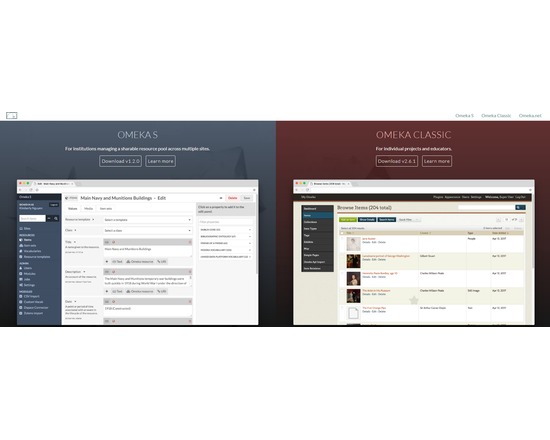
Omeka is a content management system designed for the display of library, museum, archives, and scholarly collections and exhibitions. Omeka falls at a crossroads of Web Content Management, Collections Management, and Archival Digital Collections Systems. Omeka is designed with non-IT specialists in mind, allowing users to focus on content and interpretation rather than programming. It brings Web 2.0 technologies and approaches to academic and cultural websites to foster user interaction and participation. It makes top-shelf design easy with a simple and flexible templating system. Its robust open-source developer and user communities underwrite Omeka’s stability and sustainability. Omeka allows users to publish cultural heritage objects, extend its functionality with themes and plugins, and curate online exhibits with digital objects.

Rated 5.0 out of 5.

Search

eXist-db

eXist-db is an open source database management system that stores XML data according to the XML data model and features efficient, index-based XQuery processing.

Rated 5.0 out of 5.

Publishing

Omeka.net

Omeka.net provides a web-publishing platform to curate collections and create exhibitions of digitized content. Omeka.net has grown out of the Omeka project. Omeka.net provides some of the same functionality as Omeka, but does not require the user to provide hosting or to maintain their installation in any way. However, use of Omeka.net limits customization, and hosting more than 500MB of content requires a paid account. Objects in the collection can be cataloged with Dublin core metadata fields and georeferenced for display on a map. Omeka.net includes several plugins, including COinS (which makes objects in Omeka accessible to citations management software, like Zotero), HTML5 Media (to play audio and video), and Library of Congress Suggest (which will auto-populate fields with LoC authority and subject headings).

Rated 4.0 out of 5.

Search

List Words - Plain Text (TAPoRware)

This tool lists words in an plain text document, either uploaded by the user or from a web address. List Words works with relatively small texts of under a megabyte in size. It is part of the TAPoRware collection of tools; there are XML and HTML versions available as well. This tool’s functionality has been incorporated into Voyant available online at www.voyant-tools.org.

Rated 1.0 out of 5.

Search

Comparator - HTML (TAPoRware)

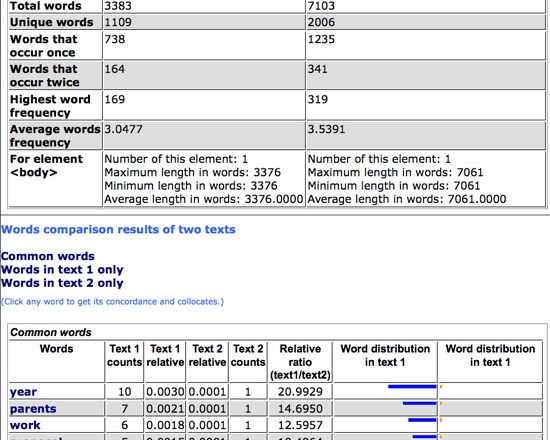
This tool compares two documents by comparing the words in each according to user specifications. XML and plain text versions are also available in the TAPoRware toolsets. This tool’s functionality has been incorporated into Voyant available online at www.voyant-tools.org

Rated 0.0 out of 5.

Search

Anthologize

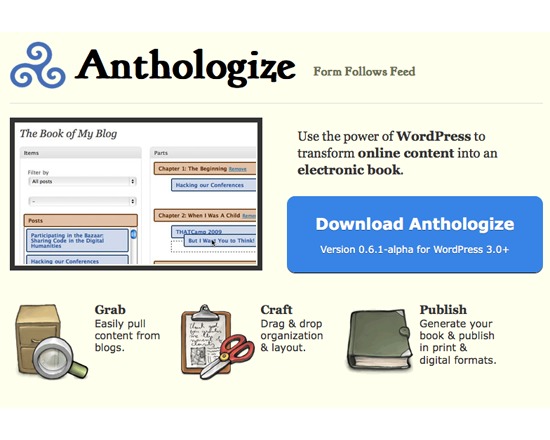
Anthologize is a free, open-source plugin for WordPress 3.0. It enables WordPress to be used as a platform for publishing electronic texts in PDF, ePUB or TEI format. The plugin enables users to grab their existing blog posts, export content from external feeds or compose new content directly in Anthologize, then apply outlining, create a custom order, and edit content into a single document for export. Anthologize requires a self-hosted or local installation of WordPress.

Rated 0.0 out of 5.

Publishing

Commentpress

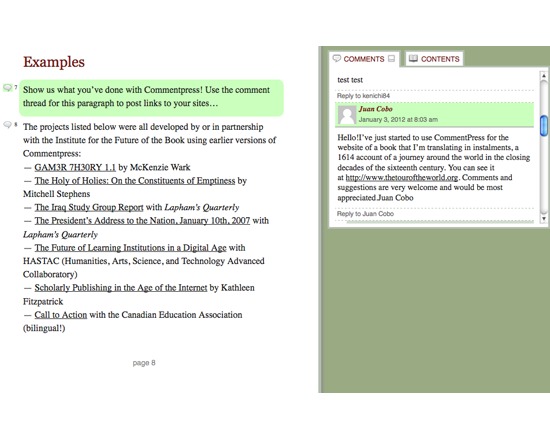
Commentpress is an open source theme and plugin for Wordpress 3.3.1 or later designed to enable readers to contribute comments to each paragraph of a text and display those comments in the margins. Commentpress turns a text into a conversation, whether a blog or a fixed document such as an essay, book or article. It may also be used to add a gloss or annotations to a document. This tool is also available for BuddyPress and BP Group Blog.

Rated 0.0 out of 5.

Natural Language Processing

MorphAdorner

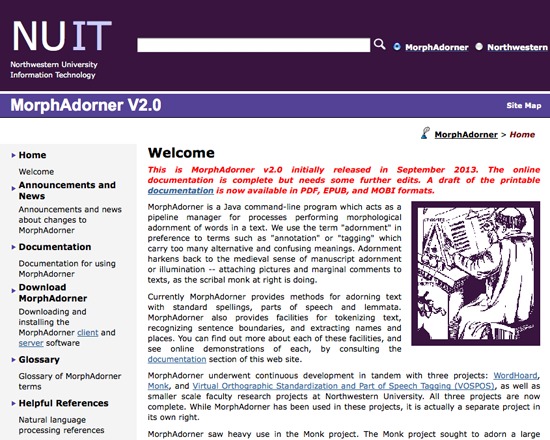
MorphAdorner, now in version 2.0, is a Java command-line program for the adornment of words in a text. At present, available adornments include standard spellings, parts of speech and lemmata, in addition to tokenization, the recognition of sentence boundaries and extracting names and places. Version 2.0 features a separate MorphAdorner Server, an improved integration with MONK's Abbot and improved processing of the Early English Books Online (EEBO), Eighteenth Century Collections Online (ECCO) and Evans Early American Imprint Collection corpori.

Rated 0.0 out of 5.