Skip to content
TAPoR Text Analysis Portal for Research

Tools

Sort by Name Rating ↓ Date

Visualization

Heurist Data Manager / Visualiser / Publisher

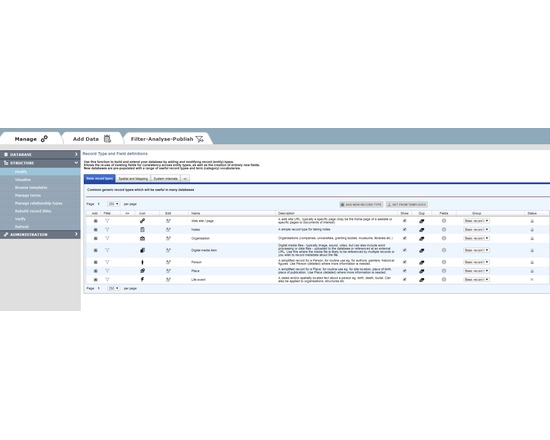
HEURIST (http://HeuristNetwork.org) is an extremely flexible, end-user oriented, web-based data management system designed specifically for Humanities data. Developed since 2005, it has been in active use across many projects since 2009. It is available both as a free web service for researchers (hosted at the University of Sydney Data Centre) or for installation on a physical or virtual server (Open Source on gitHub). Researchers can design, create, manage, analyse, visualise and publish their own richly-structured database(s) through a simple web interface, without the need for programmer(s). Quite complex databases can be built in a few hours by borrowing structures and vocabularies published by other users. Databases can be designed and built incrementally, as existing data are not affected by changes in structure. Databases created by Heurist are stored in MySQL with a repeatable structure facilitating sustainability and independent access by other software. Advanced features include record linking, graph structure, drill-down facet searches, rule-based queries, custom reports, linked map-timelines, network visualisation, normalised spreadsheet import, crosstabulation, XML feeds, XSLT transforms. The team provides initial email and skype assistance for project setup at no cost, and special customisations at modest cost. Heurist is applicable in many domains including History, Archaeology, Anthropology, Cultural Research, Linguistics, Media Studies etc. It handles everything from text, tags and categories, through networks of rich relationships and offset annotations, to images, video, spatial data and dating (including non-western systems and dating uncertainty). Sophisticated searches (including faceted and rule-based) can be saved, organised and rendered as layered interactive maps, timelines, network visualisations, crosstabulations, lists, custom reports, XML and XSLT transforms, all of which can easily be printed or embedded (live) in a website - Heurist provides the html code required to embed results in a web page or CMS. Databases can easily be migrated later to a personal or institutional server. Since the data are stored in a standard MySQL database with a fixed and well-documented structure, the data can be accessed directly via SQL from most programming languages independently of Heurist. Version 4.2 (Jan 2016 onwards) is available as a service via the Heurist website. Version 4 delivers a user-customisable interface of widgets, along with better mapping and visualisation. Existing version 3 databases are bidirectionally compatible with version 4.


Rated 5.0 out of 5.

Search

Pundit

Pundit is a cloud service that allows users to 'take notes' on web documents, like a web page or a PDF file. It consists of a set of components, amongst them the Annotator, a free extension for the Google Chrome browser used by users to create the annotations. Annotations can be highlights of text parts or comments, applied either on a selection of the text or on the whole document. It is also possible to create annotations to tag a selected text or an entire web page. Pundit supports semantic annotations, real RDF triples (subject - predicate -> object) to specify formal, structured and reusable statements associated to the annotated content.

Rated 5.0 out of 5.

Search

eXist-db

eXist-db is an open source database management system that stores XML data according to the XML data model and features efficient, index-based XQuery processing.

Rated 5.0 out of 5.

Visualization

Omeka

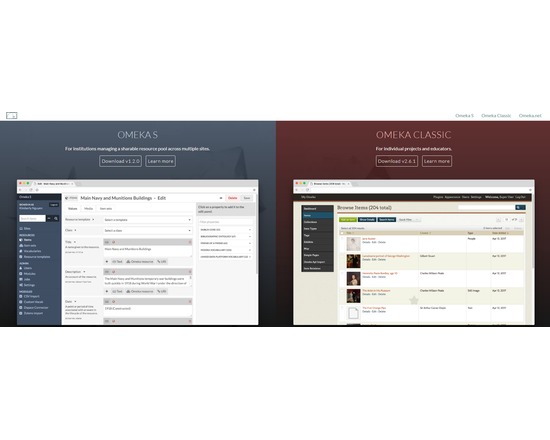
Omeka is a content management system designed for the display of library, museum, archives, and scholarly collections and exhibitions. Omeka falls at a crossroads of Web Content Management, Collections Management, and Archival Digital Collections Systems. Omeka is designed with non-IT specialists in mind, allowing users to focus on content and interpretation rather than programming. It brings Web 2.0 technologies and approaches to academic and cultural websites to foster user interaction and participation. It makes top-shelf design easy with a simple and flexible templating system. Its robust open-source developer and user communities underwrite Omeka’s stability and sustainability. Omeka allows users to publish cultural heritage objects, extend its functionality with themes and plugins, and curate online exhibits with digital objects.

Rated 5.0 out of 5.

Collaboration

Github

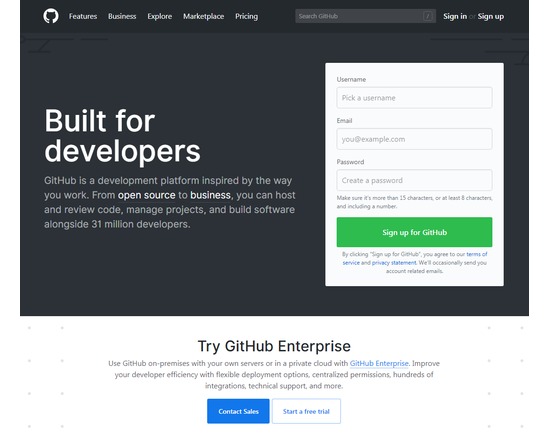
GitHub is a web-based repository service which offers the distributed revision control and source code management (SCM) functionality of GIT with a graphical user interface, desktop, and mobile integration. It also provides collaboration tools such as access control, wikis, task management, code review, bug tracking, and feature requests. It offers free accounts, often used to host opensource software projects, and private (paid) repositories. Projects on GitHub can be accessed and manipulated using the git command-line interface and all of the standard git commands work with it. GitHub also allows registered and non-registered users to browse public repositories on the site. Multiple desktop clients have also been created by GitHub and other third parties which integrate with the platform. GitHub is mainly used for code but can also be used for non-code files, it supports the following formats and features: 3D render files Photoshop's native PSD format can be previewed and compared to previous versions of the same file. Nested task-lists Documentation and wikis Small websites can be hosted from public repositories on GitHub. The URL format is http://projectname.github.io. Issue tracking (including feature requests) Visualization of geospatial data Gantt charts GitHub is a heavily used in the opensource development community but does not require hosted projects to meet the definition of Open Source.

Rated 4.0 out of 5.

Search

List Words - Plain Text (TAPoRware)

This tool lists words in an plain text document, either uploaded by the user or from a web address. List Words works with relatively small texts of under a megabyte in size. It is part of the TAPoRware collection of tools; there are XML and HTML versions available as well. This tool’s functionality has been incorporated into Voyant available online at www.voyant-tools.org.

Rated 1.0 out of 5.

Search

Comparator - HTML (TAPoRware)

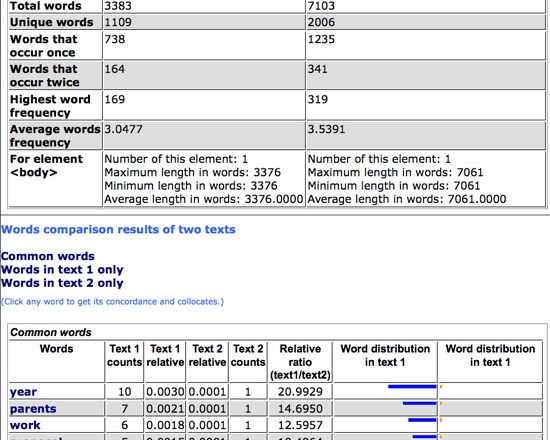
This tool compares two documents by comparing the words in each according to user specifications. XML and plain text versions are also available in the TAPoRware toolsets. This tool’s functionality has been incorporated into Voyant available online at www.voyant-tools.org

Rated 0.0 out of 5.

Search

Stanford NLP Group: Part-of-Speech Tagger

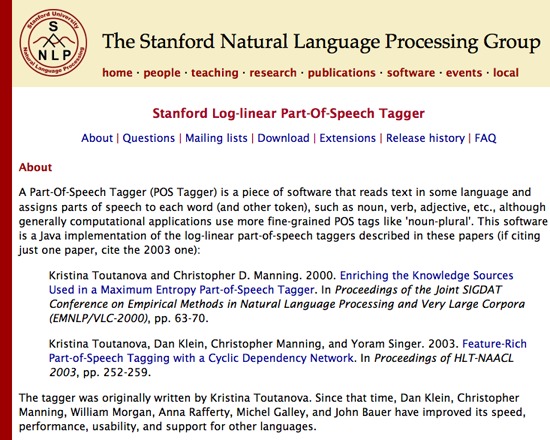
Stanford Part-of-Speech Tagger is a free Java implementation for the recognition of parts of speech, and a part of the Stanford Natural Language Processing toolset. It reads text and assigns parts of speech to each word such as noun, verb or adjective. This tool can be used with English, French, Arabic and German text.

Rated 0.0 out of 5.

Search

EURAC: Corpus Clouds

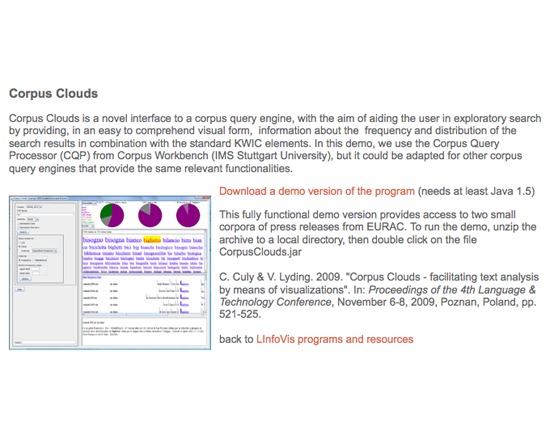
Corpus Clouds is a free Java demo of a novel interface to a corpus query engine. It aims to aid the user in exploratory search by providing visual information about frequency and distribution of search results in combination with the standard KWIC elements.

Rated 0.0 out of 5.

Search

Letter-Pairs Analysis

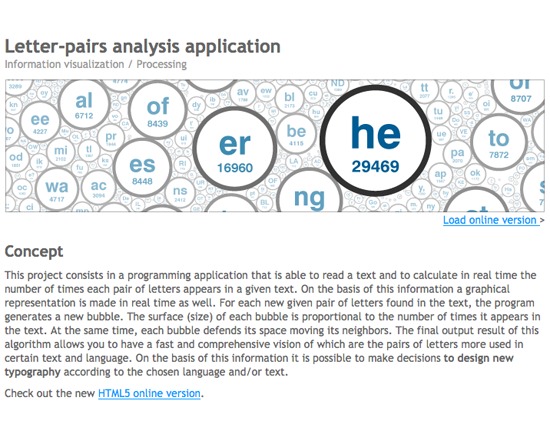
Letter-Pairs Analysis is a free, web-based tool for calculating and visualizing the number of times a pair of letters appears in a given text. Each pair is represented as a 'bubble', sized according to how frequently that pair appears in the text. An HTML5 version is also now available. Note : this tool forms the basis of Voyant Bubbles.

Rated 0.0 out of 5.